
From Storm Damage to Strength: Building a Forest That Lasts.
The recent storms were a powerful reminder of nature’s force, but they also revealed something fascinating about the resilience of our forest at Manawa Karioi.
———
Written by Ross Gardiner.
Well, what a storm we had this month! We had a big storm and several smaller ones last winter. Mostly, they blew a lot of leaves and small branches off trees, but this summer's big one brought down quite a few trees and bigger branches. This brings us to consider a very important part of forest restoration - creating a forest with a wide range of plant species to make it more resilient to storm damage.
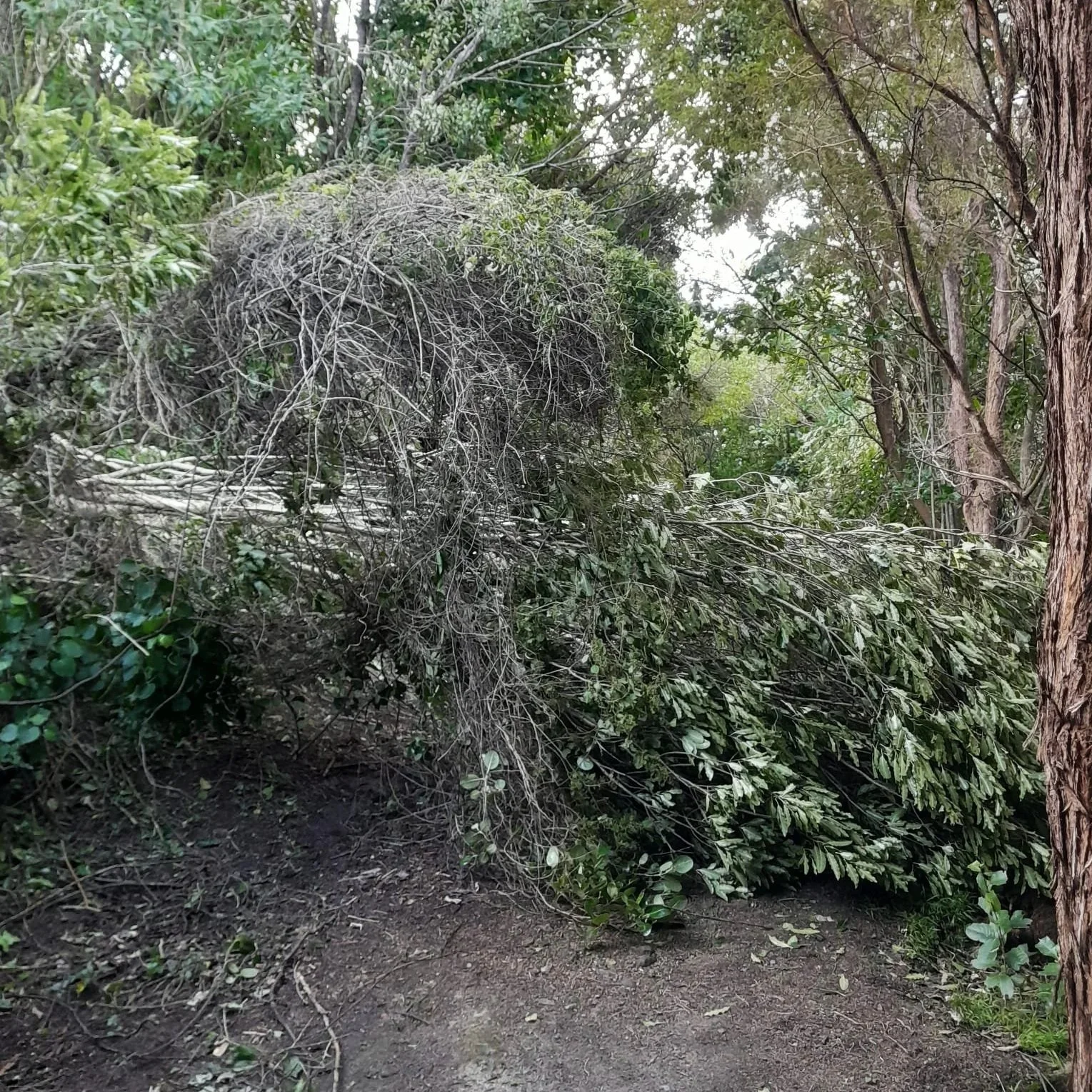
One of a number of trees that were blown over near Seed Source Gully. Trees are cleared by volunteers after storms.
You may remember our article last year about forest margins. The same concept applies to the forest interior. Having a wide range of plant species makes it more resistant to damage, but also helps it recover quickly when trees do come down.
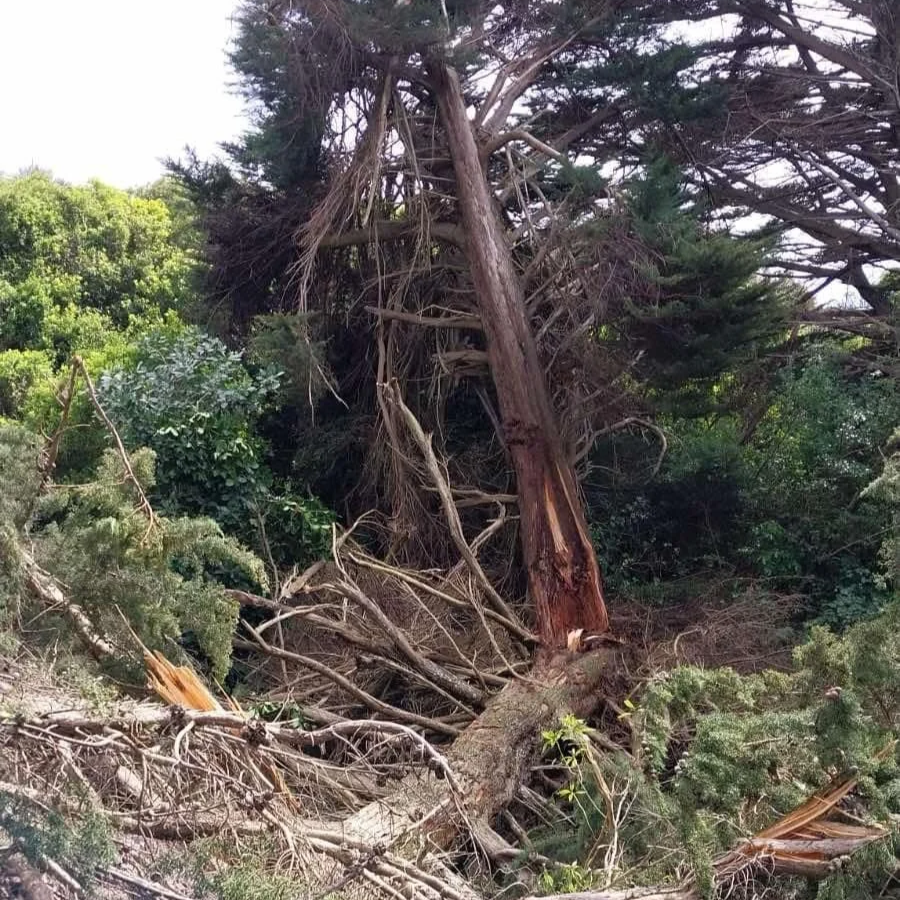
An example of this can be seen on the slope above the start of the Nature Trail. We got a team of arborists to fell a stand of large pine trees that were badly damaged in storms. They crushed a lot of the forest canopy downslope of them as they were felled. But as this was an area that had been planted with a wide range of native plants, the forest has begun restoring itself as a lot of seedlings of different species have grown up to replace the old canopy. The same is true on the various small landslips that have occurred over the last few years at Manawa Karioi.
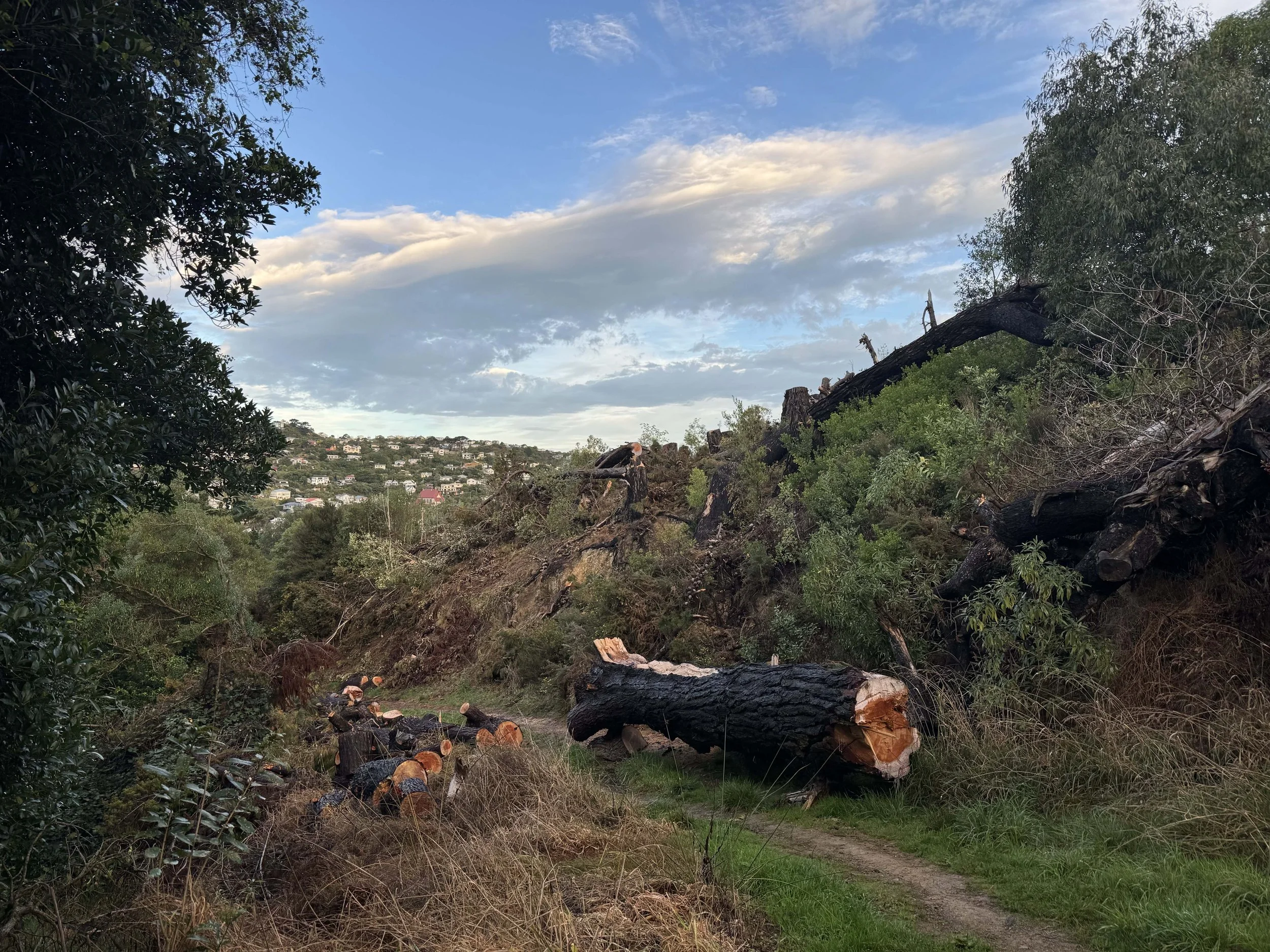
Pine Trees at Manawa Karioi felled to prevent them coming down in a storm.
Whilst the recent storm created plenty of track-clearing work, it also created opportunities. The felled trees and larger branches have created gaps in the canopy in areas where we intend to plant future canopy and emergent species, along with sub-canopy species. This is part of our ongoing strategy to create a 5-layered forest typical of lowland and hill country areas.
Our Vision: The 5-Layered Forest
1. Forest Floor: The 'carpet' of ferns and groundcover that keeps soil moist.
2. Small Trees & Shrubs: The 'understory' (Kawakawa, rangiora, hangehange).
3. Sub-canopy: The mid-tier (Mahoe, tarata, matipo, nīkau).
4. Canopy: The 'roof' of the forest (Kohekohe, tawa, tītoki).
5. Emergents: The 'skyscrapers' that tower above (Rewarewa, matai, miro, rimu, kahikatea).
At this stage, Manawa Karioi has developed a canopy of mahoe, ngaio and other mid-sized trees that will eventually become a sub-canopy as they are outgrown by kohekohe, tawa and titoki. As this canopy gets taller, it thins out a little. This is when we plant the future canopy, emergent and sub-canopy species.
Over time, as these all grow, they create a dense forest with a wide range of tree heights and shapes. They help protect each other from strong winds. But storm damage is inevitable, and part of the natural life cycle of a forest.
We are well on our way to creating this 5-layered forest. Some species such as tawa and kahikatea are slow growing, whilst others such as kohekohe and rewarewa are quite quick growing. You'll notice a lot of the rewarewa we have planted over the last couple of decades are now taller than the canopy.
Join us for our planting season starting in June. By putting a tree in the ground, you aren't just helping to repair storm damage, you’re helping us build a 5-layered forest that will stand for centuries.
———-
Manawa Karioi Winter Working Bees 2026
Join us to care for our ngahere and reconnect with the whenua
Every Sunday in June and August, 1pm–3pm
📍 Meet at the Tapu Te Ranga Marae Carpark – end of Danube Street, Island Bay, Wellington
Working bees main activities are planting natives, maintaining tracks, and enjoying the ngahere.
Tools, gloves, and good vibes provided – just bring yourself, appropriate footwear and a waterbottle.