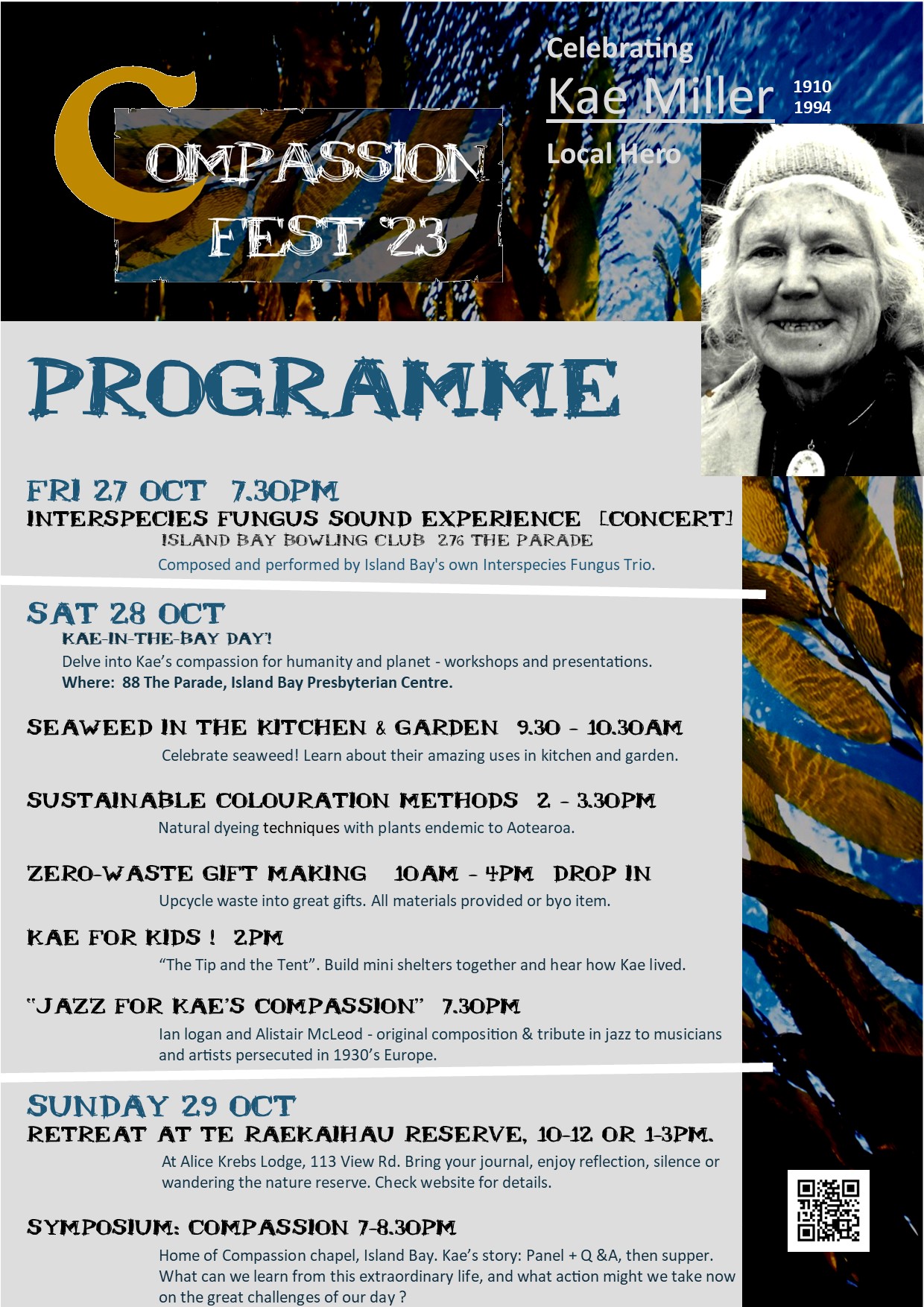

Manawa Karioi Society AGM
Whether you are a regular volunteer on the hills or simply care about protecting native bush in Island Bay, you are warmly invited to the Manawa Karioi Society AGM.
Every track cleared, native tree planted, and bench built at Manawa Karioi happens because of a dedicated community behind the scenes.
As we look ahead, we’re at an exciting and pivotal moment: we need the next generation of kaitiaki to help shape what comes next.
Whether you are a regular volunteer on the hills or simply care about protecting native bush in Island Bay, you are warmly invited to the Manawa Karioi Society AGM.
AGM Meeting Details
When: Sunday, 11 October 2026 | 1:30 pm – 3:00 pm
Where: Lyon Room, Home of Compassion, 2 Rhine St, Island Bay
Who: Everyone welcome (members, neighbours, newcomers, and future committee members)
Tea, coffee, and light refreshments provided.
What We’re Covering
Stories & Lessons from the Bush: Ross Gardiner will share how our planting and weed eradication programs have evolved over the years, key ecological breakthroughs, and what’s next for the canopy.
Future-Proofing Manawa Karioi: Insights from Ignite Consultants on how we can diversify our committee, safeguard technical knowledge, and adapt for long-term sustainability.
Annual Highlights & Financials: A quick review of the past year’s milestones and how our funds were invested.
Electing the 2026/27 Komiti: Welcoming fresh voices and energy to the team.
We’d love to see you there.
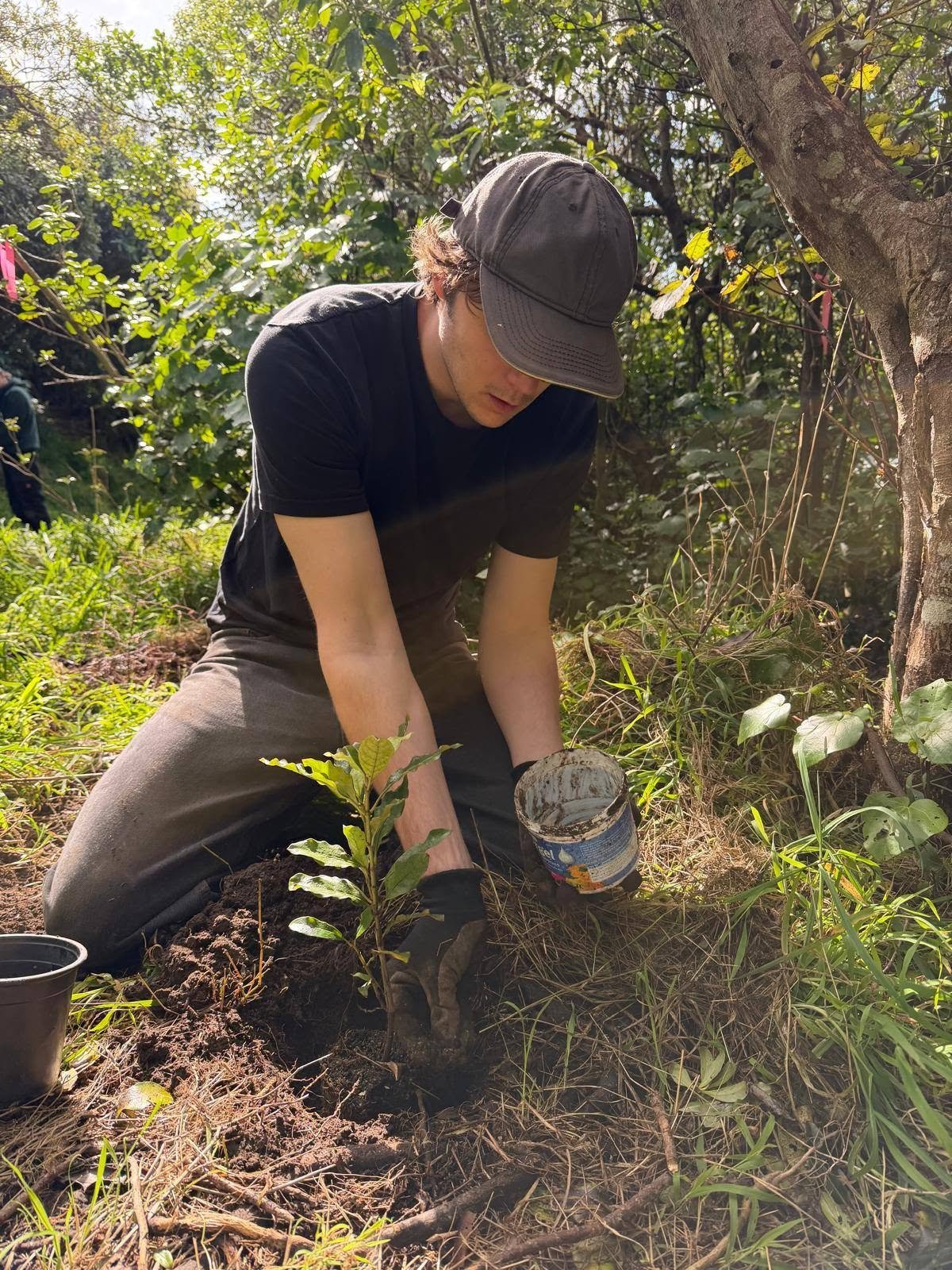
Winter Working Bee at Manawa Karioi
Kia ora from Ignite Consultants Wellington!
Based out of Victoria University of Wellington, we provide pro bono strategic support to grassroots community projects. This trimester, we teamed up with the Manawa Karioi Society to tackle two vital challenges: safeguarding the decades of planting and weed-management knowledge, media and comms currently held by a handful of people, and building clear pathways to recruit young kaitiaki to the Komiti.
Hear our findings at the AGM on Sunday, 11 October (1:30 pm at the Home of Compassion). We’ll present practical recommendations. Come along, hear our ideas, and help shape the next chapter of Manawa Karioi!
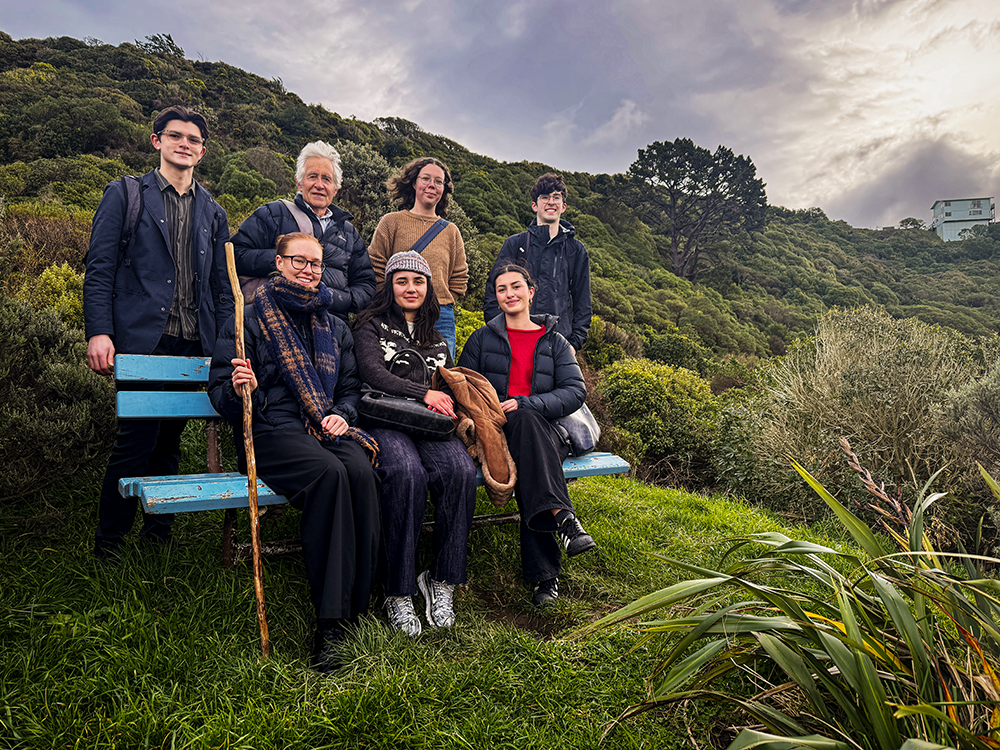
The Ignite team having a site visit with Chairman Chris Livesey and Kōmiti member Ness Patea (photo credit).

2026 Bird Count for the Aotearoa Garden Bird Survey.
In early July, 10 keen bird spotters spent a pleasant hour, mainly in the sun, looking out for birds in the 20th year of this wonderful citizen science project.
In early July, 10 keen bird spotters spent a pleasant hour, mainly in the sun, looking out for birds in the 20th year of this wonderful citizen science project. We spotted from 3 sites within the ngahere and, for the first time this year, also from a couple of open sites (near the bush edge between the main Info Board and the Marae entrance, and near one of the Tiny Houses). Pare and a group of marae volunteers took great interest in the survey and it was lovely to see and hear the construction going on there (not the wharenui yet!).
What did we see and hear? A healthy 93 sightings over the sites, with 15 species recorded. A whopping 40 sightings in an hour from Te Ahi Kaa at the horse paddock edge. The most numerous species in order were starling (20 sightings), toutou (waxeye), black-backed gull, piwakawaka (fantail), blackbird and Tui (7 sightings). We recorded pukeko for the first time, one kaka and one riroriro (grey warbler). No kereru recorded this year but we know they are becoming quite frequent.
Overall, there were slightly more native than introduced species sightings, even with starling (introduced) being the most common. But clearly there were more birds and more native birds within the 3 within-ngahere sites than at the edges. So we can confidently say that as the ngahere regenerates, the native birds are coming back too. A very satisfying morning of watching and counting!
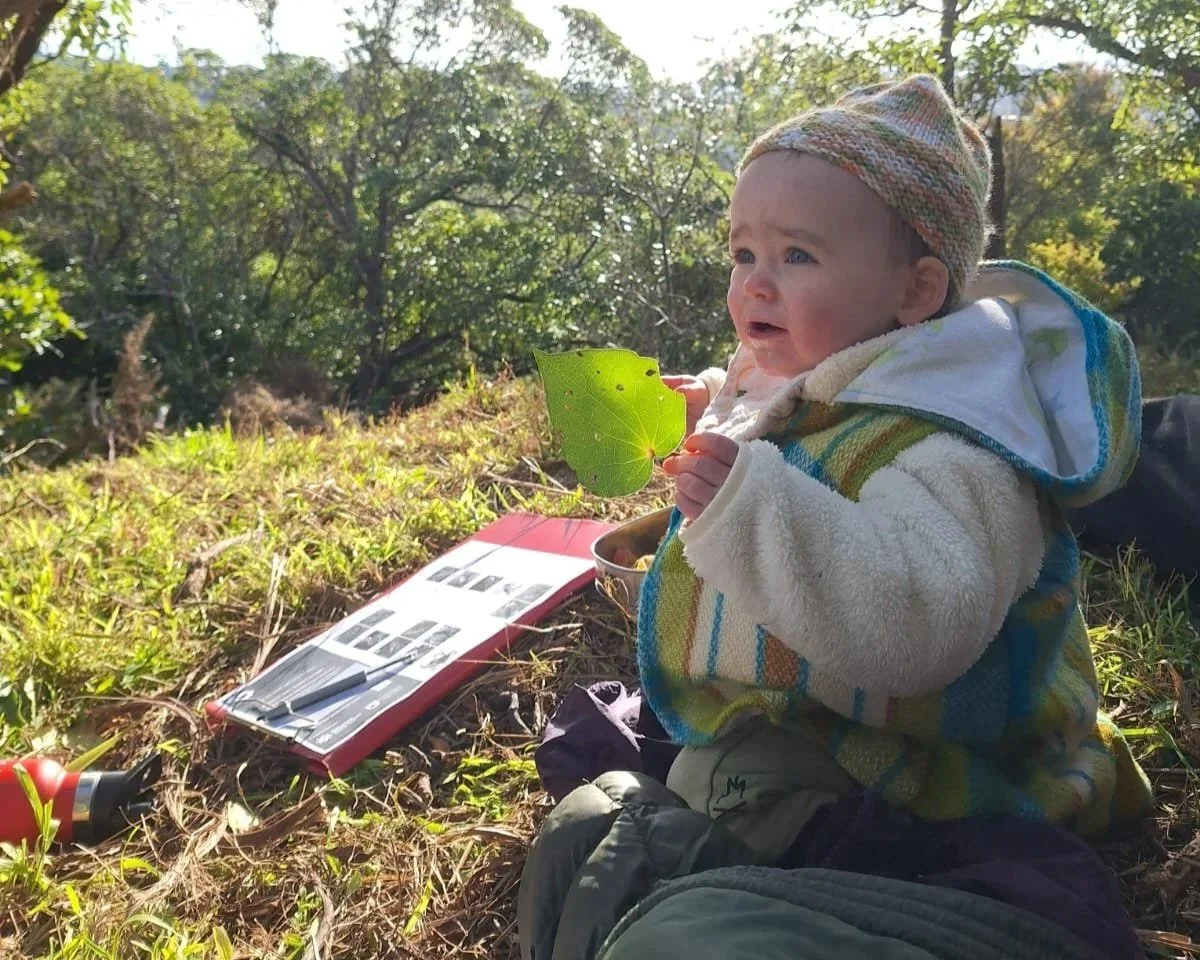
2026 bird count for the Aotearoa Garden Bird Survey - Our youngest and cutest spotter!

We're Not Just Planting Trees, We're Planting a Forest
When it comes to ecological restoration, it's important to think long term, and to bear in mind the old maxim "Less haste, more speed".
Globally, many planting projects have focused on getting as many trees in the ground as quickly as possible. This is especially true of projects aiming for carbon sequestration. But lack of plant species diversity often means in decades to come, the forest can collapse as trees get hit by disease, pests, or simply die of old age.
When it comes to ecological restoration, it's important to think long term, and to bear in mind the old maxim "Less haste, more speed".
Globally, many planting projects have focused on getting as many trees in the ground as quickly as possible. This is especially true of projects aiming for carbon sequestration. But lack of plant species diversity often means in decades to come, the forest can collapse as trees get hit by disease, pests, or simply die of old age.
There is no chance of that happening at Manawa Karioi. Right from the beginning, understory species (eg karamu, wharangi) were planted amongst the bigger pioneer species such as kohuhu. Forest giants like totara were also planted, and after low canopy was established, kahikatea and nikau were put in.
We spent the early 2000s trialling a wider range of species that we had previously thought might need shelter, and here's what we've learned...
Totara - can handle full exposure to sun and wind. It doesn't like much shade, which slows growth considerably.
Rimu - doesn't like full sun, but will die in heavy shade. We plant it where it gets some protection from the summer sun, but has to be a few metres away from fast growing taller trees.
Rata - hates heavy shade, but often dies in full sun, especially if the soil around it gets hot. We plant it with a cardboard plant protector around it, which has lead to almost 100% survival rate.
Titoki - needs light shade. We often plant it in an open area a few metres south of taller trees. This provides midday shade in summer. In more open areas, a cardboard plant protector is used.
Rewarewa - is often among the first species to establish when cleared land is left to regenerate. A good example of this is the former farmland on the hills around Otari. As it grows tall, and quickly, it provides an ideal perching tree for birds like kaka.
Kohekohe - this is often the main canopy tree in coastal forests up to 5km inland throughout Te Ika A Maui. We have been surprised to find that it can survive in open areas so long as it doesn't get hit by frost and that the soil doesn't get too dry in summer. It can survive dry areas so long as it has shade in summer.
Our trials parallel the results found in a study of revegetation projects around Tamaki Makarau.
So why is it important to try to get future canopy and emergent species established early on? To put it simply, a forest is more likely to survive and regenerate itself if it has enough of the key species right from the beginning. This natural regeneration will allow the forest to bounce back from storms and landslips. We've covered this in previous articles.
It's important to note that 98% of forest cover south of the Porirua-Johnsonville line was removed during the late 1800s to make way for farmland. This means that for many key species, there are few seed sources left. South of the CBD, we are aware of only 1 old kohekohe in Tawatawa Reserve, and 4-5 in Miramar. And there's no kahikatea at all!
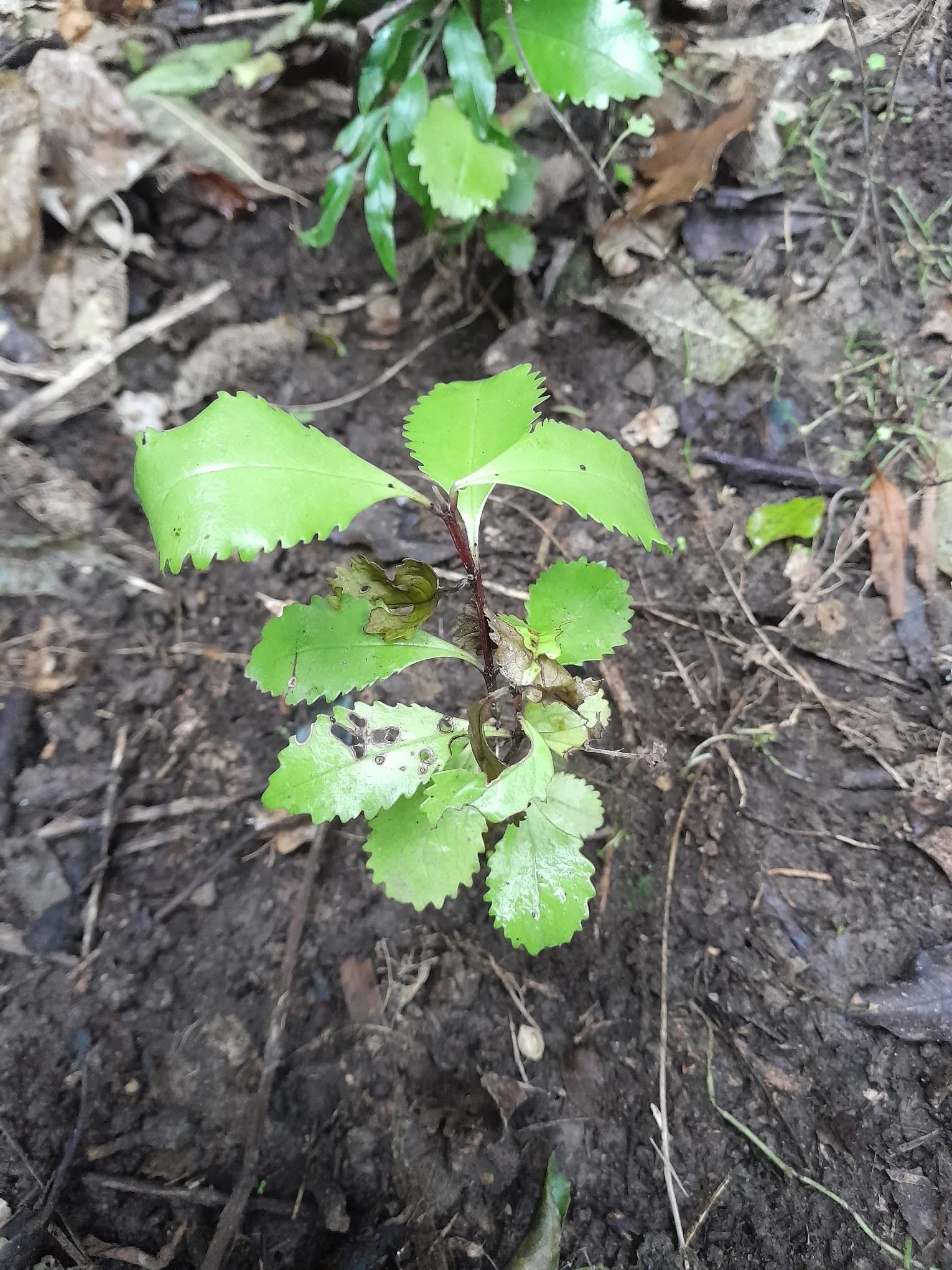
We aren't aiming to plant out the forest exactly as we hope it to be. We're simply making sure we plant sufficient quantities of as many species as we can, so that nature can do the rest for us. We're really starting to see that happen now. Not only are common species like ngaio spreading, but also locally rare species. We've seen ewekuri and poporokaiwhiri popping up around the Nature Trail for years. This year we found the first self-sown kohekohe sapling near the Nature Trail seats.
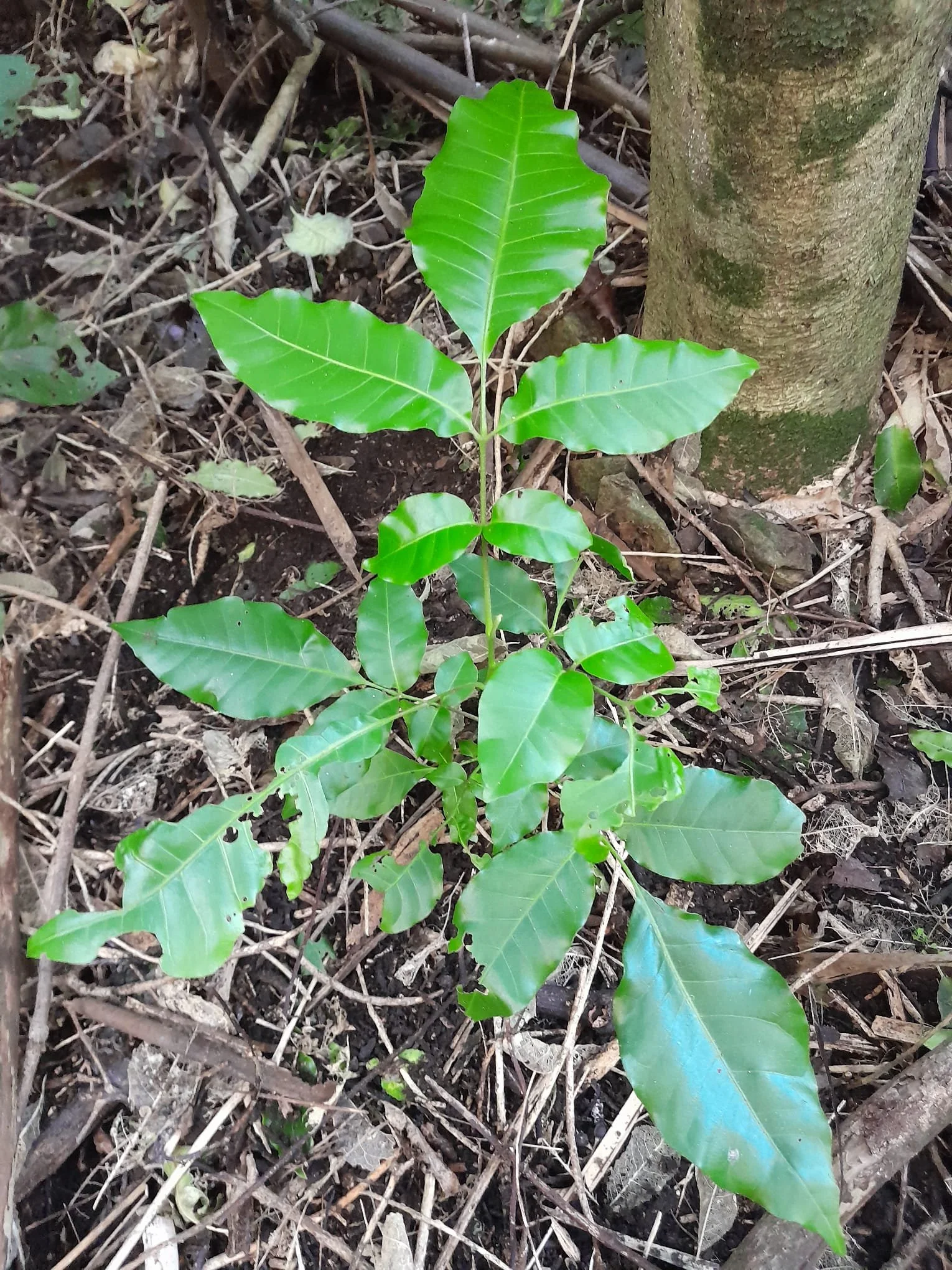
And nearby, we found 3 pukatea seedlings.
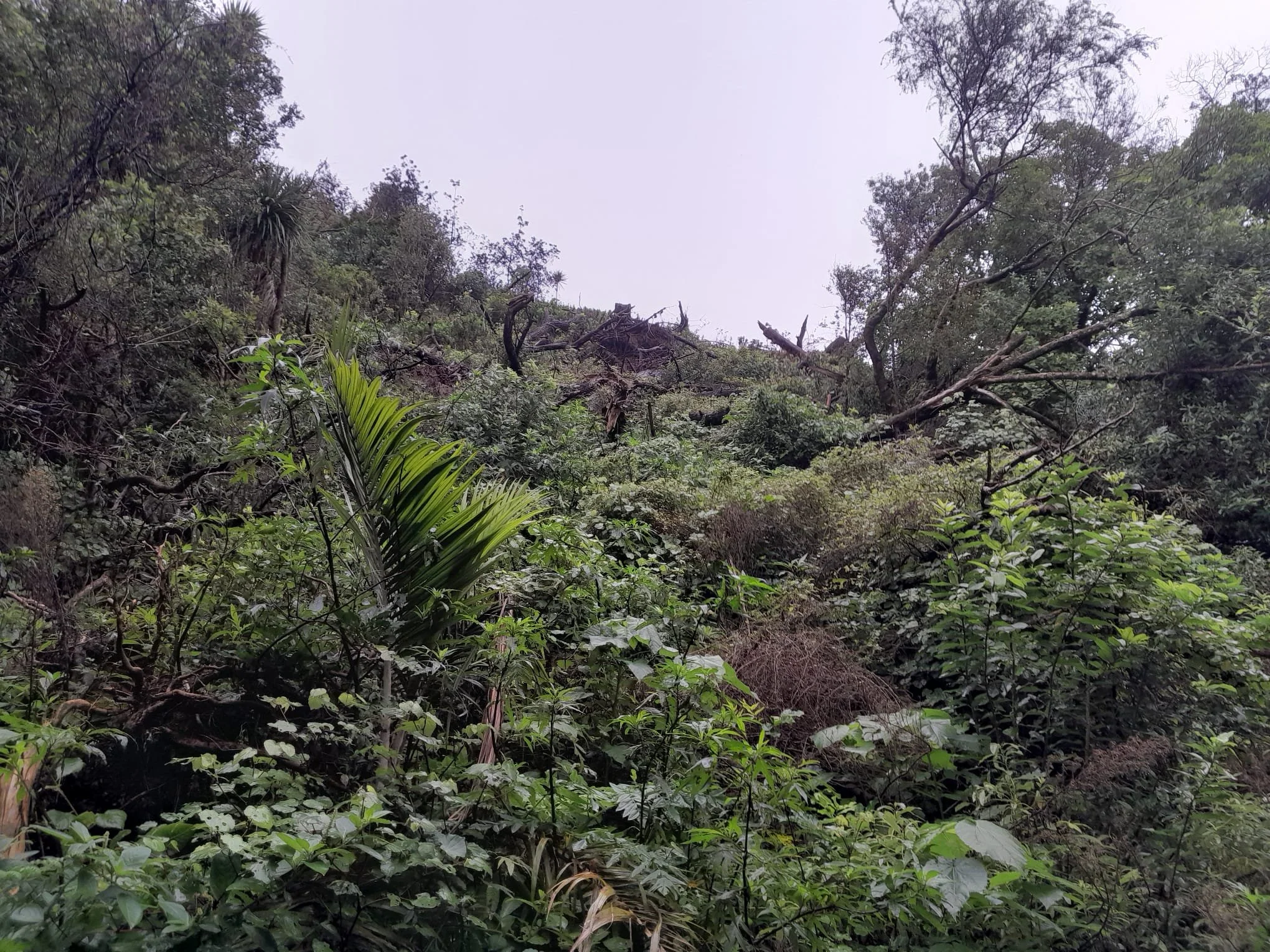
The increased trapping done by the Predator Free Island Bay group has meant there are significantly fewer rats and mice eating forest seeds. This has accelerated natural regeneration, clearly seen in the photo below. This was taken a year after the pine trees above the Nature Trail were felled.
We have 5 planting sessions this August. Amongst the usual suspects of plants, we will also be putting in a mix of over 100 emergent and future canopy trees, including titoki, totara, rewarewa, matai, rimu, rata and kohekohe.
We will also be doing some track work, principally realigning the lower section of Te Whare Ahuru now that the last of the felled pine trees have been cleared out of the way.

Manawa Karioi Bush Bird Survey 2026
Join us for a fun, family-friendly morning counting manu as part of the NZ Garden Bird Survey, now in its 19th year!
Together, we’ll build a picture of the birds living in and around Manawa Karioi.
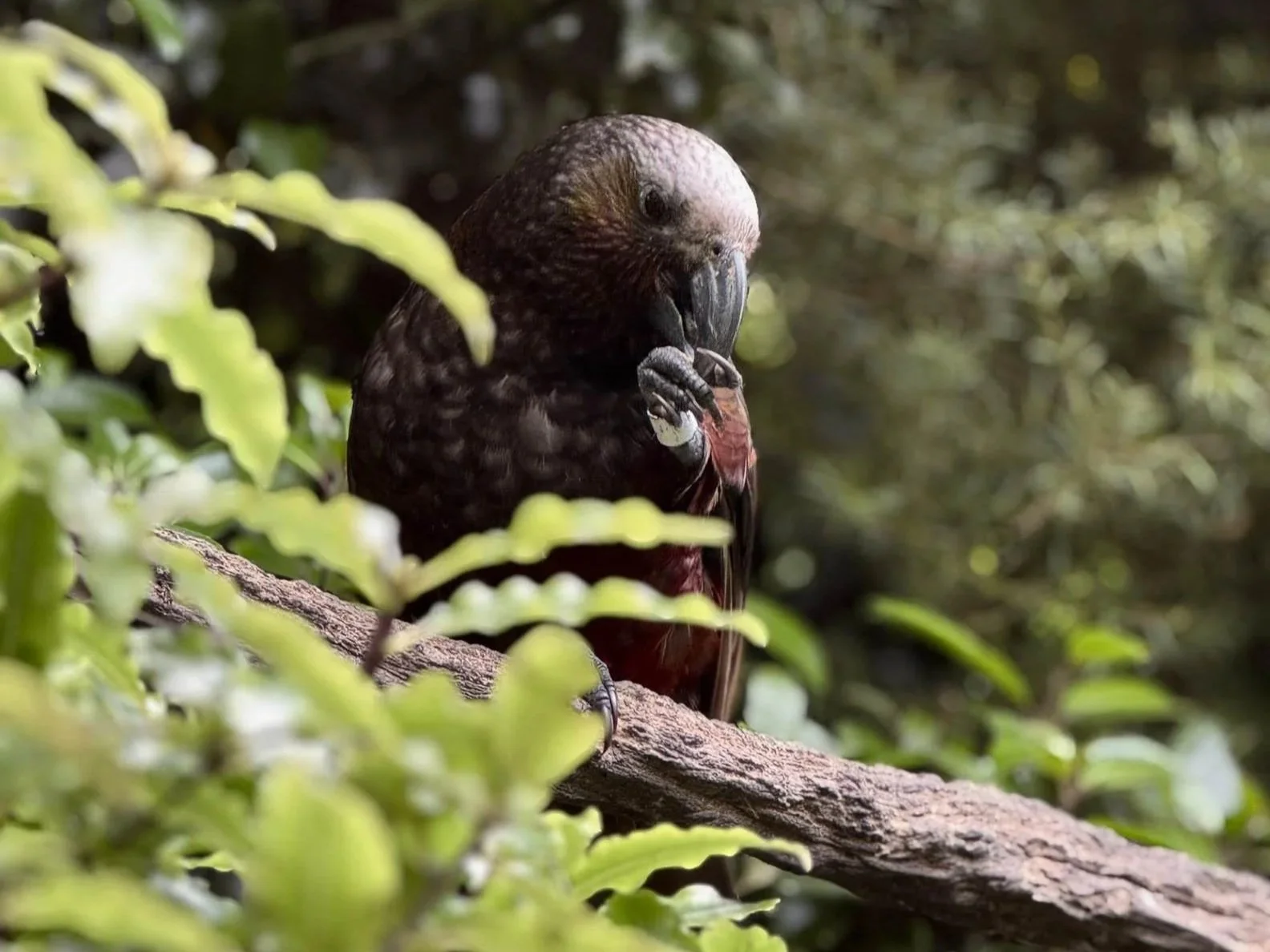
Kaka photographed at Zealandia near their feeding stations. Kaka visit Manawa Karioi.
Date/Time: Saturday 4 July, 10am - 11.30am
Meet at: Information Board, Tapu te Ranga Marae carpark (End of Danube St entrance)
Bring: Warm clothes, sturdy shoes, drink/snack, pen/pencil, binoculars (if you have them)
Optional: Bird guide, printed map of sites, survey form, light camping chair
Join us for a fun, family-friendly morning counting manu as part of the NZ Garden Bird Survey, now in its 19th year!
Together, we’ll build a picture of the birds living in and around Manawa Karioi.
Before Saturday
Learn about the survey: https://gardenbirdsurvey.nz/
Download the survey form (2 pages, colour recommended): includes photos to help ID birds
Get familiar with likely birds: Tūī, Pīwakawaka (Fantail), Kererū, Kākā, Tauhou (Silvereye), Karoro and Tarapunga (gulls) Kāruhiruhi (Pied shag), and more
Check out the online survey site map: https://maps.app.goo.gl/qr3RtEPHMzimx2Du5
Choose a site that suits your group – from scenic hilltops to easy-access spots near the track entranceForm a group (up to 5) or turn up solo – all welcome!
Enquiries to Paul Blaschke 027 2462848; paul@blaschkerutherford.co.nz

Weathering the Storm: Working bee plans
As planting season approaches, yet more extreme weather events have highlighted the importance of our plan to maximise plant species diversity.
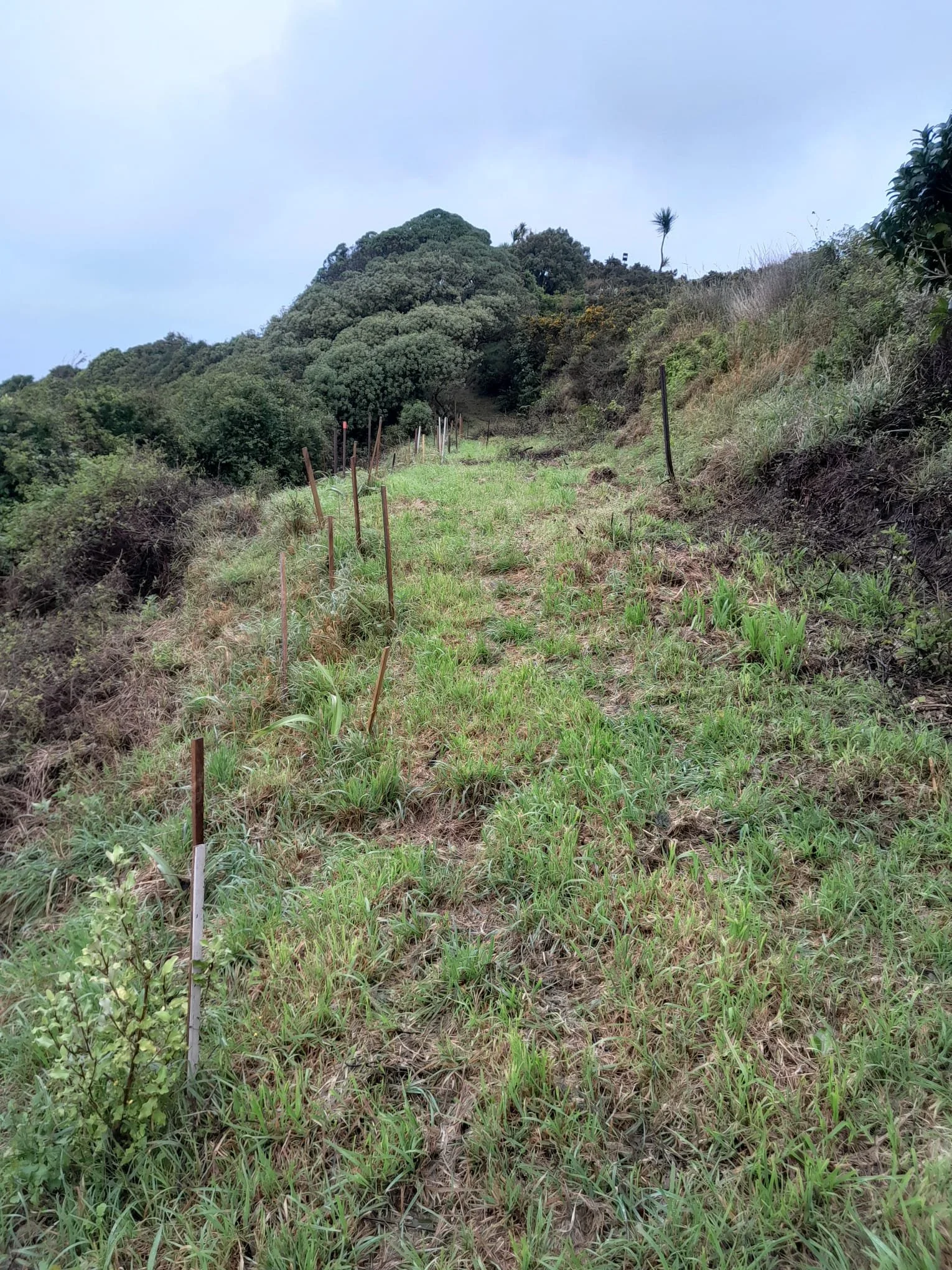
View along the new track/viewpoint near Quebec Street. The wooden stakes mark trial plantings of several plant species last year, with a 90% survival rate.
As planting season approaches, yet more extreme weather events have highlighted the importance of our plan to maximise plant species diversity. This has been discussed in a previous blog post "From Storm Damage to Strength - Building a Forest That Lasts" which talked of how plant biodiversity speeds up forest recovery after storm damage (and highlighting the 5-layers of plants in lowland podocarp-broadleaf forests).
The article "Sealing Up the Edges of the Forest" was about planting the right things on forest margins to avoid or minimise storm damage.
This year, we continue with forest margins planting as we work on new open areas. One of these areas is a short section of track with a great viewpoint linking the upper boundary of Manawa Karioi near Quebec St with the City to Sea Walkway. Near the top of the hill, this is an ideal spot for species that tolerate dry summers and strong wind.
Everything from locally common things like wharariki (mountain flax) to weird coprosmas (Comprosma areolata, C rhamnoides) and even a few kaikomako. A skink was seen at this spot whilst planting preparation work was being done, and many of the plant species we are putting in also provide ideal skink habitat. There are several known skink populations in neighboring Tawatawa Reserve.
The other open area we will be planting later in the season is where the pine trees were felled over a year ago. Some of this area is exposed and dry, whilst some is more sheltered and suitable for larger trees. This work will also see the bottom section of the track Te Whare Ahuru realigned to an easier gradient. This section of track has been inaccessible for several years due to erosion and then pine tree felling.
Besides these forest margin planting sessions, we will also be putting in dozens of kohekohe under established trees (they need shelter to survive the first few years) and similar amounts of titoki in semi-open areas. Both of these species will go on to form the future canopy (Layer 4 of the forest). And of course we will be planting more podocarps such as totara and matai, which along with rewarewa will become Layer 5 (emergent species)
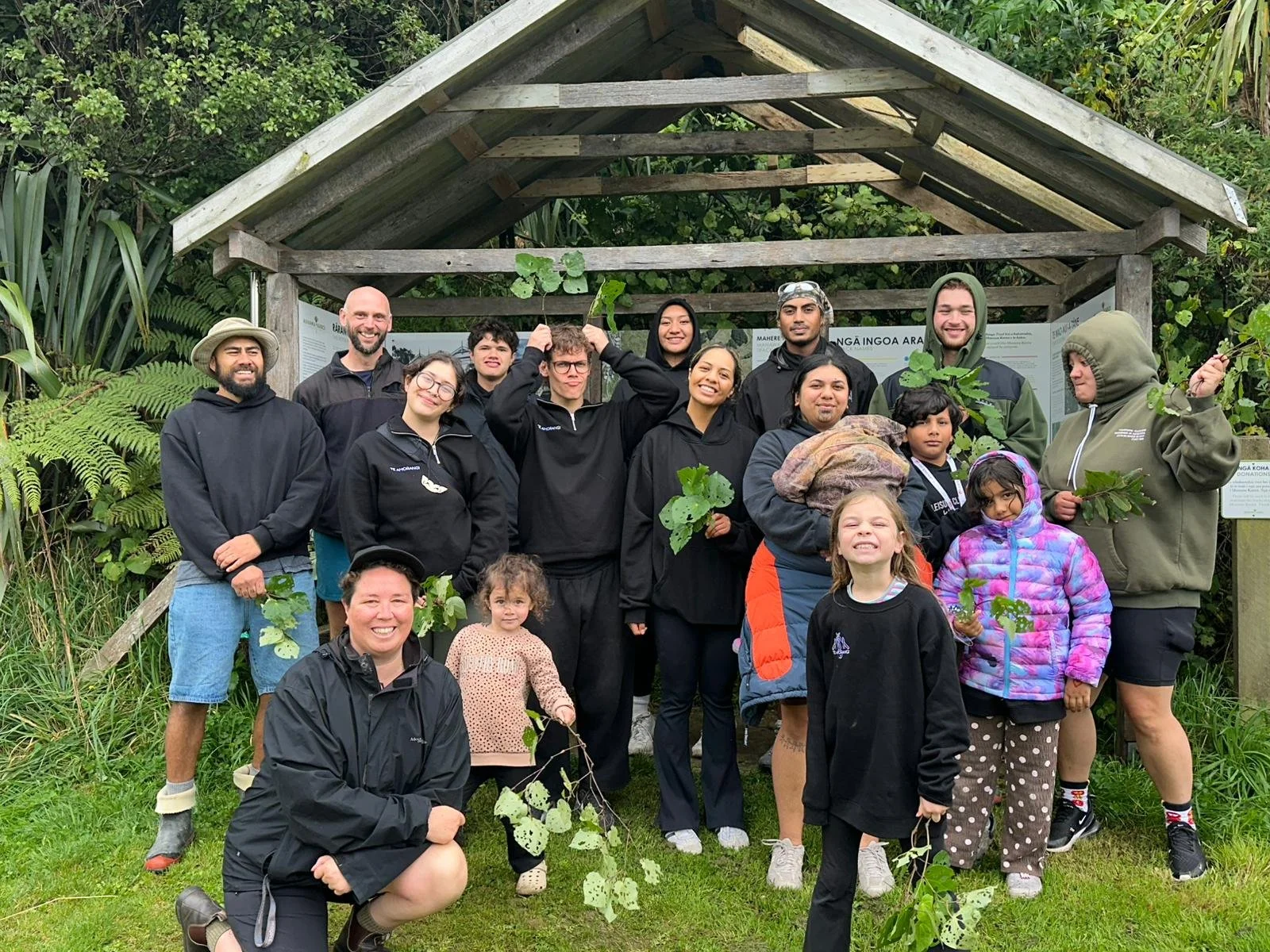
The wider whanau from Tapu te Ranga Marae learning about Rongoā Māori with Pare Sannyasi at Manawa Karioi.
Manawa Karioi Winter Working Bees
Join us to restore for our ngahere.
Every Sunday in June and August, 1pm–3pm
Meet at the Tapu Te Ranga Marae Carpark – end of Danube Street, Island Bay, Wellington
Rain or shine – we’ll be out there planting, maintaining tracks, and enjoying the ngahere.
Tools, gloves, and good vibes provided – bring suitable footwear, and a waterbottle.

From Storm Damage to Strength: Building a Forest That Lasts.
From the damp ferns of the forest floor to the soaring heights of the emergent giants, discover how we’re turning storm damage into a resilient, 5-layered forest—and how you can join our planting team this June to help us build it.
The recent storms were a powerful reminder of nature’s force, but they also revealed something fascinating about the resilience of our forest at Manawa Karioi.
———
Written by Ross Gardiner.
Well, what a storm we had this month! We had a big storm and several smaller ones last winter. Mostly, they blew a lot of leaves and small branches off trees, but this summer's big one brought down quite a few trees and bigger branches. This brings us to consider a very important part of forest restoration - creating a forest with a wide range of plant species to make it more resilient to storm damage.
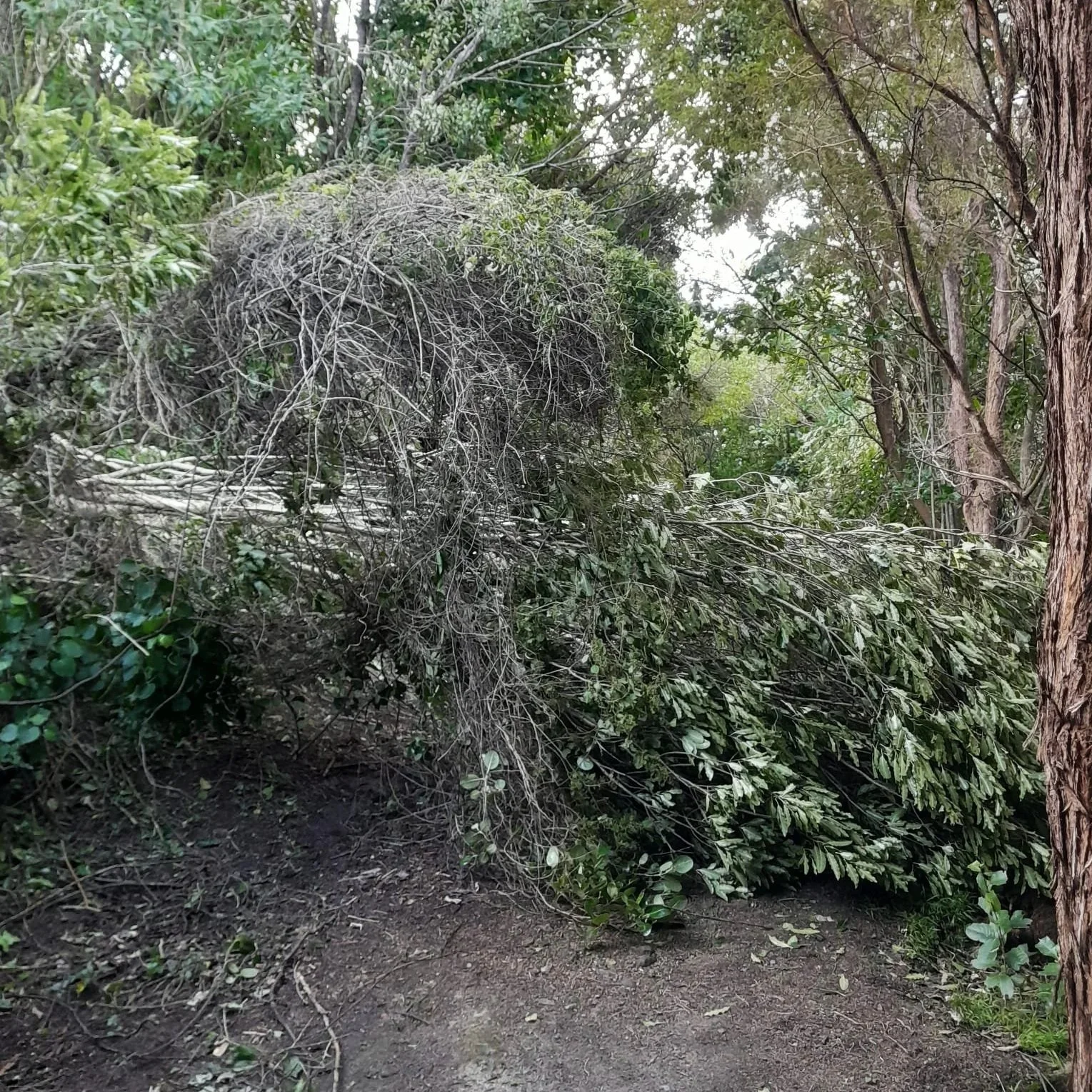
One of a number of trees that were blown over near Seed Source Gully. Trees are cleared by volunteers after storms.
You may remember our article last year about forest margins. The same concept applies to the forest interior. Having a wide range of plant species makes it more resistant to damage, but also helps it recover quickly when trees do come down.
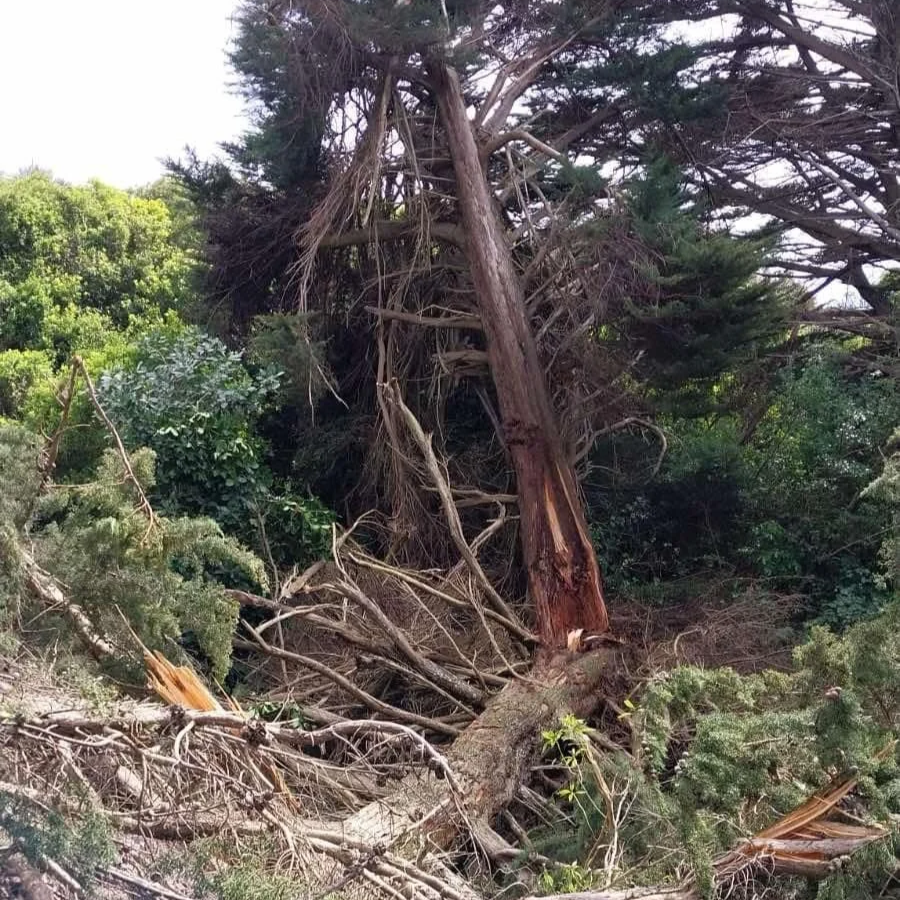
An example of this can be seen on the slope above the start of the Nature Trail. We got a team of arborists to fell a stand of large pine trees that were badly damaged in storms. They crushed a lot of the forest canopy downslope of them as they were felled. But as this was an area that had been planted with a wide range of native plants, the forest has begun restoring itself as a lot of seedlings of different species have grown up to replace the old canopy. The same is true on the various small landslips that have occurred over the last few years at Manawa Karioi.
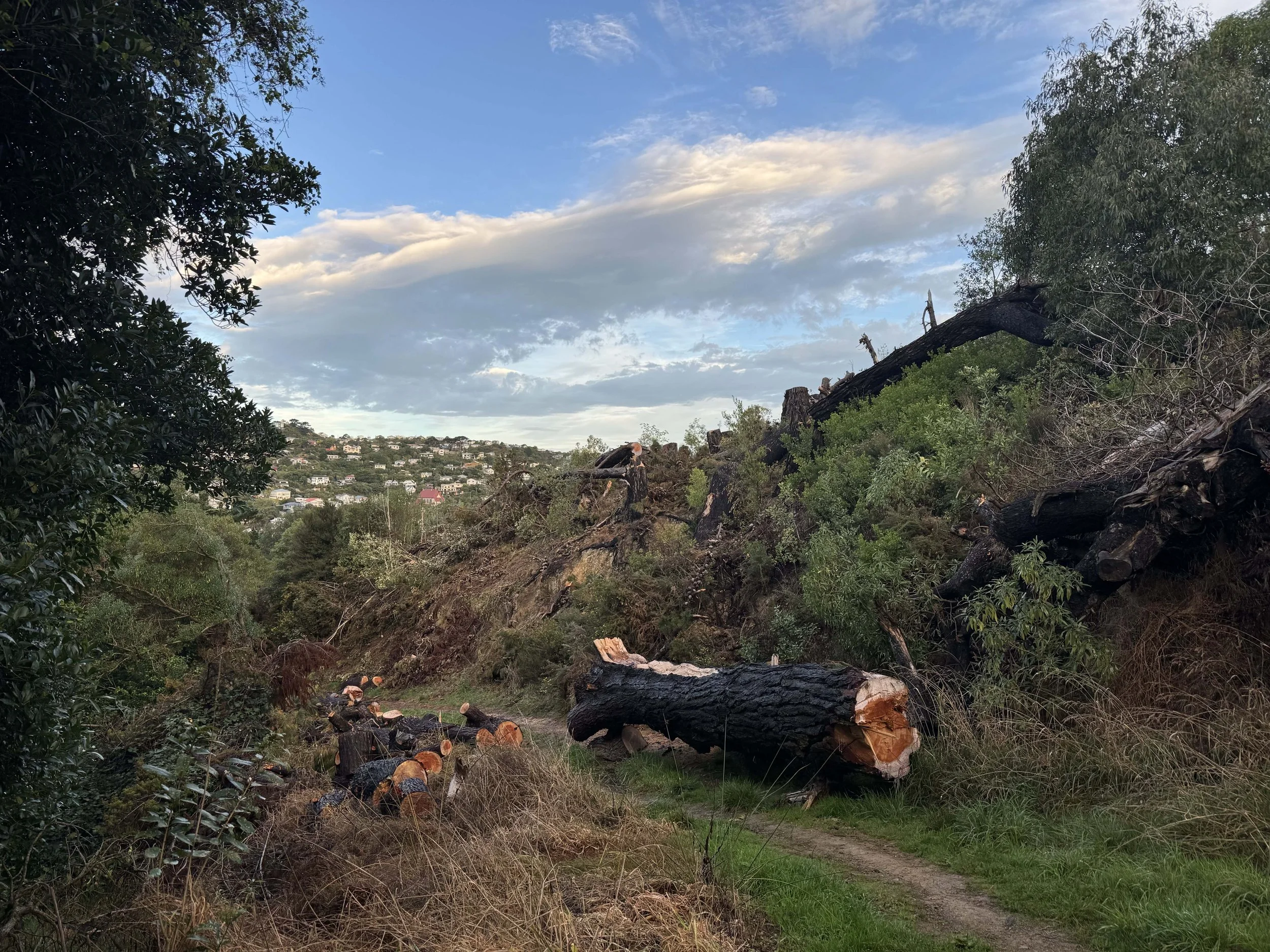
Pine Trees at Manawa Karioi felled to prevent them coming down in a storm.
Whilst the recent storm created plenty of track-clearing work, it also created opportunities. The felled trees and larger branches have created gaps in the canopy in areas where we intend to plant future canopy and emergent species, along with sub-canopy species. This is part of our ongoing strategy to create a 5-layered forest typical of lowland and hill country areas.
Our Vision: The 5-Layered Forest
1. Forest Floor: The 'carpet' of ferns and groundcover that keeps soil moist.
2. Small Trees & Shrubs: The 'understory' (Kawakawa, rangiora, hangehange).
3. Sub-canopy: The mid-tier (Mahoe, tarata, matipo, nīkau).
4. Canopy: The 'roof' of the forest (Kohekohe, tawa, tītoki).
5. Emergents: The 'skyscrapers' that tower above (Rewarewa, matai, miro, rimu, kahikatea).
At this stage, Manawa Karioi has developed a canopy of mahoe, ngaio and other mid-sized trees that will eventually become a sub-canopy as they are outgrown by kohekohe, tawa and titoki. As this canopy gets taller, it thins out a little. This is when we plant the future canopy, emergent and sub-canopy species.
Over time, as these all grow, they create a dense forest with a wide range of tree heights and shapes. They help protect each other from strong winds. But storm damage is inevitable, and part of the natural life cycle of a forest.
We are well on our way to creating this 5-layered forest. Some species such as tawa and kahikatea are slow growing, whilst others such as kohekohe and rewarewa are quite quick growing. You'll notice a lot of the rewarewa we have planted over the last couple of decades are now taller than the canopy.
Join us for our planting season starting in June. By putting a tree in the ground, you aren't just helping to repair storm damage, you’re helping us build a 5-layered forest that will stand for centuries.
———-
Manawa Karioi Winter Working Bees 2026
Join us to care for our ngahere and reconnect with the whenua
Every Sunday in June and August, 1pm–3pm
📍 Meet at the Tapu Te Ranga Marae Carpark – end of Danube Street, Island Bay, Wellington
Working bees main activities are planting natives, maintaining tracks, and enjoying the ngahere.
Tools, gloves, and good vibes provided – just bring yourself, appropriate footwear and a waterbottle.

Interview with Helen Mechen: Virescent Gardens
Welcome to our Q&A with Helen Mechen, the founder of Virescent Gardens, a native plant nursery nestled in Stokes Valley of Wellington. Helen is passionate about providing high-quality, eco-sourced native trees and plants, and she plays a vital role in local conservation efforts by supplying special native trees to projects like Manawa Karioi. In this interview, we'll delve into her background, her favourite plants, and gather some expert tips for gardening in Wellington's unique climate.
Welcome to our Q&A with Helen Mechen, the founder of Virescent Gardens, a native plant nursery nestled in Stokes Valley of Wellington. Helen is passionate about providing high-quality, eco-sourced native trees and plants, and she plays a vital role in local conservation efforts by supplying special native trees to projects like Manawa Karioi. In this interview, we'll delve into her background, her favourite plants, and gather some expert tips for selecting natives in Wellington's unique climate.
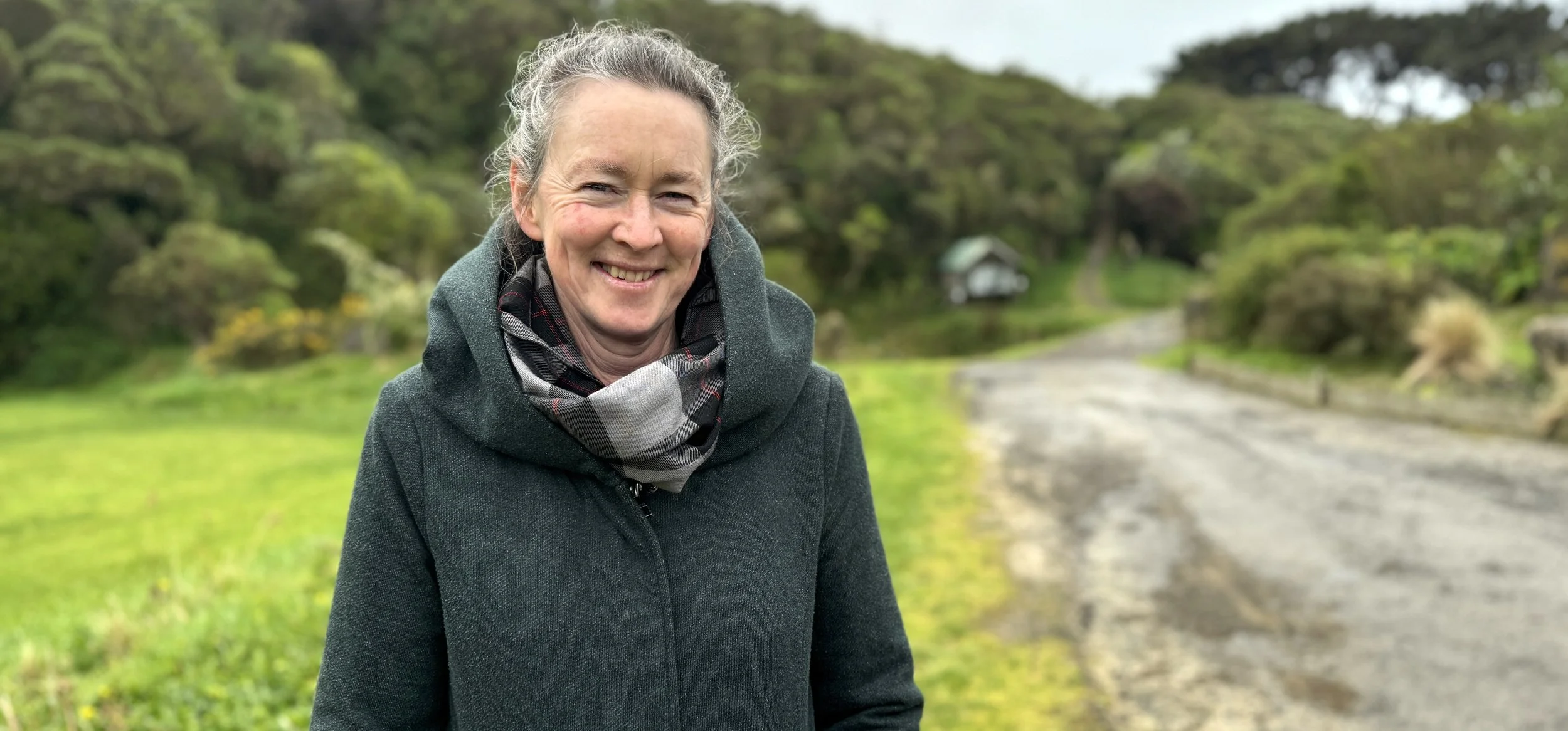
Helen on a recent visit to Manawa Karioi.
What is your background, and what inspired you to start Virescent Gardens?
I've always loved natives but it was studying Ecology and Biodiversity at Victoria Uni that really got me excited about the science behind them and specifically plant breeding systems, plants do it all ways!
My first job, post University was with the collections at Te Papa, a great way to solidify what research can teach us about plants. After that I was the Propagation Specialist at WCC and really wanted to apply what I'd learned about how useful data collection is to the propagation of plants. I was really motivated to see to what we could learn if we could gather enough data about propagation processes and outcomes.
I wanted to make a start on converting anecdotes into science. That data along with a huge demand for prop information from a growing number of dedicated community groups led to the Wild Fruits of Wellington blog site I designed and authored. Virescent Gardens is a broad Horticulture venture that is mostly me but sometimes others too.
Alongside the on-the-ground stuff I've really enjoyed the education opportunities the most, a dabble in a few Enviroschools activities, public and community group talks and workshops, that's the stuff I'm really passionate about.
I always wanted Virescent Gardens to include a nursery, it's just taken a bit of time to land at a site where that can happen. My aim is to eventually have a supply of some more obscure, hard-to-grow, uncommon species to augment the bulk plantings around the region.
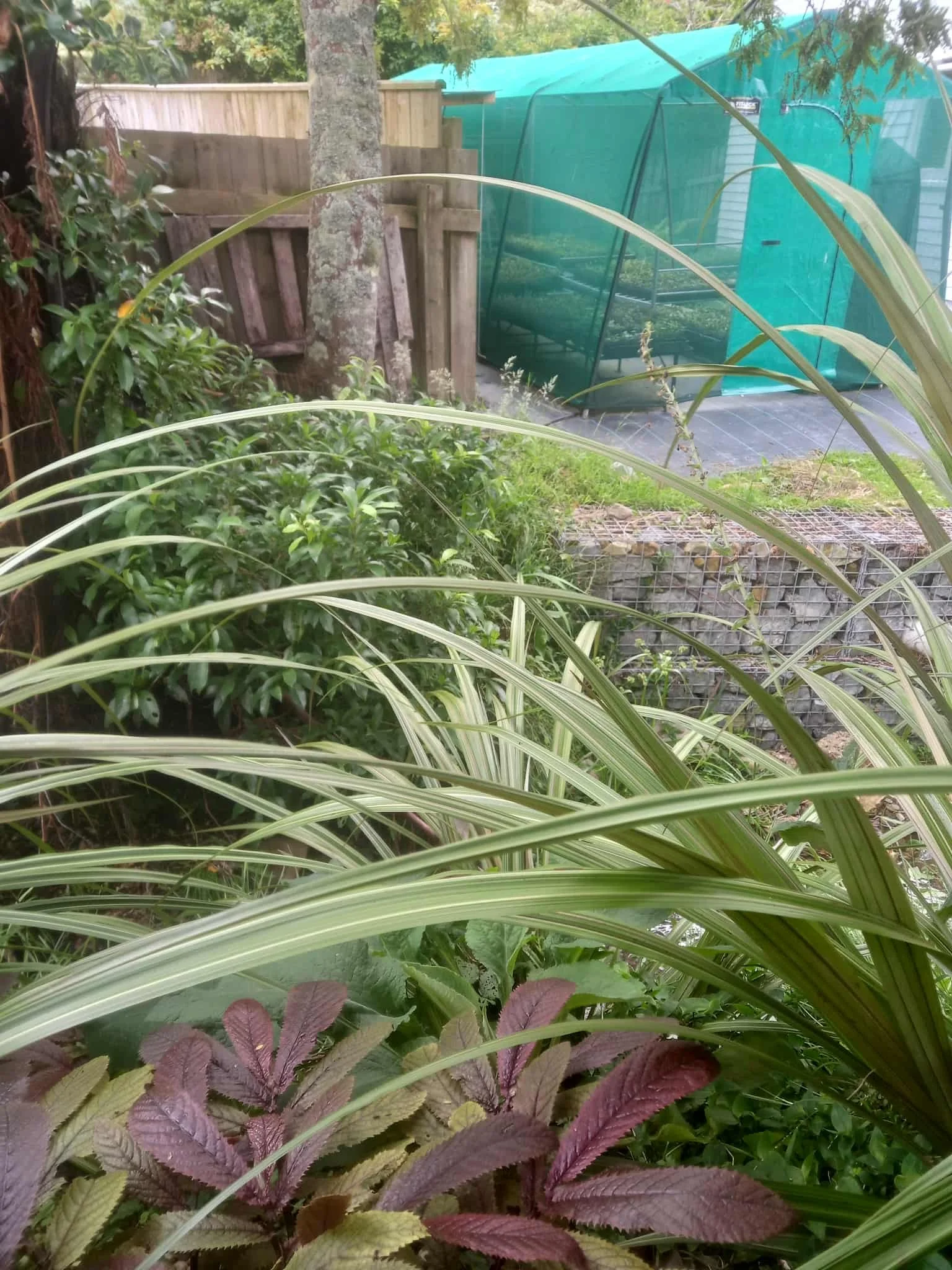
Virescent Gardens in Stokes Valley
What is the philosophy behind your company, and how does it inform the way you approach your work?
I think I can grab that pretty much directly from the front page of my website. Work with nature, not against it. Creating healthy resilient gardens relies on nurturing a healthy and flourishing environment using ecological principles. Understanding the intricacies of your site and drawing on extensive plant knowledge ensures the best garden solution with the added benefit of eliminating the need for harmful toxins.
I think it makes me take particular care when recommending what to plant. There's lots of choices that might survive but really, it's best to choose the ones that will thrive. My business is 100% organic reflecting my commitment to the environment. It's been really great introducing clients to a huge suite of organic products available these days as well as encouraging a 'ground up' approach to their gardens e.g. feed the soil not the plants. Once the plants have everything they need you wont need the chemicals, everything can achieve a balance.
Can you tell us about the special native trees you supply to Manawa Karioi? What makes these trees particularly suitable for that area?
What makes these trees particularly suitable for that area? Manawa Karioi is really cool because it's got such a range of environments from deep gullies to hilltops. I've supplied some special things like the large-leaved milk tree Ewekuri to increase the population and the genetic diversity they already have.
It is also great to supply some climbing rata, those sorts of things can take a while to establish in restoration sites and it's not one that is readily available. Kohekohe is one that's really needed in large numbers so I've been supplying larger numbers than they can get from council. Kamahi also is one that is so, so common but it's uncooperative in nursery production and because my nursery is in a kamahi site I have a constant supply.
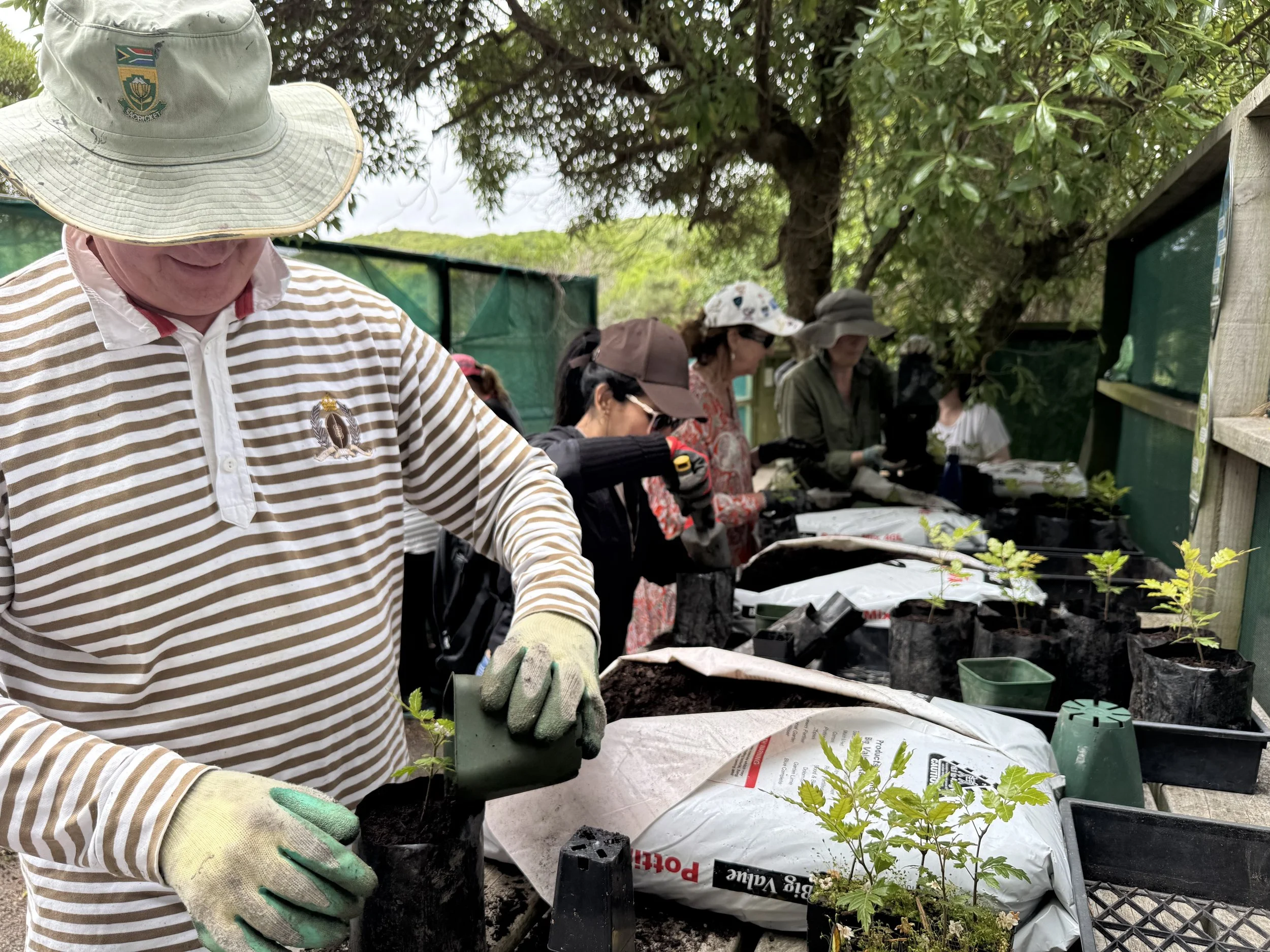
Potting up trees from Virescent Gardens at SEA Nursery. Helen in the background.
Do you supply any other restoration projects in Wellington?
Only SEA at this stage and a group in Heretaunga Friends of Māwai Hākona or Mawaihakona Stream a really cool riparian strip restoration that started 23 years ago. I work directly with one of the original founders so that's been really cool
What are some of your favourite native trees or plants, and why? Do you have any personal favourites you love to grow in your own garden?
I'm completely obsessed with the tiny and tenacious members of our native flora, the hilltops and alpine environments, just stunning plants. I'm planting lots of eco-sourced stuff to use as future seed sources in my garden but it's gotta be pretty too! I use heaps of divaricating shrubs and my objective is to collect and grow as many of the local ones as possible. I like to mix these in with grasses and other strappy structural things like flaxes and Astelias to create that contrast between forms.
Given Wellington's unique climate, what are your top tips for selecting native trees successfully in the region?
Look at what's already growing in the area naturally and peer into other people's gardens and see what is thriving. The plants will tell you. If you've never ever seen a particular plant growing in your area, there might be a reason for that. If you're adventurous, just try it but bear in mind the labels in the plant shops are not detailed enough to use as a guide, seek more detailed info. Use my handy site guide list on the Nursery page of my website as a starting point. https://www.virescentgardens.com/nursery.html
Helen’s blog to share some basic knowledge about local native plants, when they flower and fruit, and how to grow them.

Insights from the 2025 Bush Bird Survey
We're excited to share the fascinating results of the 2025 Bush Bird Survey, conducted on June 29th and 30th, 2025, at Manawa Karioi! This year's survey provides valuable insights into the birdlife thriving within our cherished reserve.
We're excited to share the fascinating results of the 2025 Bush Bird Survey, conducted on June 29th and 30th, 2025, at Manawa Karioi! This year's survey provides valuable insights into the birdlife thriving within our local reserve.
A Comprehensive Look at Our Feathered Friends
Six dedicated groups spent an hour on the afternoon of Sunday, June 29th, meticulously counting birds at various sites both within and on the edges of Manawa Karioi. To gain an even deeper understanding, one group revisited a site the following morning, and we incorporated data from two earlier counts conducted in 2023 and 2024. These nine counts offer a comprehensive picture of the bird species present and their distribution across the reserve.
The seven survey sites, stretching from north to south, included:
Greens Lookout: Offering views over the northern part of Manawa Karioi, near the top of Te Uma i Mokotia.
The Horse Paddock: Located on Te Ahi Kaa, near the Home of Compassion boundary, with views up the large northern gully.
Nature Trail Stream Bend: Focusing on birds within the most advanced regenerating bush in Manawa Karioi.
Mokopuna Lookout: Situated near Te Ahi Kaa in the central southern part of the reserve, looking mainly north.
Subdivision Lookout: Near the Rhine St entrance, providing views over the southern part of the reserve and Island Bay.
Paekawakawa Link Track - Top: Overlooking open ground on the boundary between Manawa Karioi and the Paekawakawa Reserve and the South Coast.
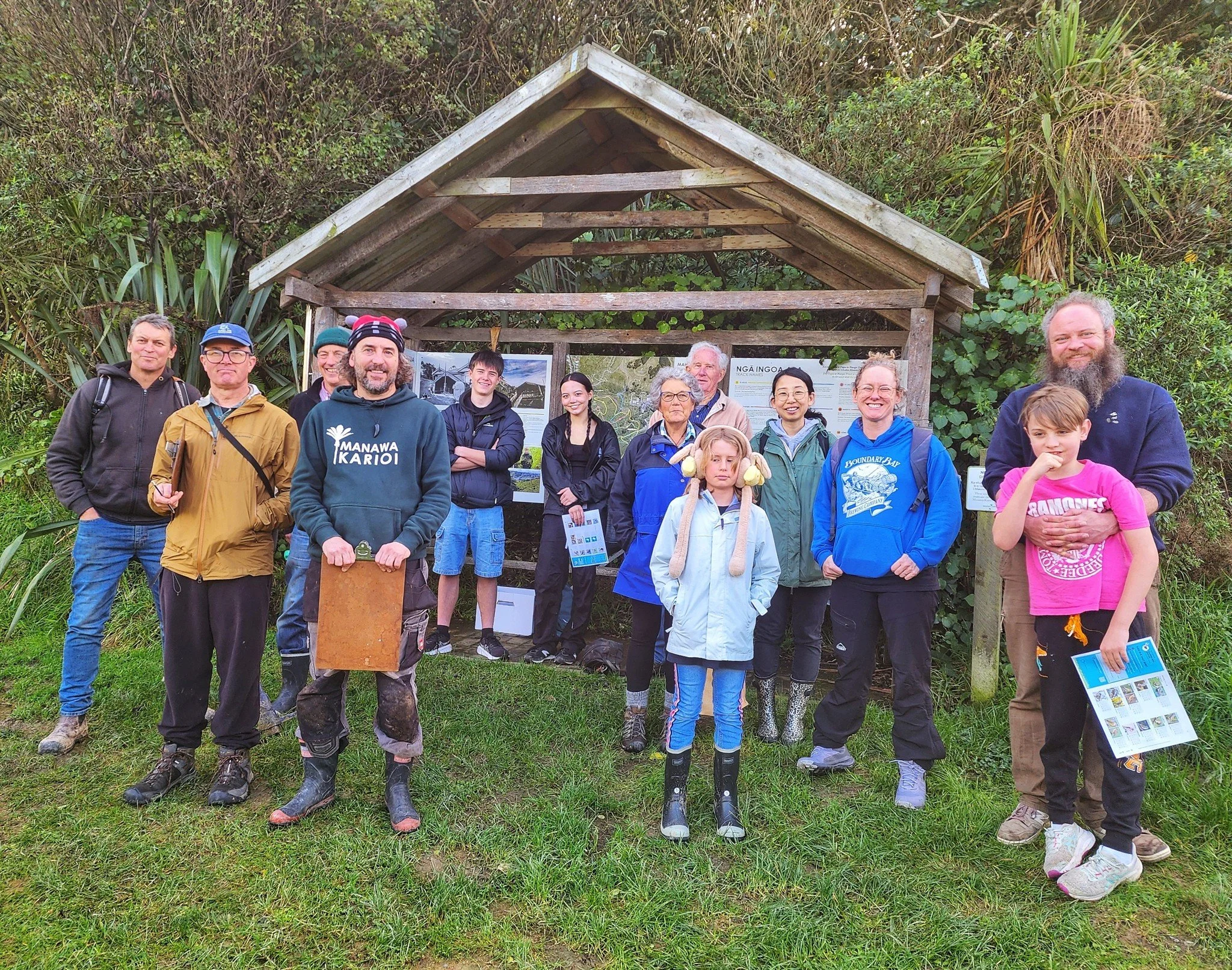
Key Findings: A Diverse and Familiar Avian Community
All survey sites showcased a wonderful diversity of birds, with 5 to 9 species recorded per hour and sightings ranging from 13 to 24. The horse paddock boasted the most sightings, followed closely by the top of the Paekawakawa Link Track. These more open sites provided clear views of high-flying species like gulls.
The good news is that there were no major surprises in the results – all species recorded are familiar to those who regularly visit Manawa Karioi. However, the detailed findings offer valuable insights into the types of species thriving in the reserve.
The most abundant species observed overall were:
Gulls (black-backed and red-billed)
Tauhou (silvereye)
Piwakawaka (fantail)
Blackbird
Tui
Notably, five out of these six most abundant species are native to New Zealand. This strongly suggests that our regenerating native bush is successfully attracting more native birds compared to typical garden environments. In fact, only native birds were spotted at the Nature Trail site, a testament to the maturing native bush there, even though it's close to open ground.
Adding Context: Trends from Previous Years
Three additional one-hour Bush Bird Survey counts between 2023 and 2025 provide further context to these recent findings.
A morning re-survey of the horse paddock site on Monday, June 30th, 2025 (when bird activity is often higher), revealed a greater number of species, including five not recorded the previous afternoon: kākā, pied shag, goldfinch, quail, and songthrush. Interestingly, the total count number for this re-survey was slightly lower.
An earlier winter 2024 morning count at the horse paddock showed similar diversity and count numbers to the 2025 morning count, also including kākā and pied shag, which were not seen on June 29th.
Finally, a winter 2023 morning count at the top of Union Road (another site) displayed similar diversity but a higher count number (32 sightings) compared to 2024 and 2025. This earlier count also included two species – eastern Rosella and starling – not observed in 2024 and 2025.
Detailed Bird Counts from June 2025
For those interested in the specifics, here's a summary of the bird counts at Manawa Karioi in June 2025:
These survey results reinforce the importance of our ongoing efforts to restore and maintain Manawa Karioi's native bush, providing a thriving habitat for our precious native birdlife. We look forward to continuing these surveys and observing the positive impact of our collective work.
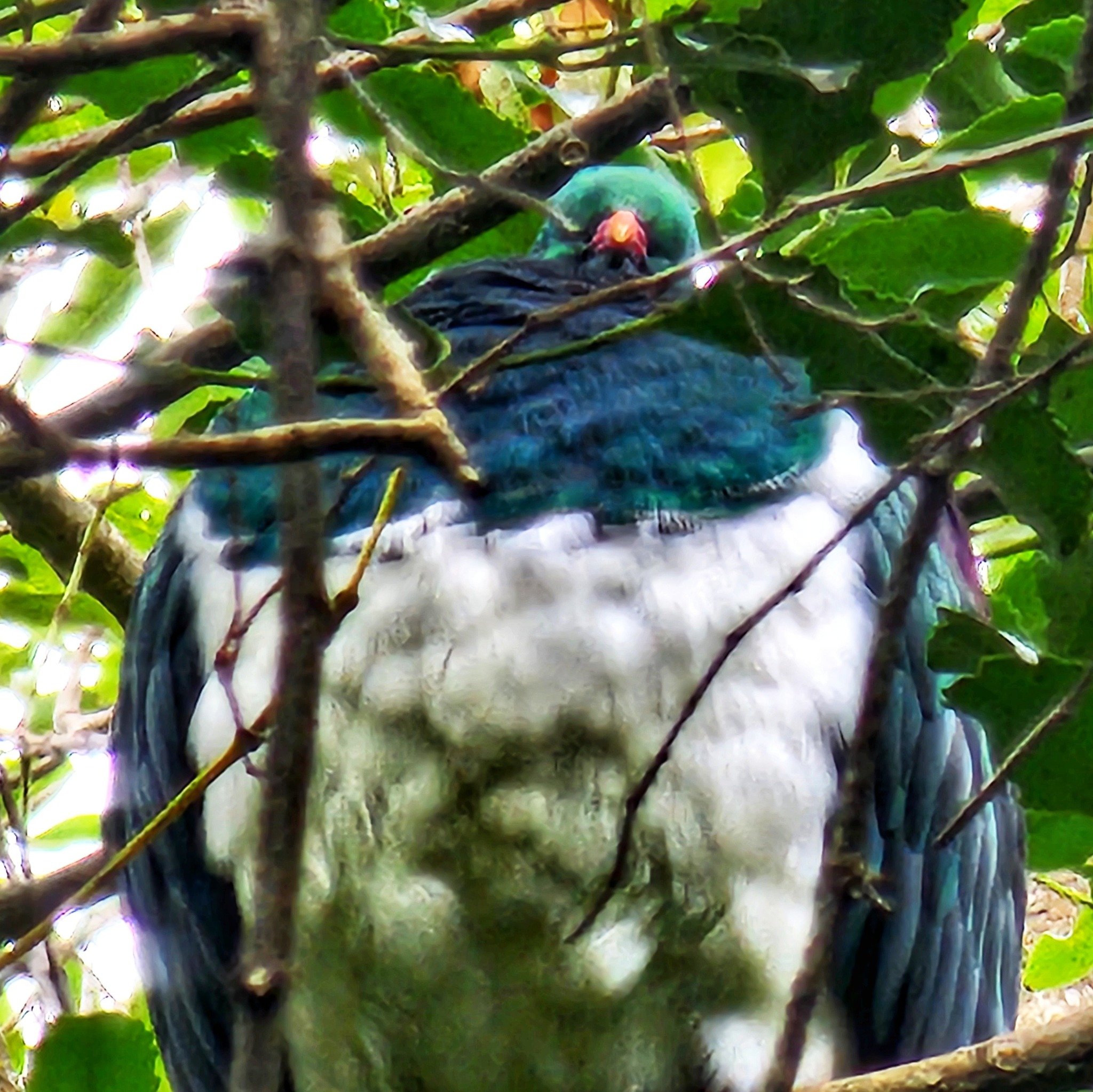
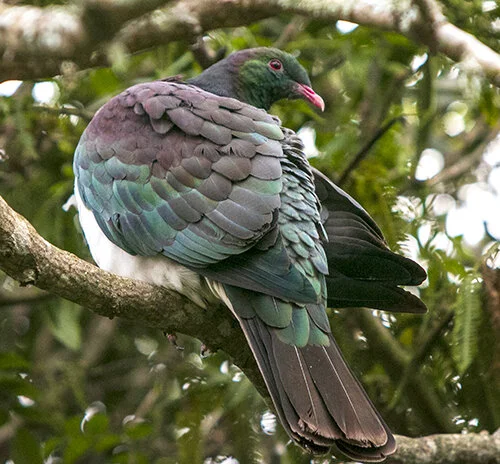
Kereru

Manawa Karioi Bush Bird Survey
Join us for a fun, family-friendly afternoon helping count manu as part of the NZ Garden Bird Survey, now in its 18th year! Together, we’ll build a picture of the birds living in and around Manawa Karioi.
Manawa Karioi Bush Bird Survey
Sunday 29 June, 1–3pm
Meet at: Main Info Board, Tapu te Ranga Marae carpark (Danube St entrance)
Bring: Warm clothes, sturdy shoes, drink/snack, survey sheet (if printed), pen/pencil, binoculars (if you have them)
Optional: Bird guide, printed map of sites, light camping chair
Join us for a fun, family-friendly afternoon helping count manu as part of the NZ Garden Bird Survey, now in its 18th year! Together, we’ll build a picture of the birds living in and around Manawa Karioi.
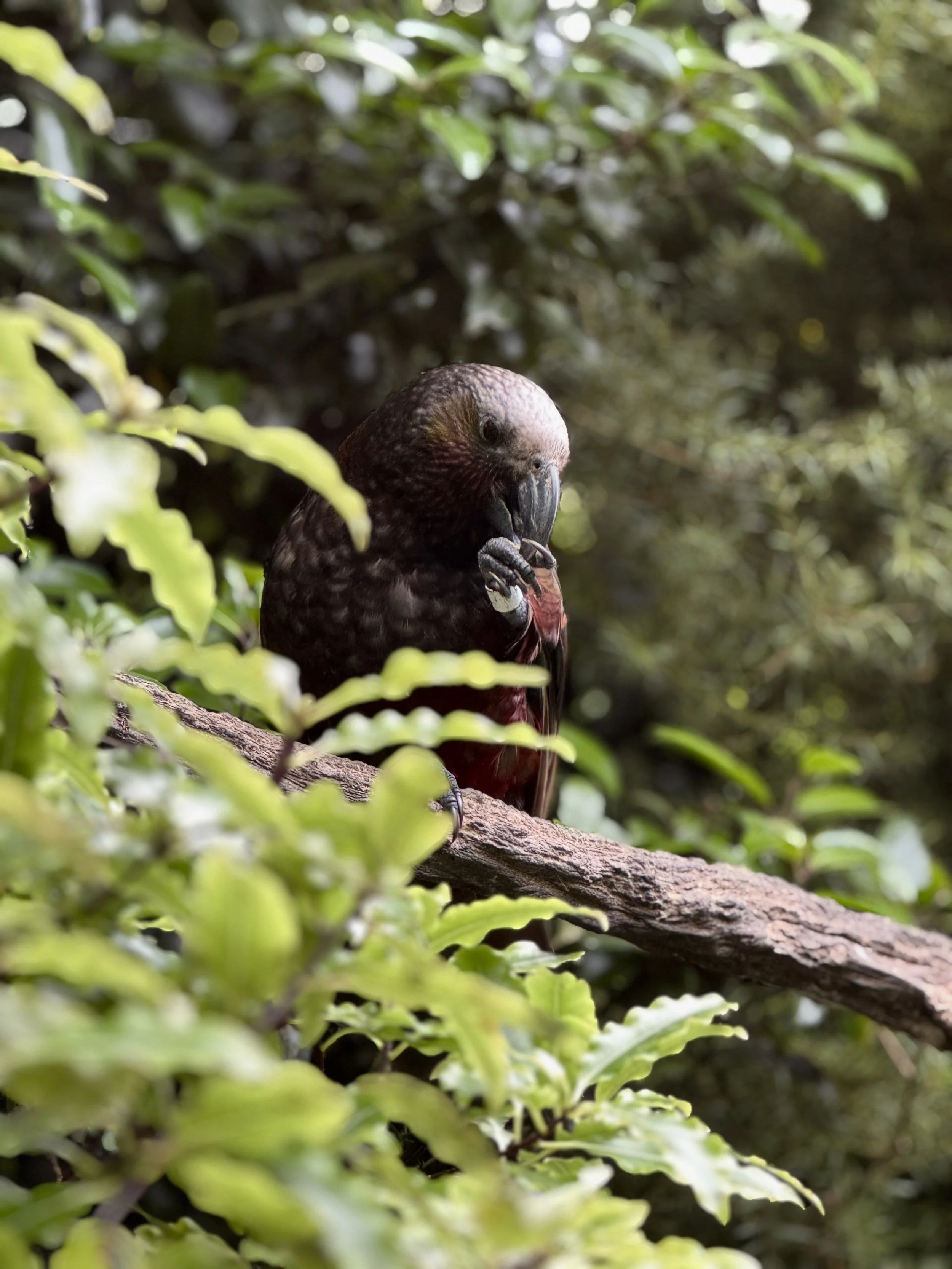
Kaka photographed at Zealandia near their feeding stations. Kaka visit Manawa Karioi on occasion.
Before Survey Day
Learn about the survey: gardenbirdsurvey.nz/results/report-2024
Download the survey form (2 pages, colour recommended): includes photos to help ID birds
Get familiar with likely birds: Tūī, Pīwakawaka (Fantail), Kererū, Kākā, Tauhou (Silvereye), Kāruhiruhi (Pied shag), and more
Check out the online survey site map: https://maps.app.goo.gl/qr3RtEPHMzimx2Du5
Choose a site that suits your group – from scenic hilltops to easy-access spots near the track entranceForm a group (up to 5) or turn up solo – all welcome!
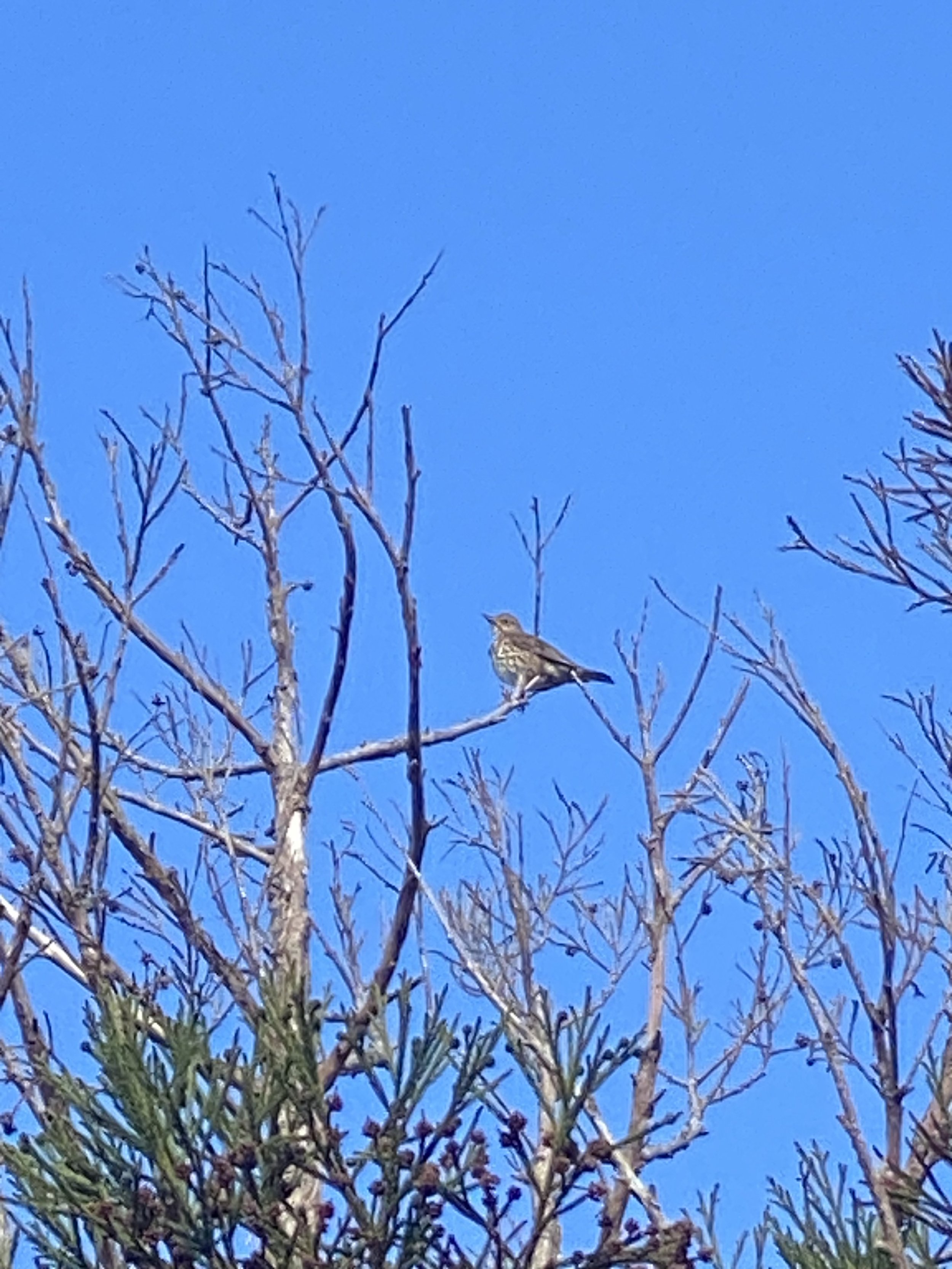
Pipiwharauroa spotted at Manawa Karioi
On the Day
Dress warm – you’ll be still for an hour
Meet at 1pm at the Danube St entrance/info board for site assignments, a short briefing, and help with the survey form
If heading to a top entrance (e.g. Quebec St) by car, please still check in at the info board first, then walk back up
Survey takes 1 hour + time to get to and from your site
Some sites are close by, others up to 20 mins walk
Return your results online or hand your tally sheet to a Kōmiti member after your count
Feeling energetic? Ross will have some harakeke ready to plant after!
Let’s enjoy the birds, the bush, and each other’s company. See you there!
Sealing Up The Edges of the Forest
Planting a forest is a fairly complicated process, but once you understand the stages, it's not too daunting.
Firstly, you can't just plant everything that you want in the forest all at once. You have to start off with a small range of trees and shrubs that can handle lots of sun, dry soil in summer, and wind. Especially in windy Wellington. These "pioneer species" can range from kohuhu, tarata, ngaio and akiraho through to totara, rata and rewarewa.
Once these trees get to 2+ metres in height, you need to start planting a wider range of species - things that need a bit of shelter. But also things that will eventually fill in the spaces below the canopy and above it. If you don't do this, the forest doesn't develop and can start to decline, especially if weed species become established.
It's especially important to do this on the edges of the future forest. As the canopy gets taller, the wind can get in through the edges. During severe storms as what we had this autumn, this can cause a lot of damage - breaking branches, uprooting trees and blasting leaves off. So everywhere we have a forest edge, we plant it densely with smaller trees and shrubs to keep the wind out. Key species here include wharangi, ramarama, karamu, matipo, tauhinu and korimiko.
Our track sides are the most common forest edge at Manawa Karioi, a community-led ecological restoration project in Wellington. While the canopy will eventually close over the track, this can take about two decades. Until then it's vulnerable to storms and weed infestations.
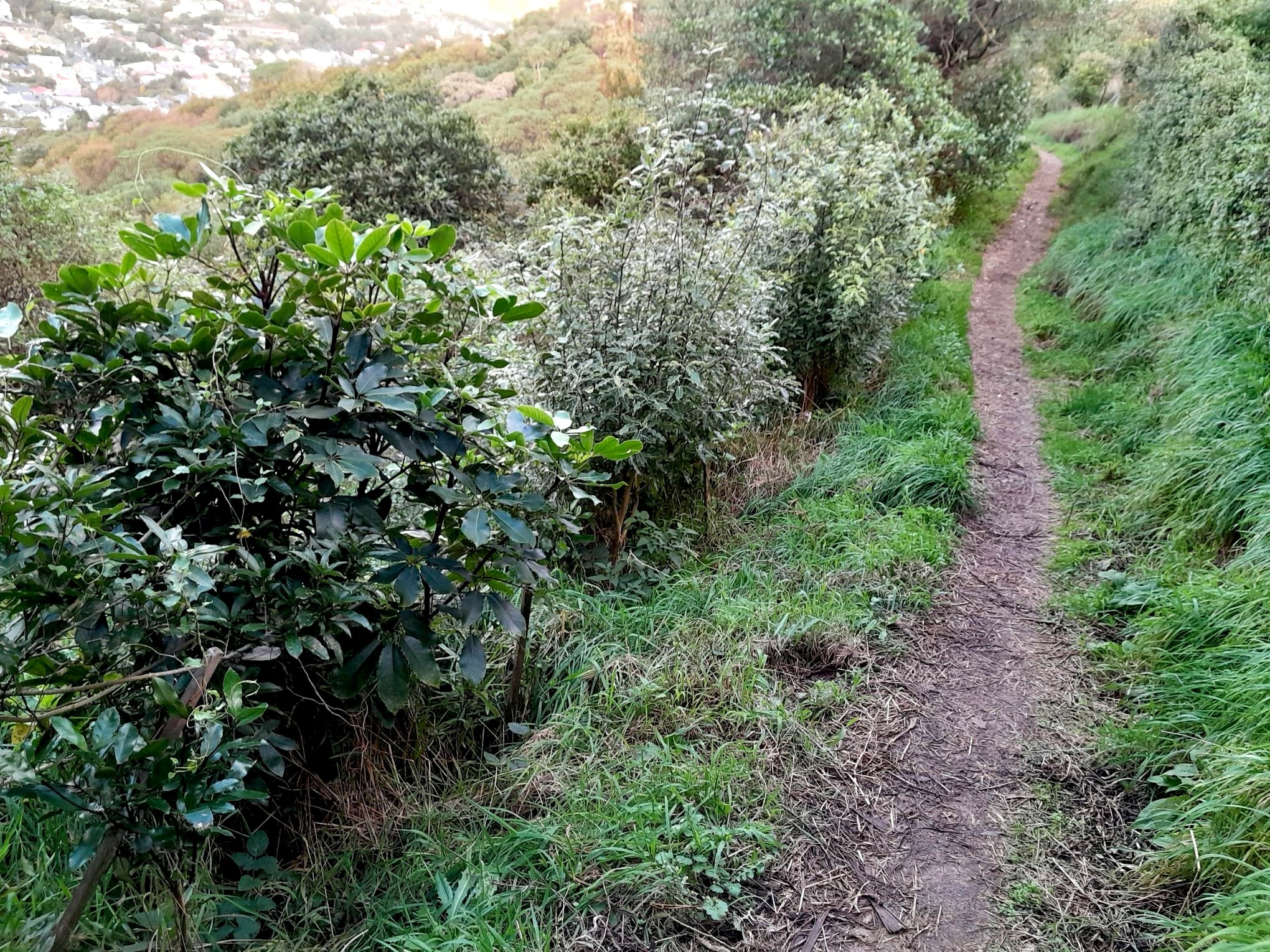
We've almost completed this planting task along Te Ahi Kaa, the 2 kilometer loop track, and have spent the last few years focusing on Moemoea track. The plantings we did on the southern end of Moemoea about 5 years ago have now grown into a dense hedge of about 20 different species. This year we will focus on the mid section of Moemoea, around where the track intersects with Te Uma I Mokotia. There are several advantages to planting a wide range range of species on forest edges. An obvious one is that if one or more species don't handle the conditions (salt-laden wind, low soil fertility etc) then you don't get canopy collapse if too many plants die off. If there is die-off, then the more suitable species will "fill the gaps".
Another reason is plant disease and pests. Putting lots of one or two species together makes it easier for pests and diseases to become established. This does occur in nature - a disease decimated a huge amount of the wharariki (mountain flax) growing on the rocky slopes on the south coast of Pōneke in the 2010s. This left large bare patches, which can potentially fill up with weed species. But fortunately there are a lot of mingimingi and hebe species in the area which will fill the empty spaces.
We only planted small patches of wharariki, and none were affected.
Lastly, make sure you plant in the right locations. Tauhinu has proved to be a valuable species on the driest upper slopes and lookout points at Manawa Karioi, where it is hard to establish much else. It's one of the most common species that are naturally establishing on the upper slopes of former farmland along the Skyline Walkway west of the Pōneke CBD. But it needs full sun, so if planted on the south side of established trees, it will quickly die.
We will also be working along the upper half of Koiwi Tohora. Like Moemoea, it's relatively sheltered from the southerly storms, but cops the northerly winds year-round.
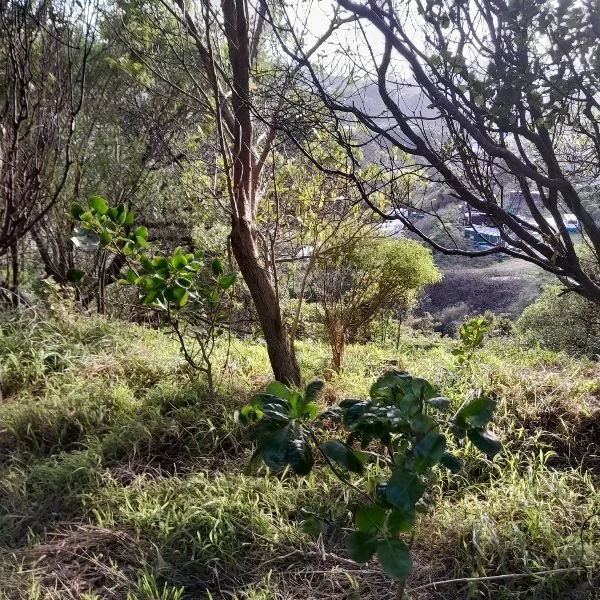
A view of the intersection of Te Ahi Kaa and Koiwi Tohora. The taller trees are a mix of ngaio, tarata and kohuhu. Some underplanting has been done in recent years, but not enough. Everything risks wind damage if more underplanting isn't done.
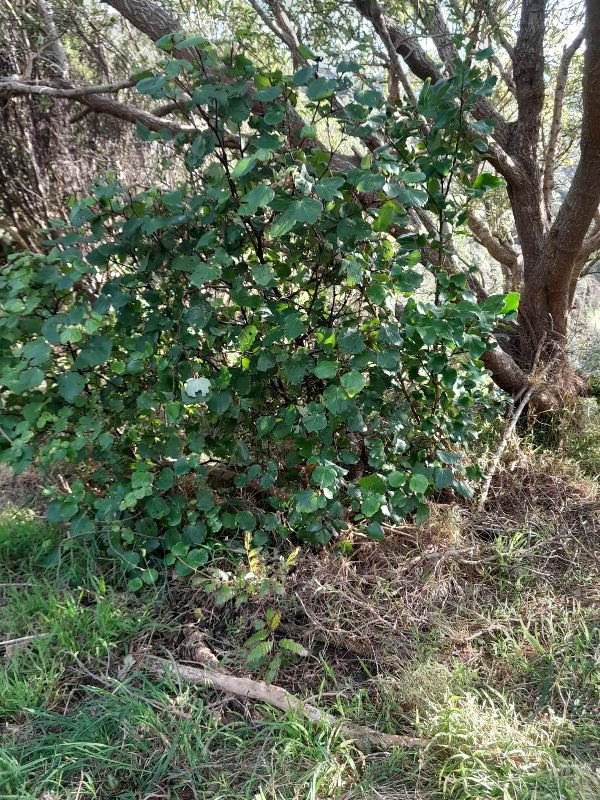
Another view of the same area. There are several kawakawa that were planted on the south side of existing trees. They have thrived as they are protected from direct sun and wind.
Written by Ross Gardiner.
At Manawa Karioi, our goal is to restore a thriving native forest ecosystem—one that supports biodiversity, protects against erosion, and revives the cultural and ecological heritage of this whenua. The planning and planting is carried out by committee members and a dedicated group of volunteers who work together to shape a resilient, self-sustaining forest for future generations.
If you’d like to support the restoration of native forest at Manawa Karioi, there are plenty of ways to get involved. We’re always looking for volunteers to help with planting, weeding, and track maintenance—no experience needed.
You can also support us by spreading the word or donating to our project via Givealittle: givealittle.co.nz/org/manawakarioiproject. Every bit of support helps this forest grow stronger for future generations.
Glossary of Native Plant Species
Akiraho (Olearia paniculata) – Also known as golden akeake, a hardy shrub with wavy, yellow-green leaves, often used in shelter planting.
Karamū (Coprosma robusta) – A fast-growing shrub with glossy leaves and orange-red berries, important for birds; also known as shiny coprosma.
Kōhūhū (Pittosporum tenuifolium) – Known as black matipo, this small tree has dark foliage and thrives in dry, windy conditions.
Koromiko / Korimiko (Hebe stricta and related species) – A shrub with spiked white to pale purple flowers; commonly called native hebe.
Matipo / Māpou (Myrsine australis) – A small tree with reddish stems and leathery leaves; commonly referred to as matipo.
Ngaio (Myoporum laetum) – A fast-growing coastal tree, sometimes called the mousehole tree, with distinctive notched leaves.
Ramarama (Lophomyrtus bullata) – A small tree with blistered, dark green to purple leaves, valued for its dense form.
Rātā (Metrosideros spp.) – Canopy trees known for their brilliant red flowers; includes northern and southern rātā.
Rewarewa (Knightia excelsa) – Also known as the New Zealand honeysuckle, this tall tree has striking red flowers and toothed leaves.
Tarata (Pittosporum eugenioides) – Known as lemonwood, a fragrant tree with lime-coloured leaves and wavy edges.
Tauhinu (Ozothamnus leptophyllus) – A silver-grey shrub, also called cottonwood, that tolerates wind and dry conditions well.
Tōtara (Podocarpus totara) – A slow-growing but long-lived tree with needle-like leaves and valued timber; iconic in Aotearoa’s native forests.
Wharangi (Melicope ternata) – A shiny-leaved coastal shrub, sometimes referred to as three-leaved melicope, though often known simply by its Māori name.
A Special Working Bee – Garden Bird Survey at Manawa Karioi
Sunday 29 June, 1pm–3pm
June’s last Working Bee will be a little different – instead of our usual planting and track maintenance, we’ll be turning our eyes and ears to the sky!
Manawa Karioi is taking part in the New Zealand Garden Bird Survey, a nationwide project that helps track bird populations across Aotearoa. By using our volunteer power, we’ll be able to get a detailed snapshot of the birds living in and around Manawa Karioi.
How it works:
You’ll work in small groups of 3–5 people (great for whānau or friends).
Spend 1 hour observing and recording all birds you see or hear (native and introduced) from a fixed location.
We’ll provide tally sheets and instructions, and a Komiti member will help submit results online afterwards.
With enough volunteers, we aim to cover all of Manawa Karioi, and parts of nearby bush and open areas (Paekawakawa, Tawatawa, City to Sea Walkway).
Before the day, we’ll mark suitable counting sites and share more details. No need to register – just turn up!
Meet at the Te Ahi Kā notice board at 1pm
We'll brief you, organise groups, and send you off to your bird count spots.
Want a head start? Check out the bird ID guide on the NZ Garden Bird Survey website. Some of the birds you’re likely to spot include:
Karoro / Black-backed gull (native)
House sparrow (introduced)
Tauhou / Silvereye, Pīwakawaka / Fantail, Tūī, Kererū, Kākā (all native)
Starling, Eastern rosella (introduced)
Kāruhiruhi / Pied shag (native)
Let’s listen, watch, and help build a picture of our birdlife together.
See you on Sunday 29 June!

20 years (on and off) with Manawa Karioi
Written by Vanessa Patea
When I first moved to Wellington at the start of the millennium, I discovered nestled in the hills of Island Bay, an improbable wooden building called Tapu Te Ranga Marae. Rising up behind it was what seemed like a sprawling, and equally ambitious urban/māori restoration project that was already 10 years old - Manawa Karioi.
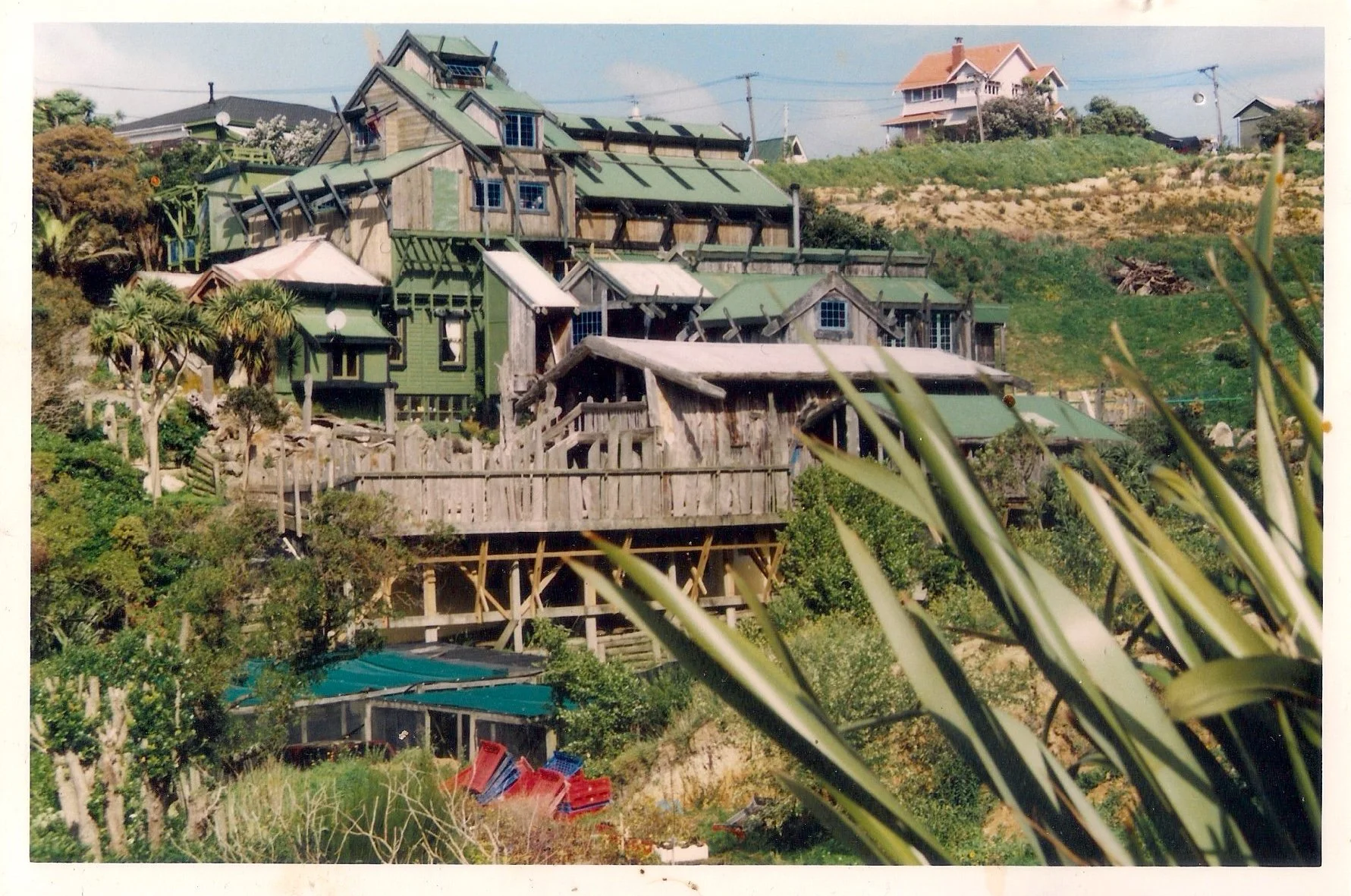
My earliest photo of Tapu te Ranga Marae, taken around the year 2000. See the nursery in the foreground.
I didn’t know then, but I was about to get into a long-lasting and ethically non-monogamous relationship with trees, birds and this patch of land in Island Bay hills.
We’ve been in an on-again, off-again relationship for almost a quarter of a century. It’s been full of tree hugging, spontaneous reforestation dates, and some long distance longing (when I travelled to distant shores). But somehow, I found my way back. Let me tell you the story.
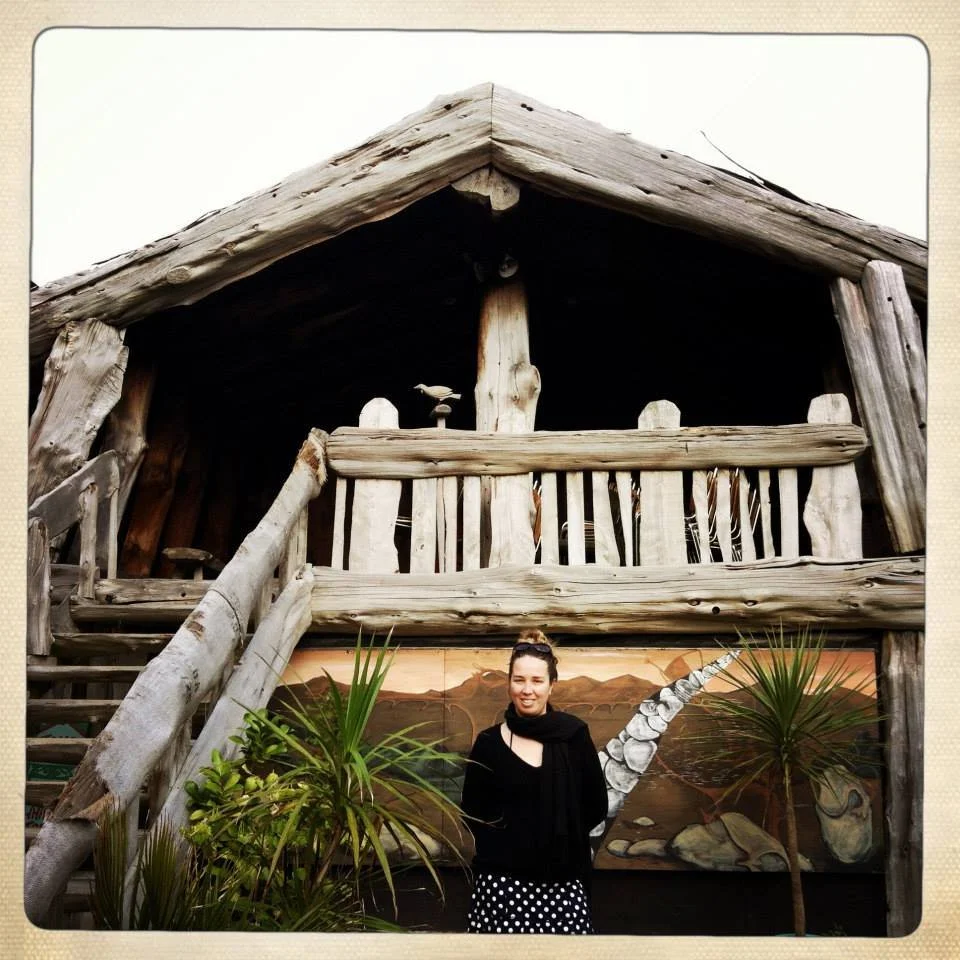
Me in front of Tane Whai Ora - Bruce asked me to adorn this original whare with Māori rock art motifs in 2003/2004.
I was new to the city, hanging around the marae—doing dishes, chatting with Matua Bruce, and working on an art installation in Tāne Whai Ora.
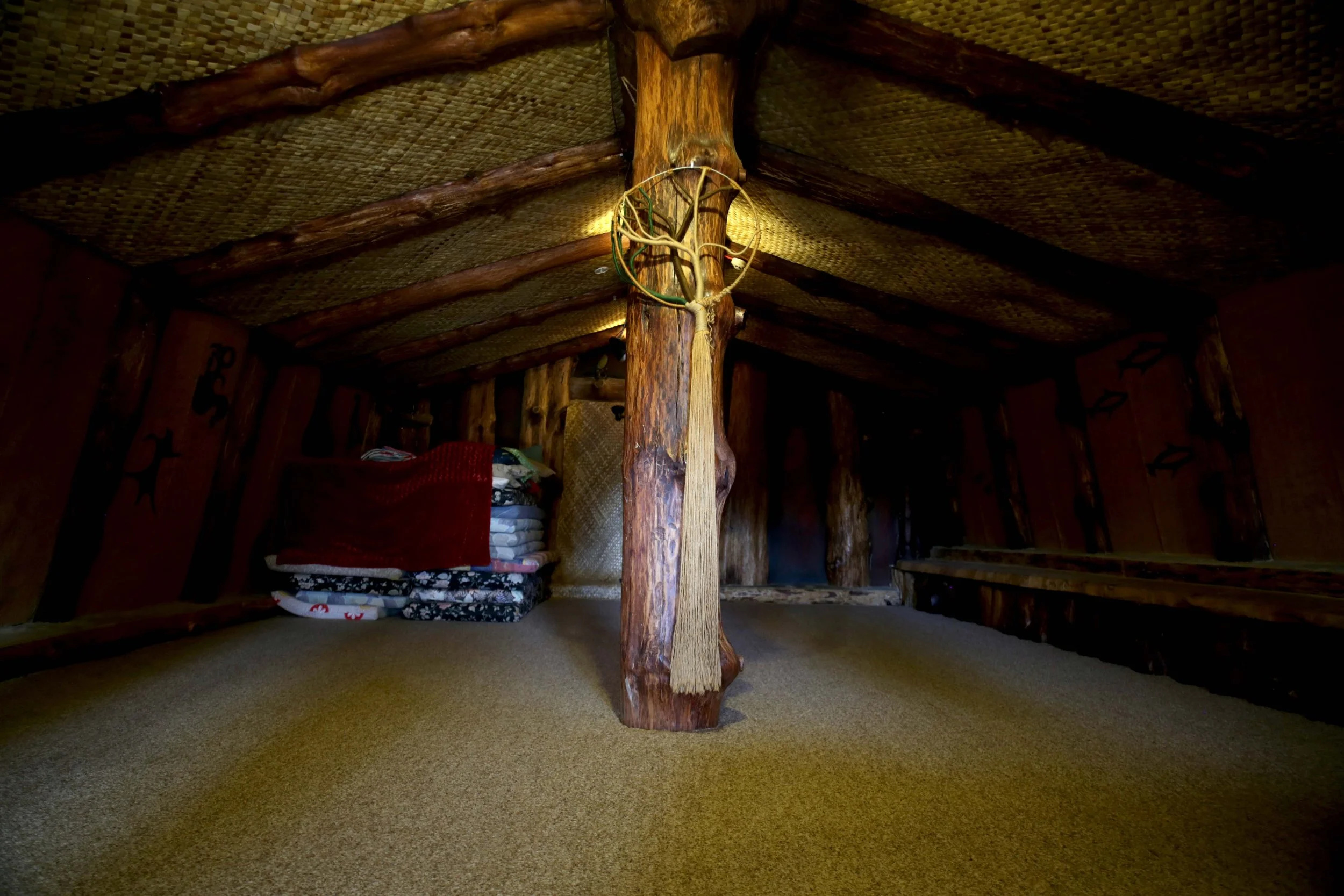
Interior: Tane Whai Ora
I have hazy memories of the restoration project back then: a bit of tree planting, some artwork here and there. The details are fuzzy, but I like to imagine how tall those trees are now, two decades on.
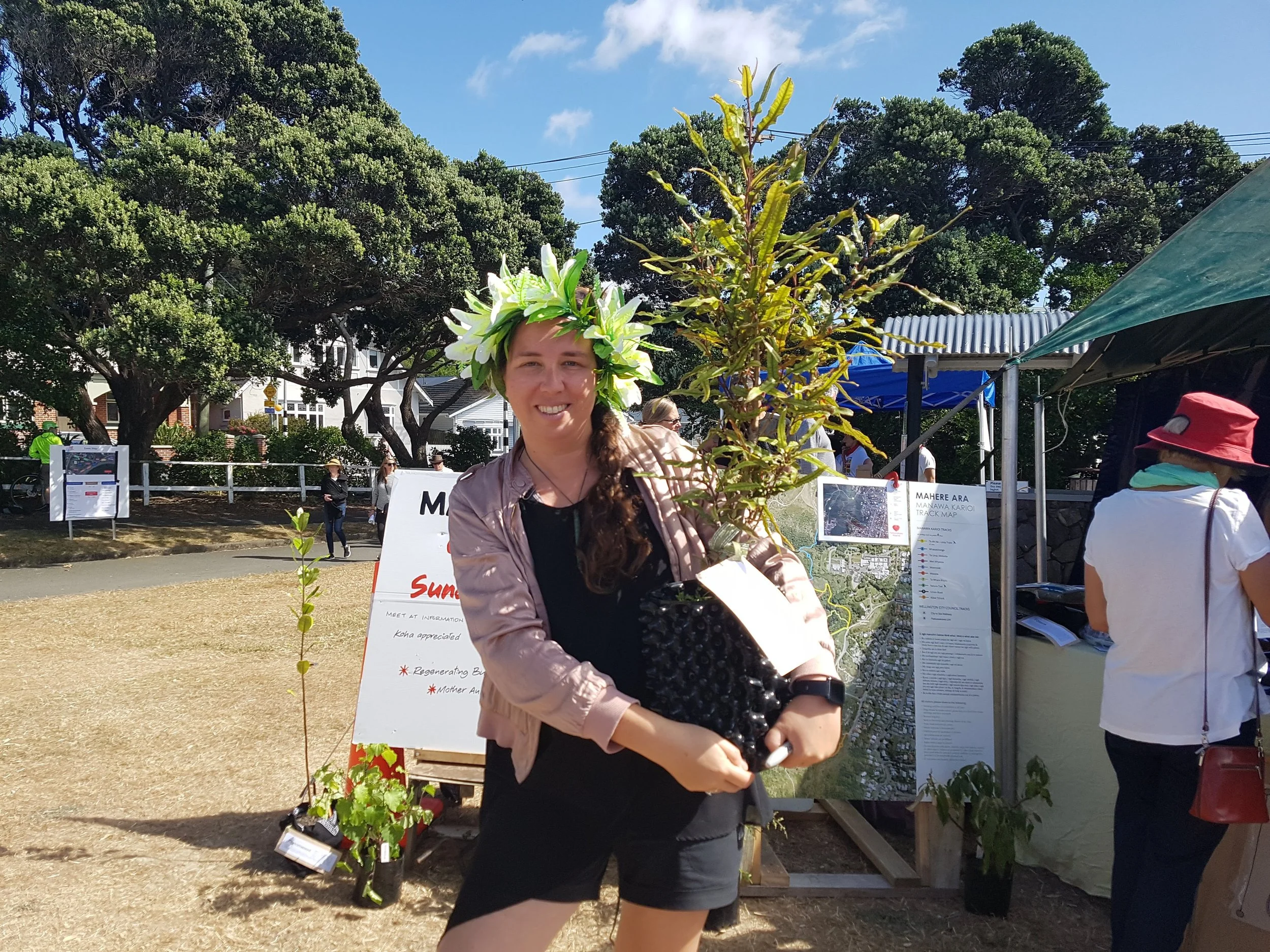
Volunteering with the Southern Bays restoration groups at the Island Bay Festival in Wellington.
About nine years ago, invited by Peter Russell I joined the kōmiti. It was time to commit. I had gathered experience in media, communications, and storytelling—and I realised those skills could be of service to this project. I brought my camera, comms skills, and a desire to document the story of Manawa Karioi.
I found new ways to contribute to the project. I led the refresh of our branding and online presence—logo, website, socials, newsletter, and more recently a WhatsApp members group to keep the community connected.
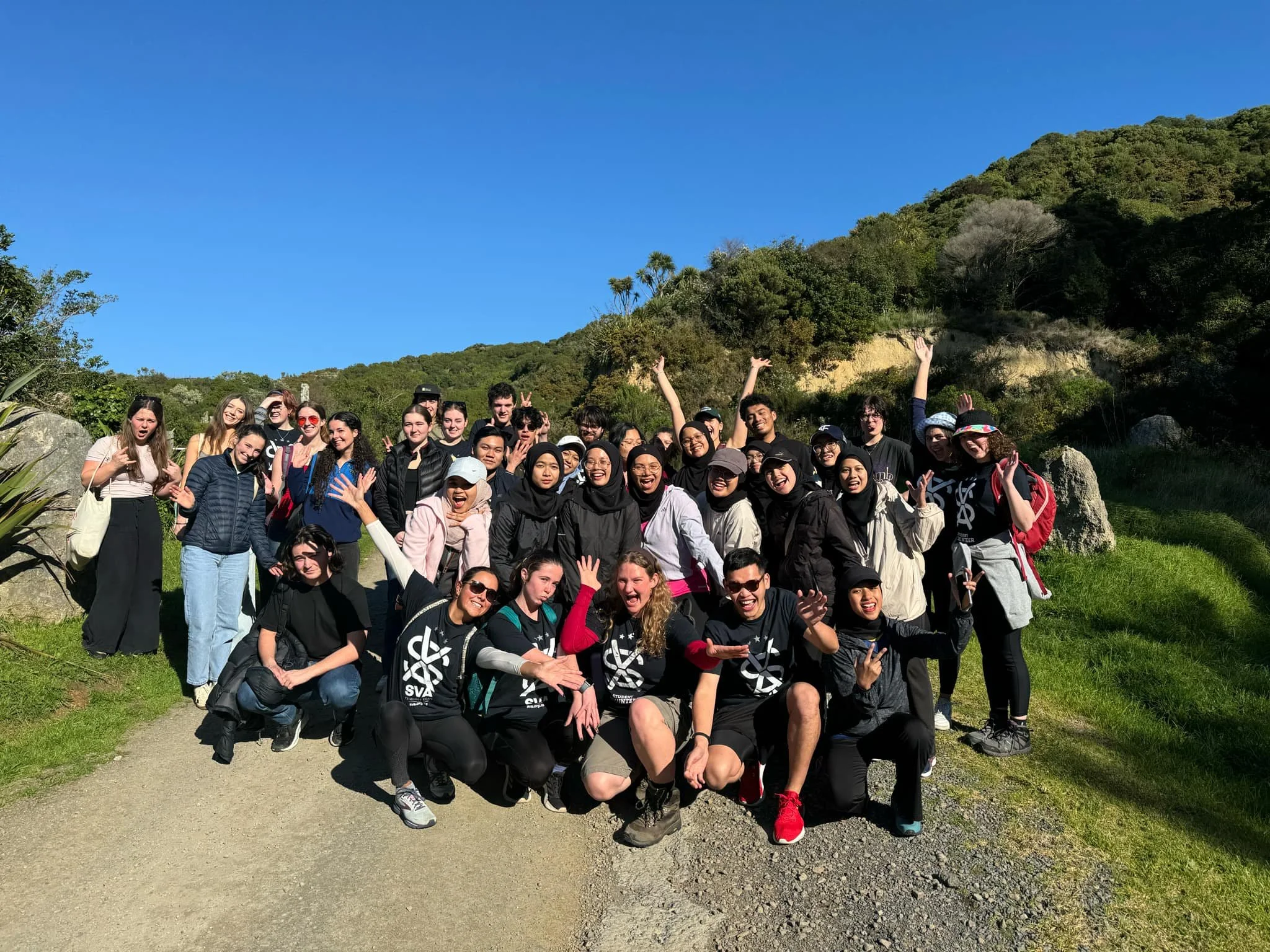
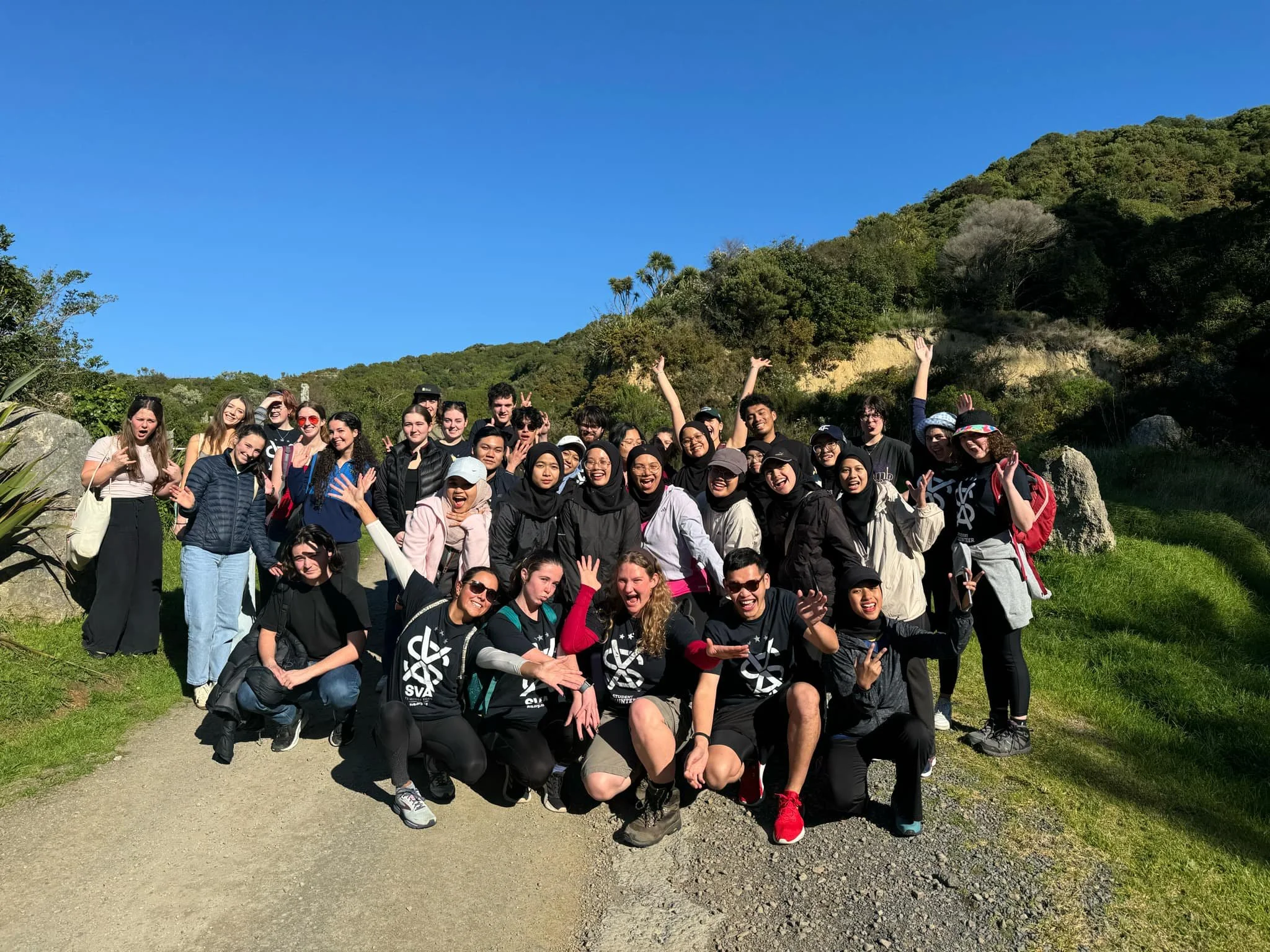
The Student Volunteer Army showed up to work on the hill!
Over time, we started to notice a shift. Working bees were packed. Community, corporate and research groups were contacting us. Lockdown turned the tracks into a local pilgrimage site. People were tuning in to the Manawa Karioi story—the story of Manawa Karioi was reaching further.
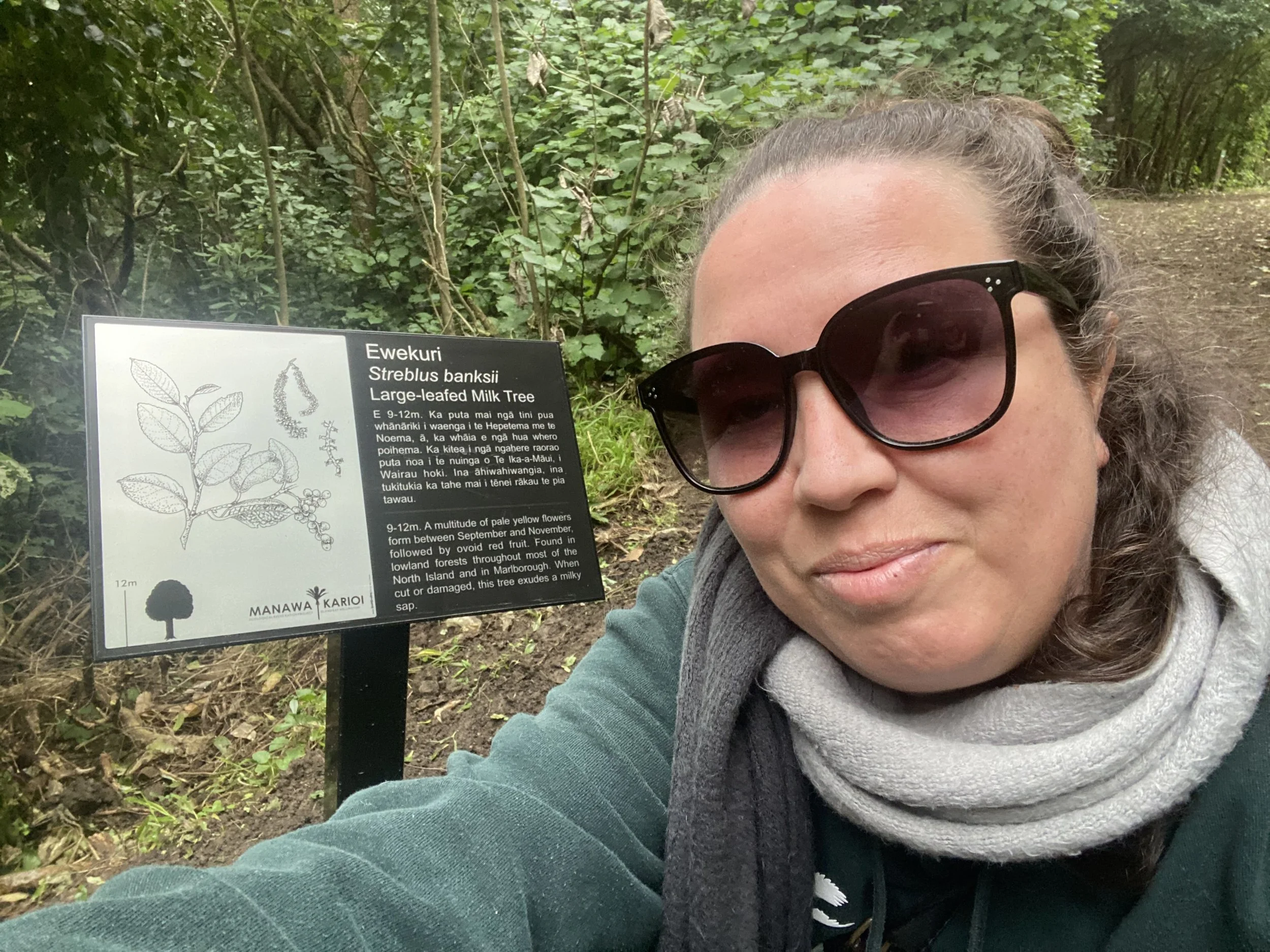
Reo Rua Signage on the Nature Trail.
One of my proudest moments was wrangling the reo rua signage into existence—finally helping people find their way without getting lost in the bush! We hustled some funding, got a nature trail built, and we threw a bit of an opening event to celebrate.
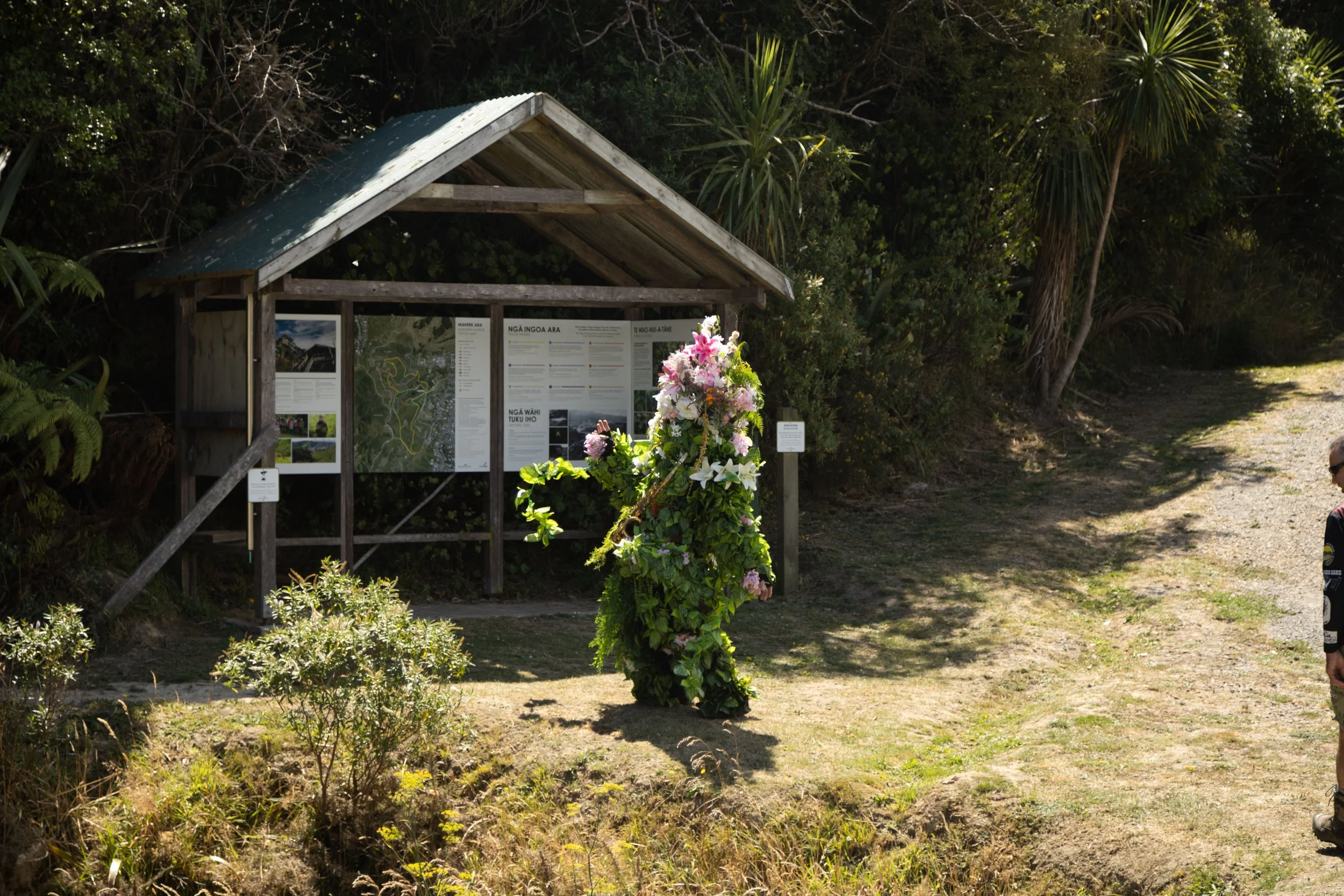
‘Woody’ entertains the community at the Nature Trail Opening event.
These days, I’m still in it. I show up to working bees—sometimes with a spade, often with a camera. I believe in documenting the journey, because these moments matter. Sharing them helps others see the magic of Manawa Karioi and feel invited into the story.
My connection to Tapu Te Ranga Marae has remained strong over the years, and I’m proud to have made a documentary that features the marae with a small cameo of Manawa Karioi. You can watch it here.
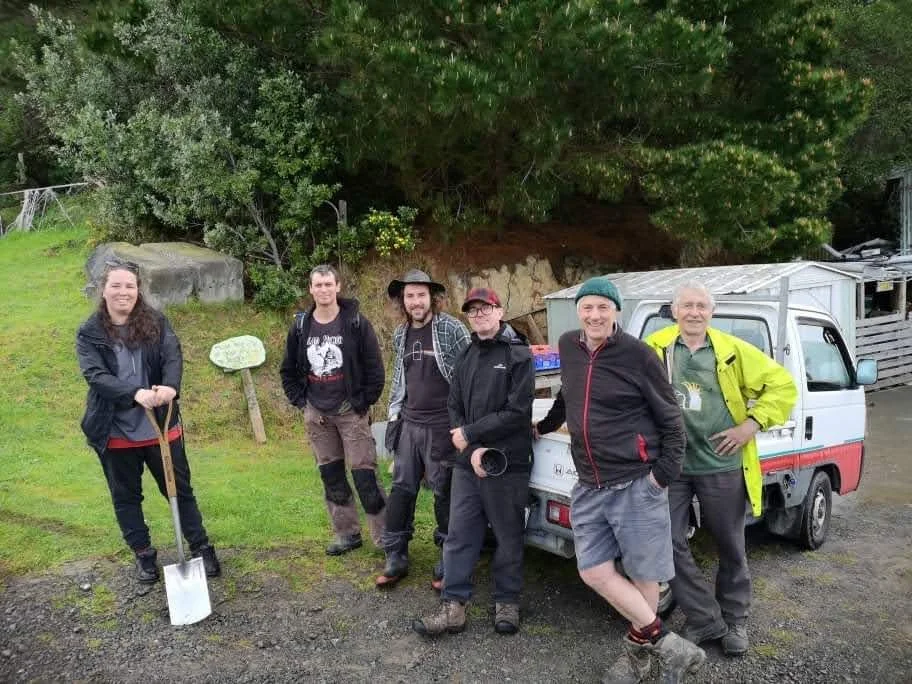
Some the kōmiti after a working bee.
My journey with Manawa Karioi hasn’t followed a straight path but has led to some surprising outcomes. We’ve drifted and come back - Manawa Karioi and I? We’re in it for the long haul!
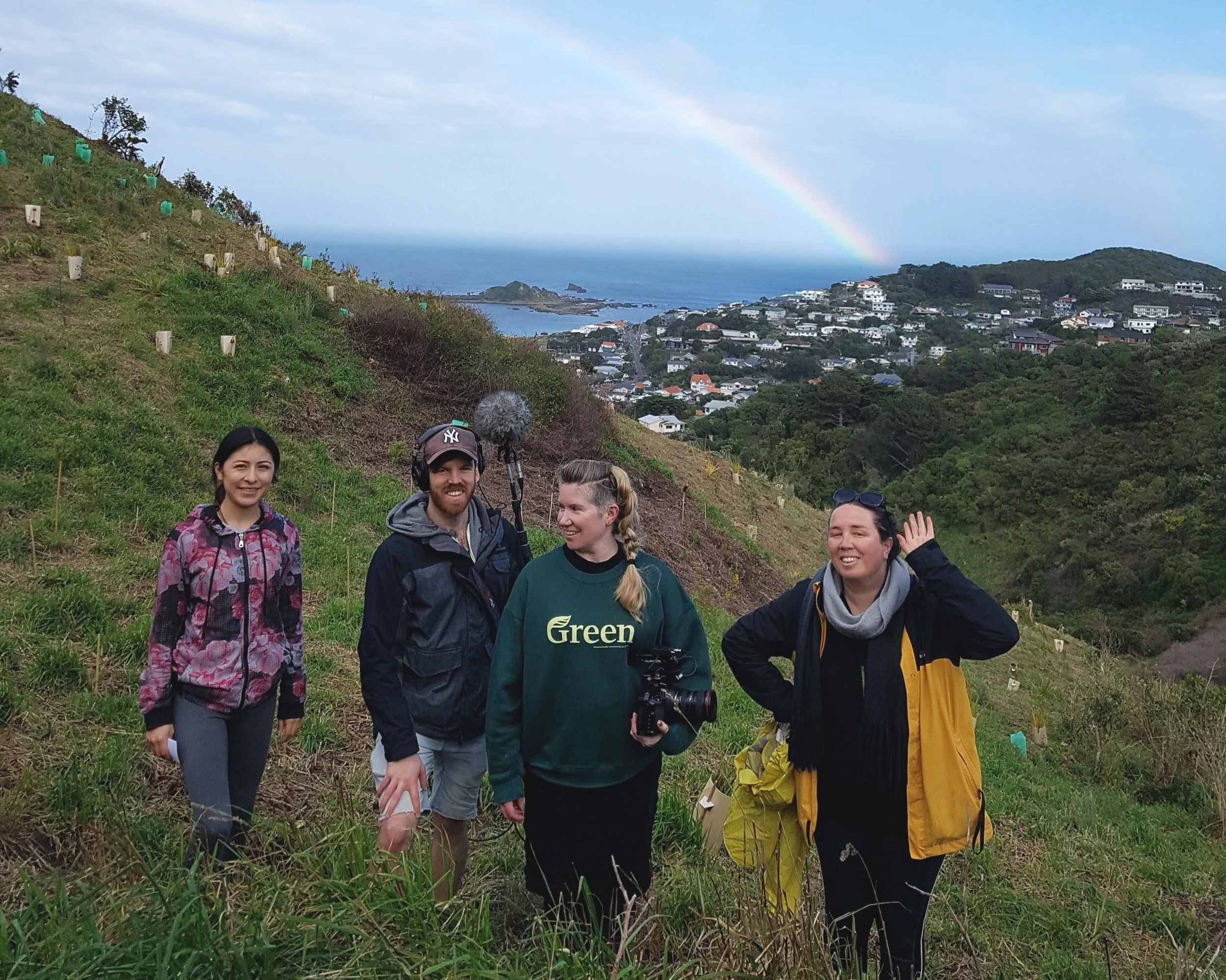
Filming a documentary about Manawa Karioi with the crew.
After the Storm: New Life on the Slopes of Manawa Karioi
The big storm that rolled into Wellington in early May caused minor damage at Manawa Karioi. One small ngaio was blown over and a few branches broken on other trees, and some trees have suffered from salt-burn.
Things could have been worse, but fortunately the stand of pine trees along the ridge above the marae carpark were removed a couple of months ago. The pines had been suffering storm damage for years, and were becoming hazardous.
In the process of being felled, a number of them fell onto the slope above the Nature Trail. This resulted in a number of native trees being damaged or even flattened in the process.
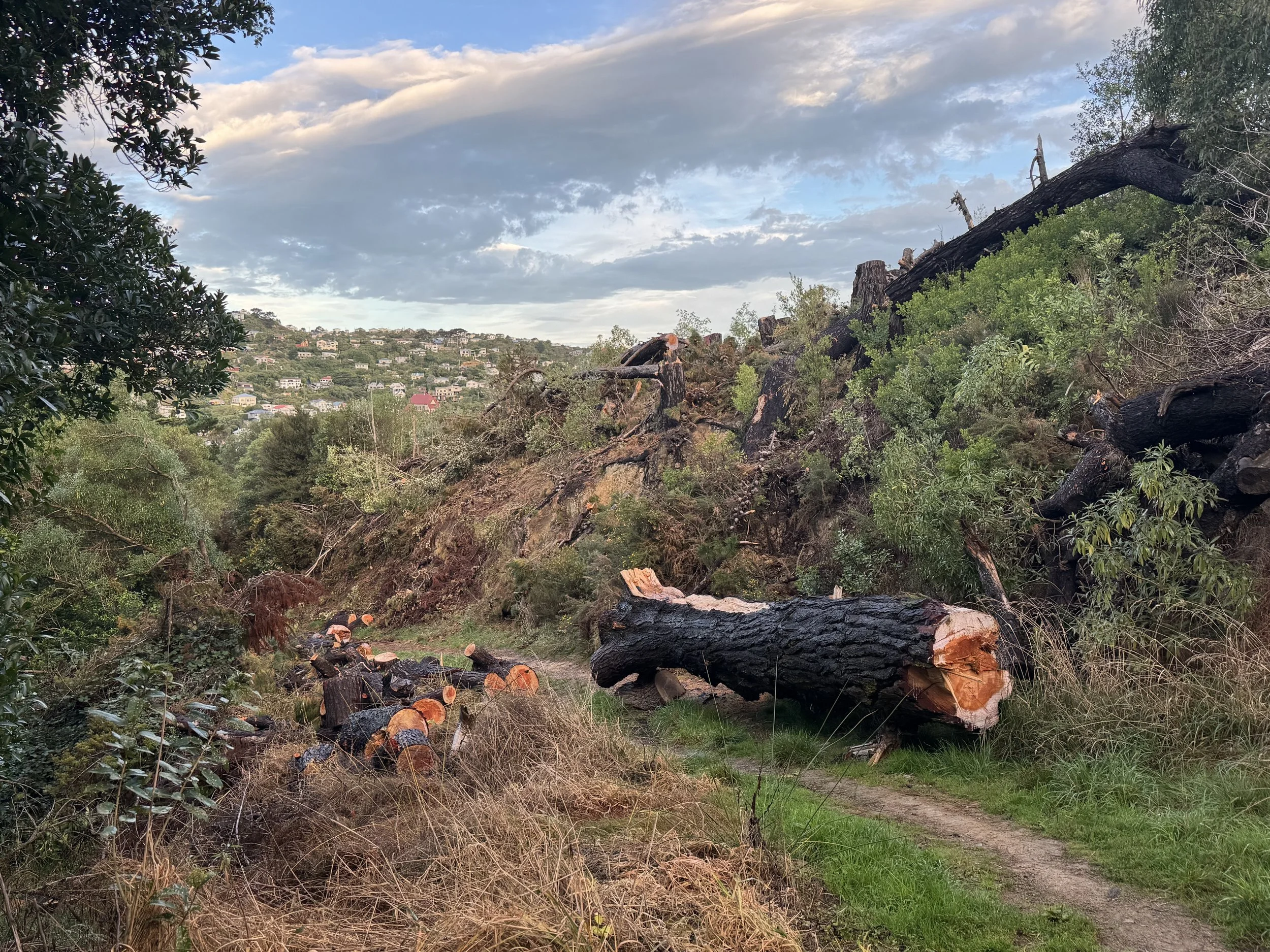
But every cloud has a silver lining. The felling of the pines means that the soil will no longer be acidified - you may have noticed that very little grows under pine trees. And pine trees also draw a lot of moisture from the soil, severely limiting what else can grow. With the pines gone, the 30 years of native tree seeds that have accumulated on the slope will begin to germinate, quickly filling in the gaps that have been created.
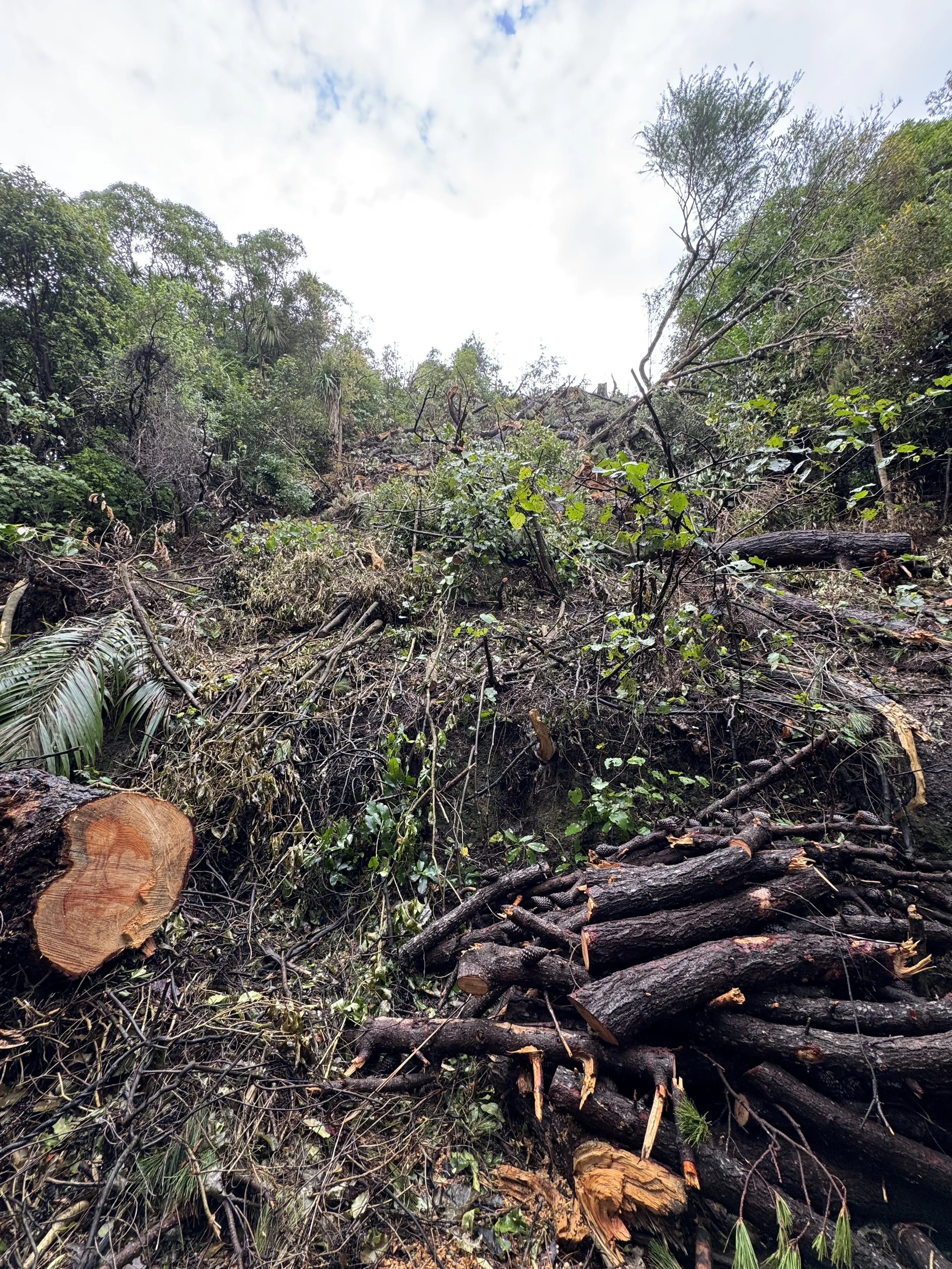
The gaps also give us the opportunity to fill the area with podocarps like kahikatea, matai and miro on the lower slope, which is shaded and holds soil moisture longer into the summer.
The upper slope will provide the opportunity to plant a large stand of titoki.
Other areas we will be focusing on this season include the mid section of Moemoea, the mid section of Te Uma i Mokotia and the upper length of Koiwi Tohora. These all will involve lots of titoki. We have about 140 titoki that were grown for us, most of which are ready to plant this year.
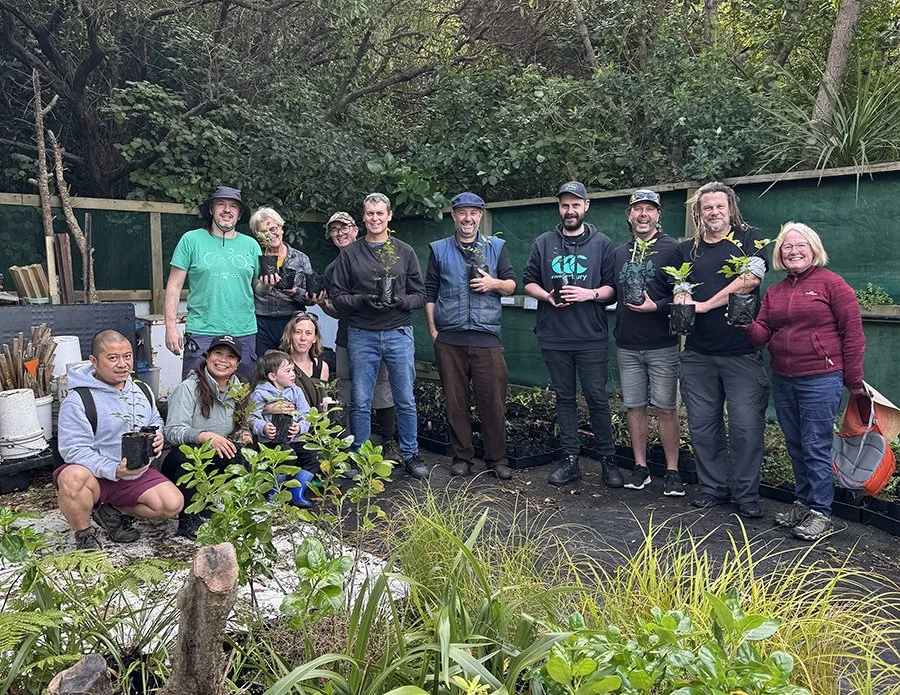
Potting up working bee of Manawa Karioi seedlings at SEA / Tawatawa Nursery.
Titoki (Alectron excelsus)
Titoki grows to about 10m high, and is quite common throughout Te Ika A Maui. It often forms the forest canopy on north-facing slopes, growing in association with rewarewa. Not many stands of titoki/rewarewa forest remain within Poneke, but there is an impressive remnant at the canopy walkway at Otari. We have planted over 100 rewarewa at Manawa Karioi, but until now we have had trouble obtaining titoki.
Titoki has small flowers, with male and female flowers being found on separate trees. Flowering occurs from spring to early summer, with the fruit capsule taking a year to mature. It then splits open to reveal one large shiny black seed that is covered with bright red, fleshy fruit. Trees can become loaded with fruit, which is targeted by birds like tui, who swallow the seed whole, thus dispersing it when they fly away.
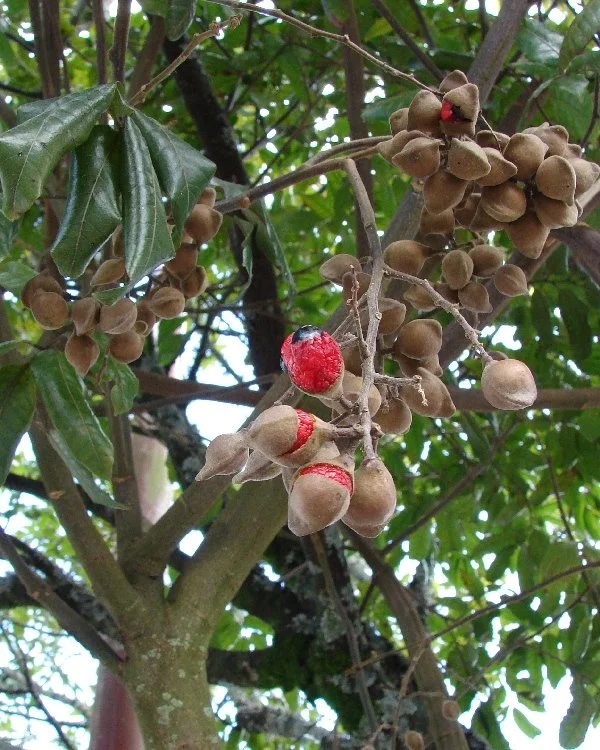
Titoki - Alectryon excelsus (fruit, seeds) Photo by Tatiana Gerus, Татьяна Герус. Attribution: https://www.flickr.com/photos/tgerus/5032544657
Post written by Ross Gardiner
From Risk to Resilience: Suncorp Steps Up
In recent years a group of over 20 old pine trees at Manawa Karioi were beginning to show signs of collapse and both the Tapu-Te-Ranga Trust and the Manawa Karioi Society had become concerned about the risk that these trees posed to people visiting Manawa Karioi. It was decided that to ensure the safety of visitors and volunteer workers the old pine trees should be felled.
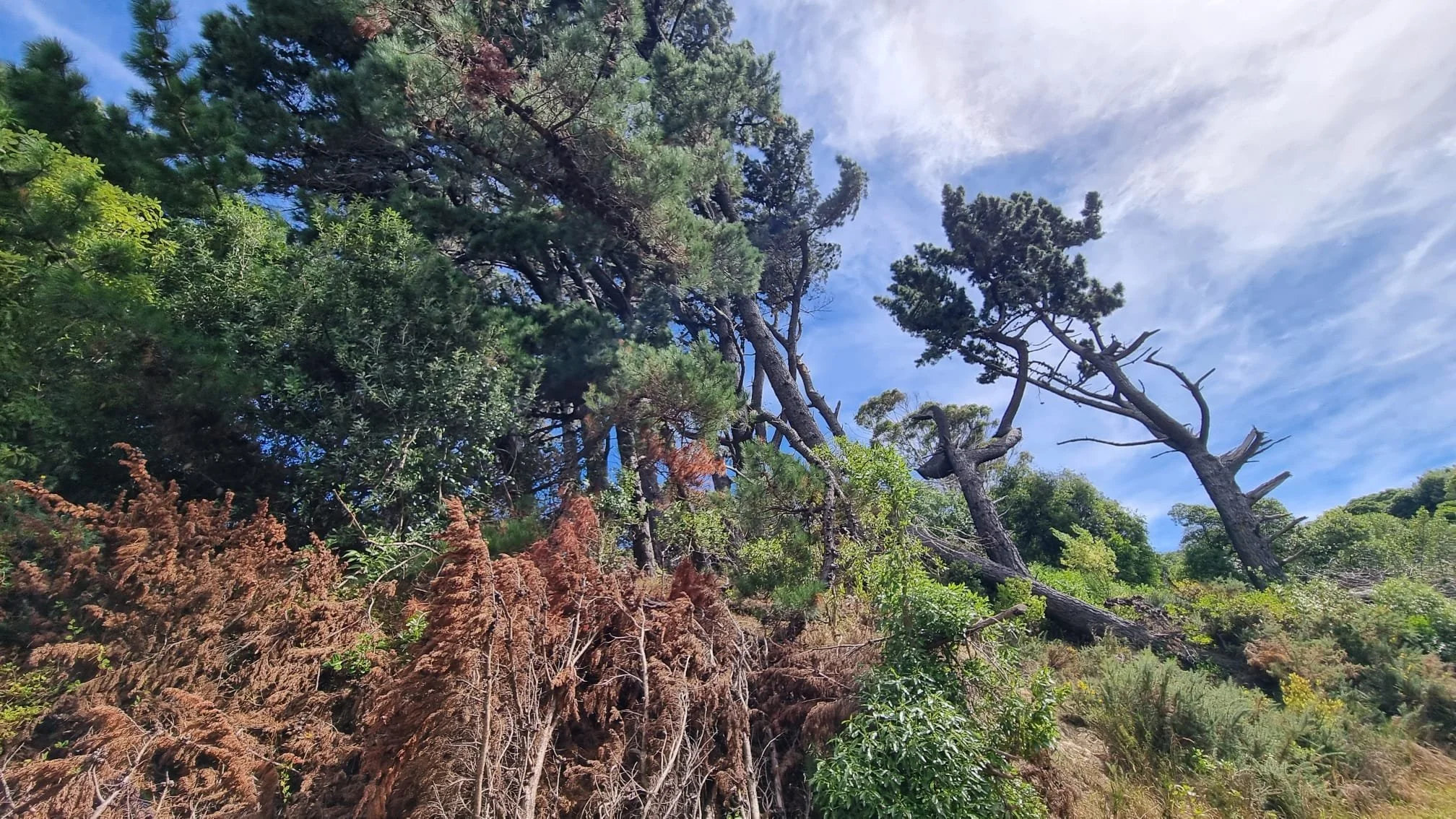
In March 2025, arborist Richard McIntosh, with assistants Morgan and Niki, set about the job. The first day was spent working on the trees in preparation for felling – judging how and where each tree would fall and cutting branches to ensure that when the trees fell they would not get hung up in other trees and would not end up resting on their own branches suspended above the ground and a danger to anyone working near them.
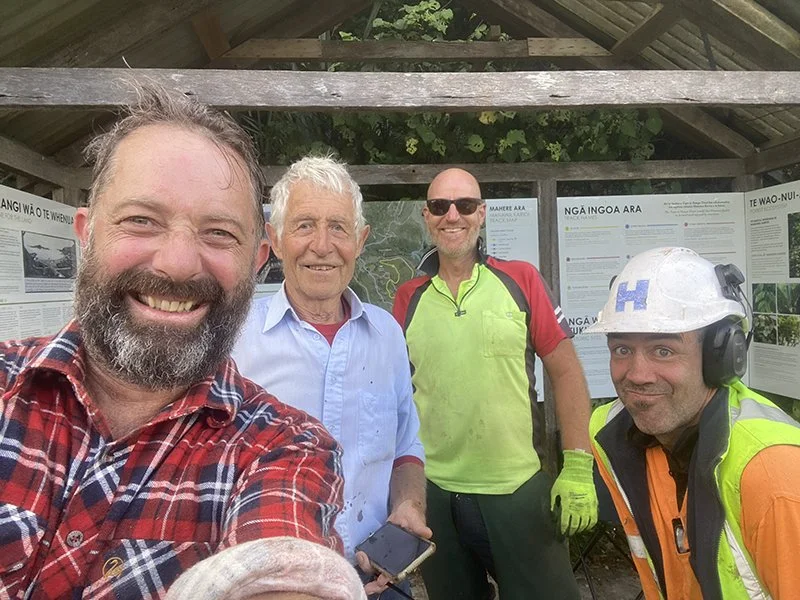
Tree Fellas', Niki, Morgan and Richard with Manawa Karioi Society Chairman Chris Livesey
One tree that had already fallen into a neighbouring tree proved quite problematic to deal with. Despite using ropes to climb up into it Richard was unable to safely make the cuts high up that would have freed it. Eventually the arborists had to resort to hiring a winch to safely dislodge the tree by moving the base of the trunk after they had cut through it.
For the second day a roster of volunteers had been organised and at the start of the day the first shift of volunteers were stationed at three appropriate points on Te Ahi Kā to stop walkers and bikers from entering the work zone. Thereafter, the day was filled with the sound of chainsaws and thunderous crashes as the trees were successively felled. Cheers were heard from some of the neighbours each time there was a loud crash.
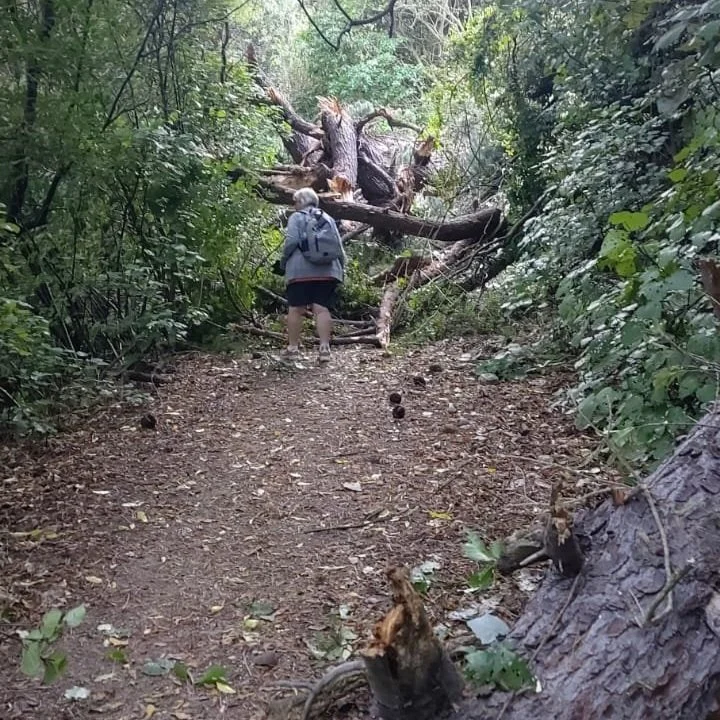
With two exceptions the felled pine trees stayed where they fell: this is what we had hoped would happen. However, two large pine trees had a mind of their own – as they fell they bounced and shot further down the hillside onto Te Ahi Kā making a considerable mess and blocking the track. For most of the day the volunteers keeping walkers and bikers out of the work area had a pretty boring time but these two trees crashing down the hillside onto the track did provide them with some excitement. It also demonstrated the value of having the volunteers stationed on the tracks to keep people away from the work area – it would have been curtains for anyone under those trees when they came crashing down! By a stroke of very good fortune the trees that fell on Te Ahi Kā narrowly missed hitting and destroying the Nature Trail signage that was there.
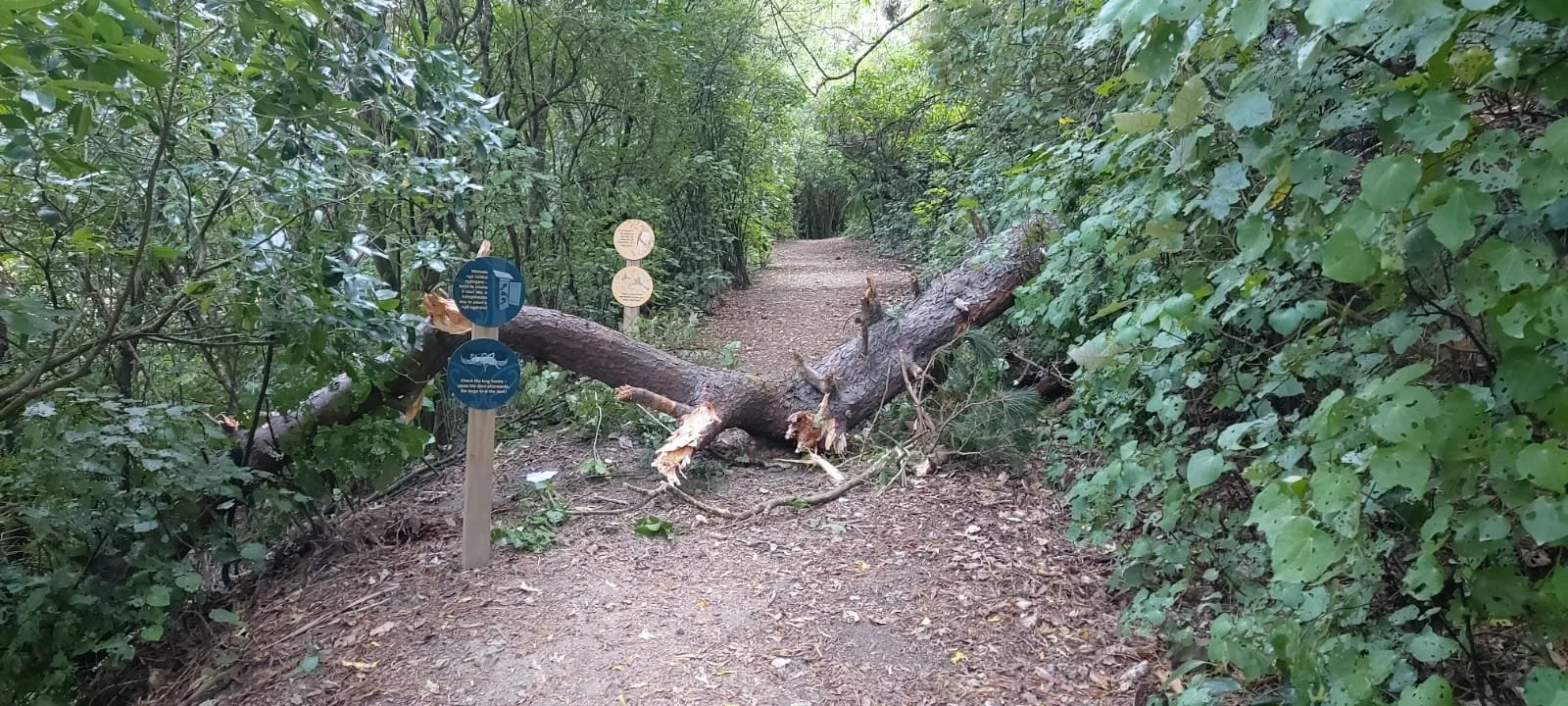
Richard and Morgan spent a further two days cleaning up the mess on Te Ahi Kā and ensuring that all the felled material was stable and did not create a risk for people using the tracks. With the pine trees safely down we will be able to extend our native plantings into that area but we will also need to carefully monitor and control the inevitable weed growth that will now occur.
With the two extra days of work the whole exercise turned out to be more costly than had been anticipated but again we were very fortunate in that our application to Suncorp New Zealand’s special funding project to support charities that work with vulnerable communities as well as climate/natural hazard resilience was approved and we were able to use some of that money for this work. Suncorp New Zealand is in the insurance business and owns the brands Vero and AA Insurance.
Written by Chris Livesey.
Look out for our Lookouts!
We put effort into improving our lookout points. There are currently 4 of these with seats. Gorse was removed, and only low-growing species have been planted to avoid blocking the view. We take care to keep the plantings natural-looking, but make sure we put in a variety of food sources for the birds (and consequently bird-watchers). This includes kowhai (late winter flowers for hungry nectar-feeders like tui, korimako and kaka. Kereru also eat the flowers). Wharariki provides more nectar throughout springtime, and all the lookouts have nearby rata for summer nectar.
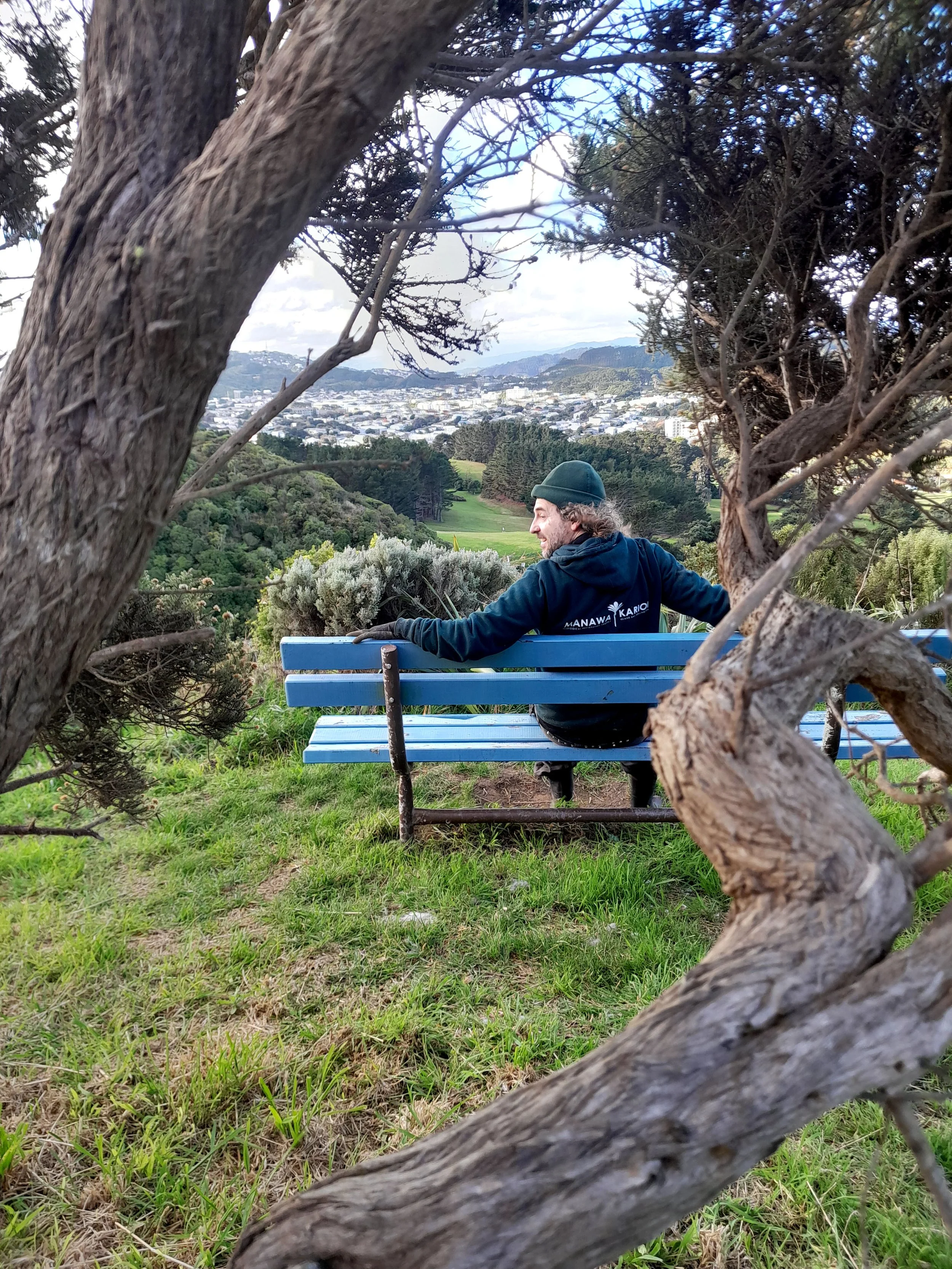
The view from Green's Lookout.
Careful pruning opened up the view at Mokopuna Lookout. In this view north you can see the hospital, the western flank of Mt Vic, and across the Harbour to Ngauranga gorge.
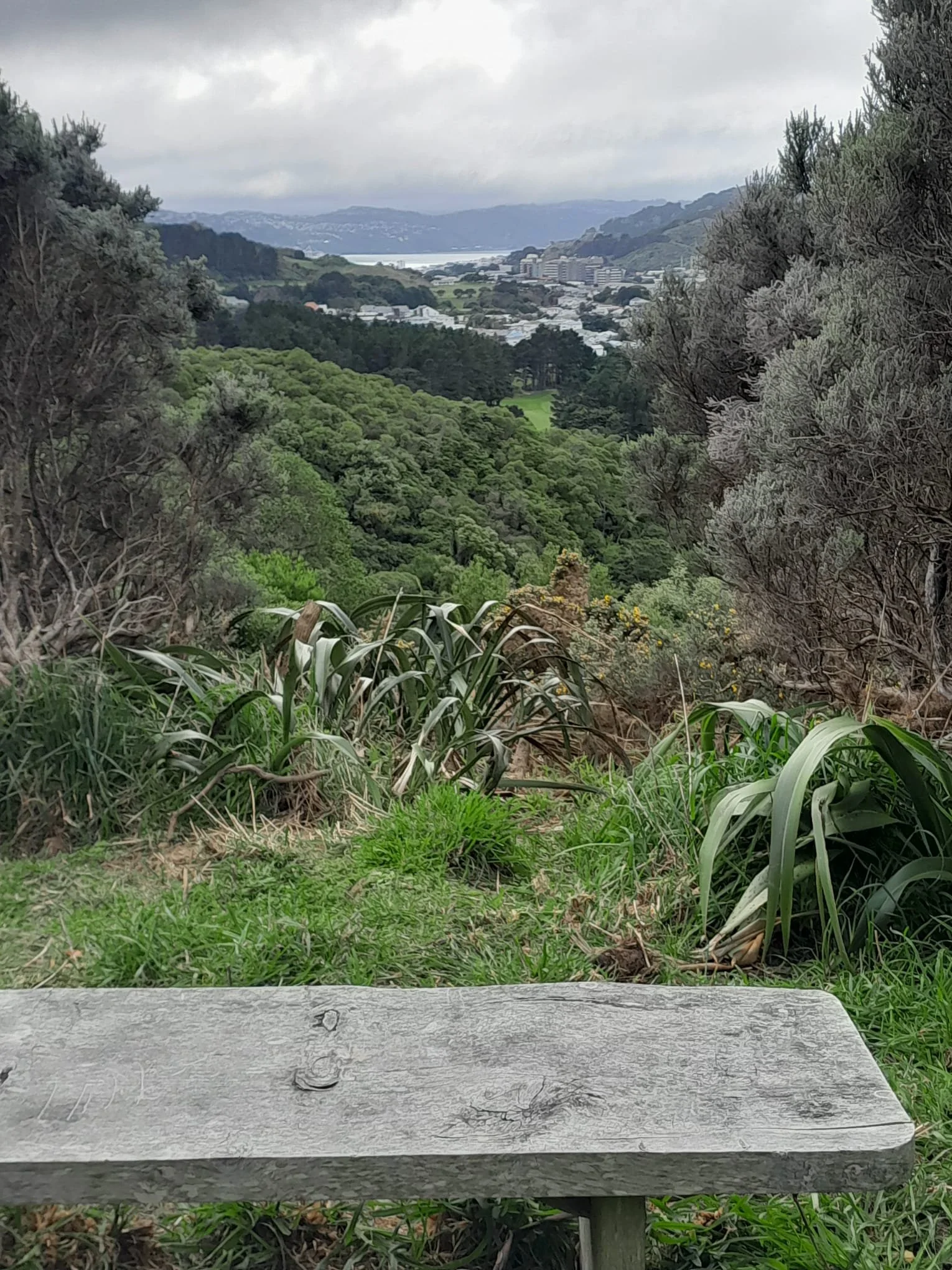
Mokopuna Lookout
Careful pruning opened up the view at Mokopuna Lookout. In this view north you can see the hospital, the western flank of Mt Vic, and across the Harbour to Ngauranga gorge.
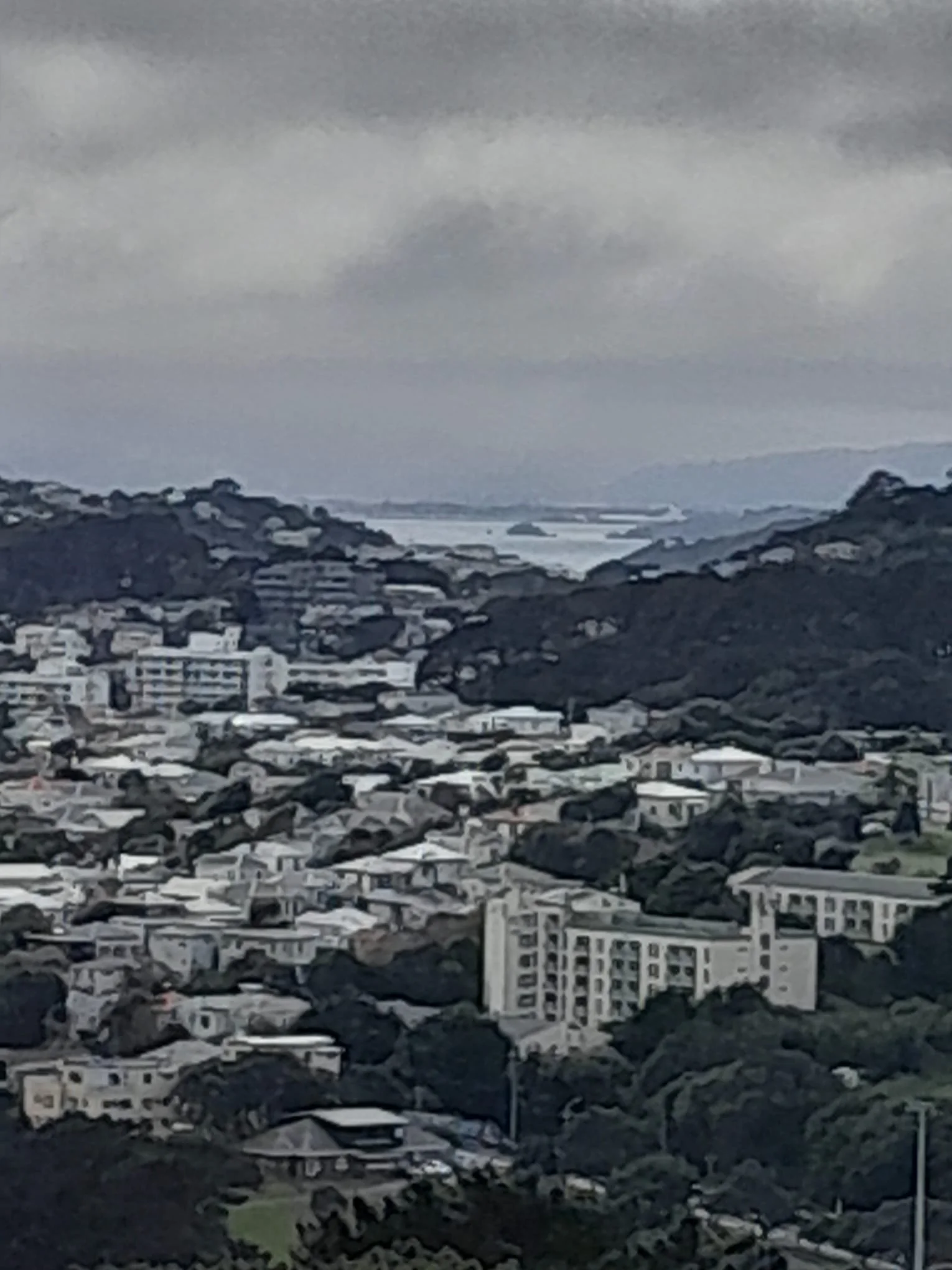
The (zoomed in) view from Mokopuna Lookout of Mokopuna Island.
Looking to the right from the same lookout point, you can see Mokopuna, the small island just to the north of Matiu in the middle of the harbour. Both of these islands were named by Kupe when he voyaged here with his wife and daughters about 1,000 years ago.
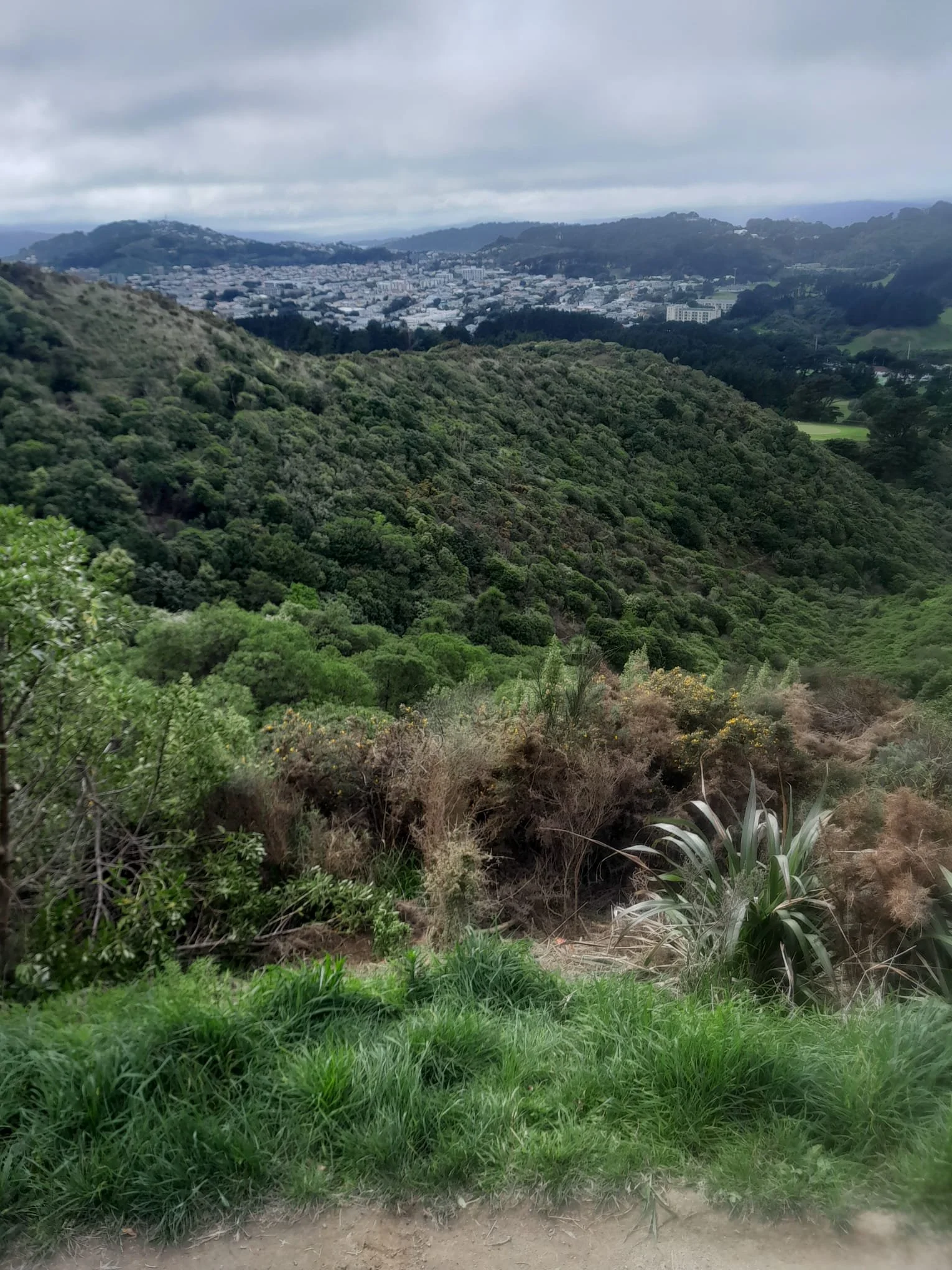
View from the seat on the Moemoea track.
The view from the seat at the north end of Moemoea, above Manawa Karioi gully. This looks east over Berhampore and Newtown. In the distance is the northern tip of Te Motu Kairangi (Miramar) and beyond that, you get a glimpse of the southern end of the Remutaka Ranges.
What Did We Plant This Year?
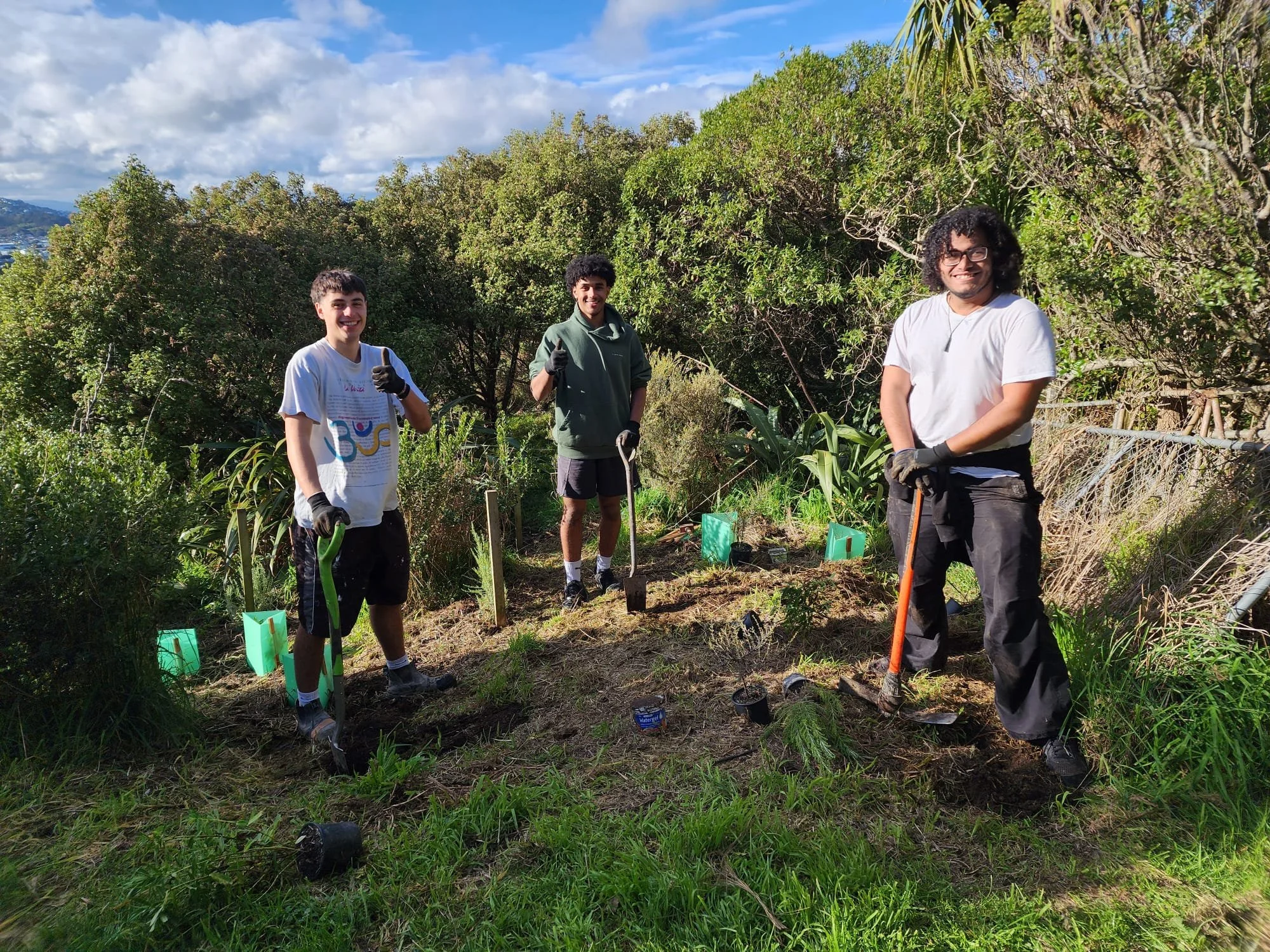
We started the planting season in June 2024 by planting along Moemoea, the track on the upper slopes that connects us to the Berhampore Golf Course to the north and Tawatawa Reserve to the south. It's become an increasingly popular track, so we put in some effort to improve the track surface too. As it is quite high up the slope, it gets very dry in the summertime. For this reason, most of what we plant is lower-growing species that can tolerate the dry conditions and lower soil fertility. We use this to our advantage to put in locally uncommon shrubs like mingimingi.
Where there are folds in the hillside with small gullies (with better soil that holds moisture further into summer) we can put in things like totara, rewarewa and titoki in the open spots, and under established trees we add nikau, poporokaiwhiri and kohekohe. We also added a few more rata, following from the success of last year's rata plantings. Some of those flowered last summer, despite being less than 1m high.
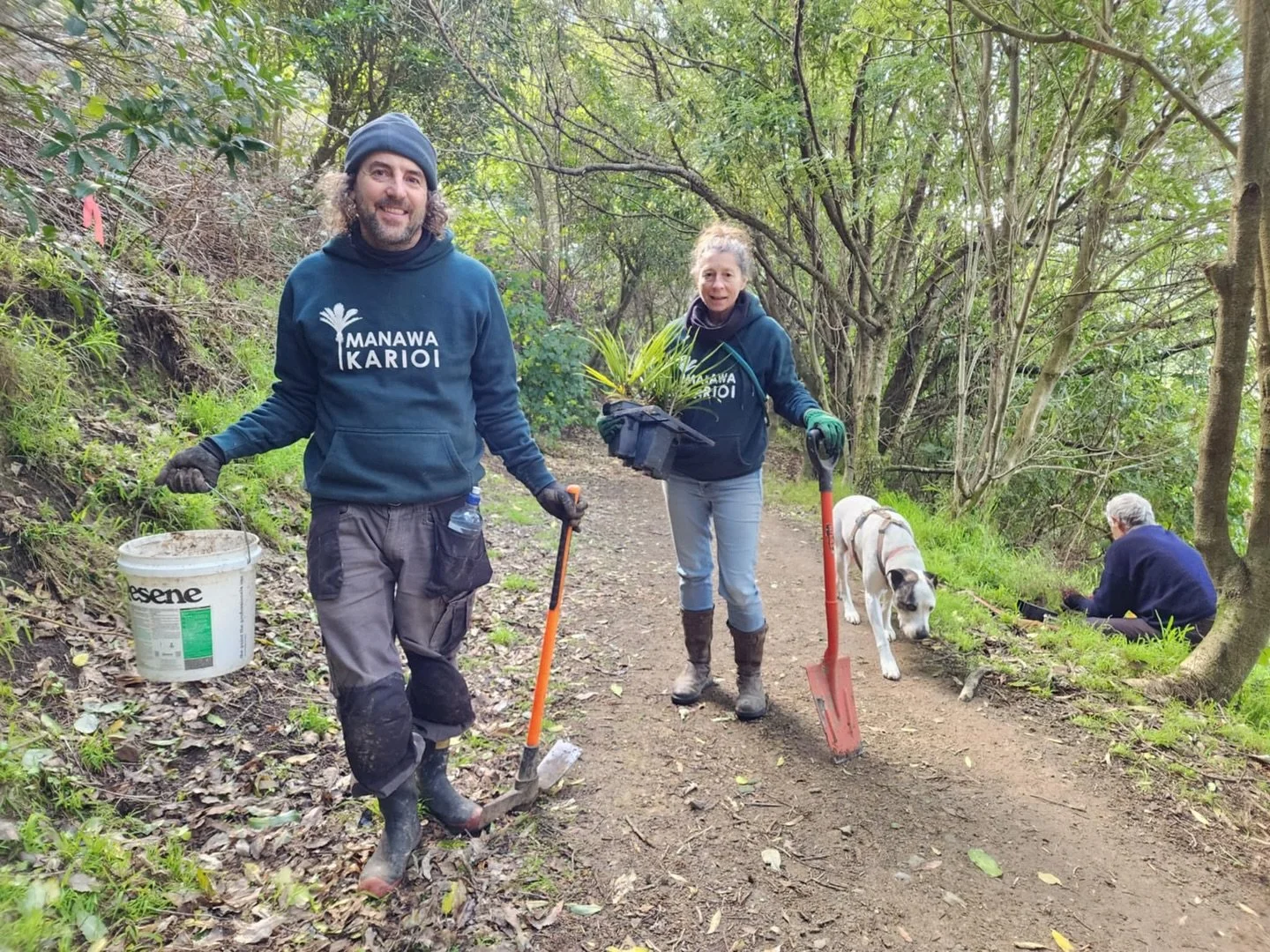
We also focused on Te Uma I Mokotia, a track that runs roughly east-west through Manawa Karioi, linking up to Moemoea. The track surface was widened in places, and slightly rerouted in the centre stretch to make it easier to walk up and to reduce erosion.
Our planting is focusing a lot more on expanding biodiversity, with forest giants such as kahikatea, totara, matai and miro featuring more. We put in close to 30 of these podocarps (ancient conifer trees) this year.
While much of the current forest canopy at Manawa Karioi is currently ngaio, mahoe matipo and pittosporums, these will eventually become sub-canopy as the tawa, kohekohe and titoki that we have been planting in increasing numbers take over.
New Focus for planting
Our June working bees saw a focus on planting around some of our lookout points, with an emphasis on low-growing shrubs to avoid blocking the view. Stuff like wharariki, tauhinu and mingimingi.
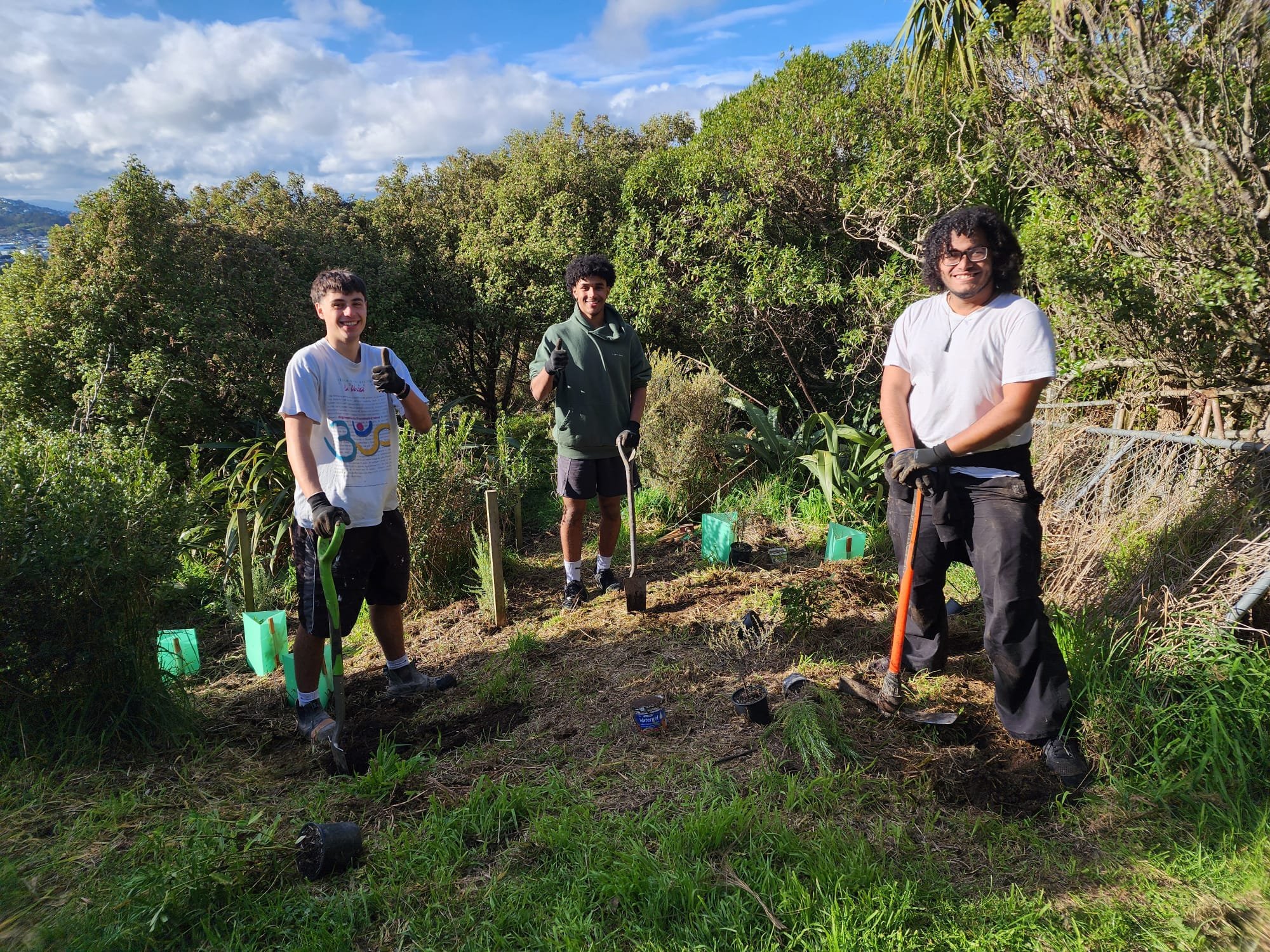
For August, we are taking a different approach, with an emphasis on BIG. This will include putting in some future canopy species that grow from 15-20 metres tall. In sunny, drier spots this will include titoki. In shaded spots that retain soil moisture further into the summer, this will involve kohekohe and tawa.
And of course, there will be some of the forest giants planted in various locations - totara and rewarewa in sunny locations. Kahikatea, pukatea, matai and miro in more sheltered areas.
And under all that we will be putting in about 30 nikau!

Trees, tracks and a demographic shift!
There were 5 Sundays this June, which along with some pretty good weather, allowed us to get a lot done.
Today's working bee focused on Te Uma I Mokotia, a track that runs roughly east-west through the center of Manawa Karioi.
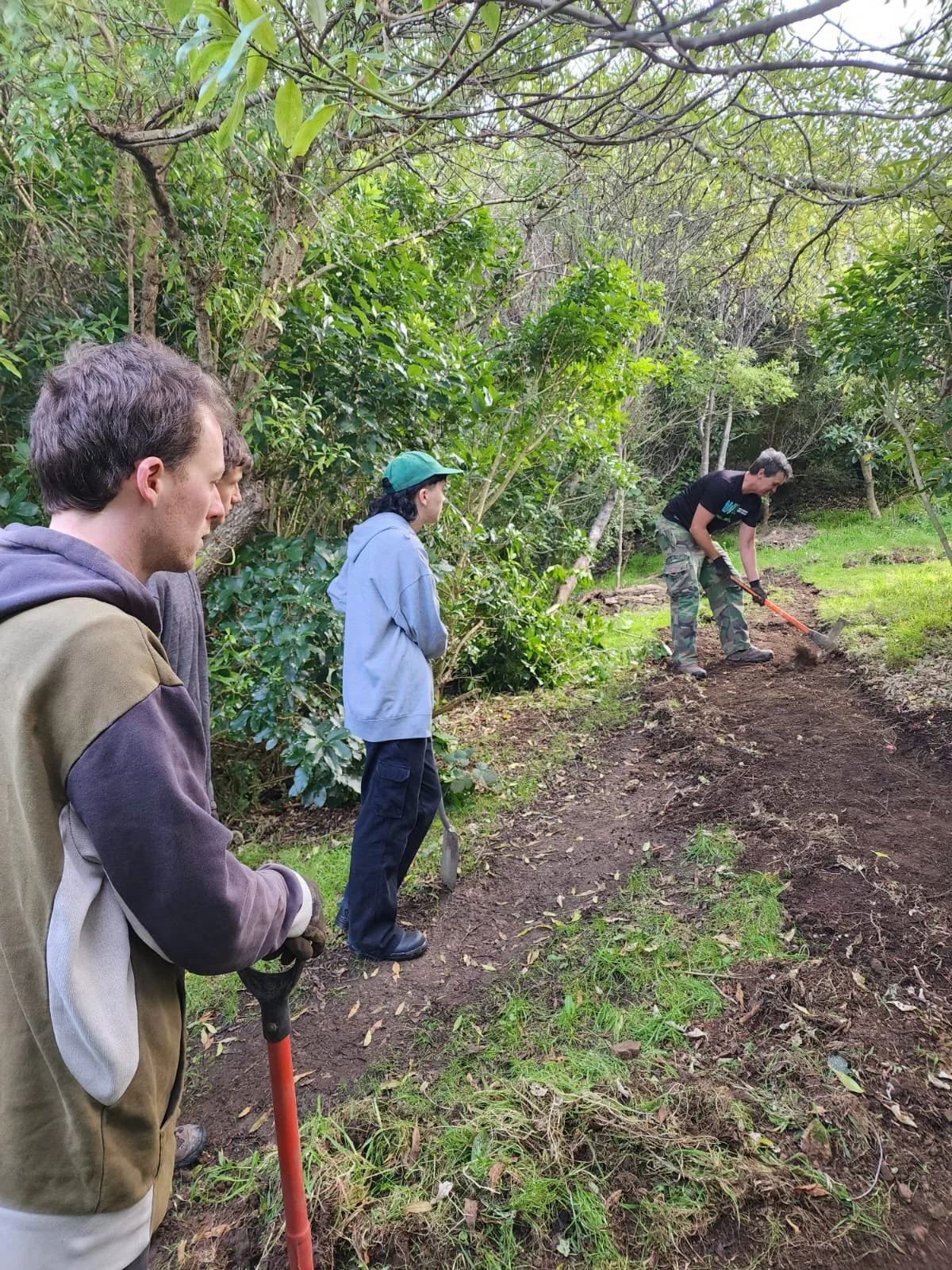
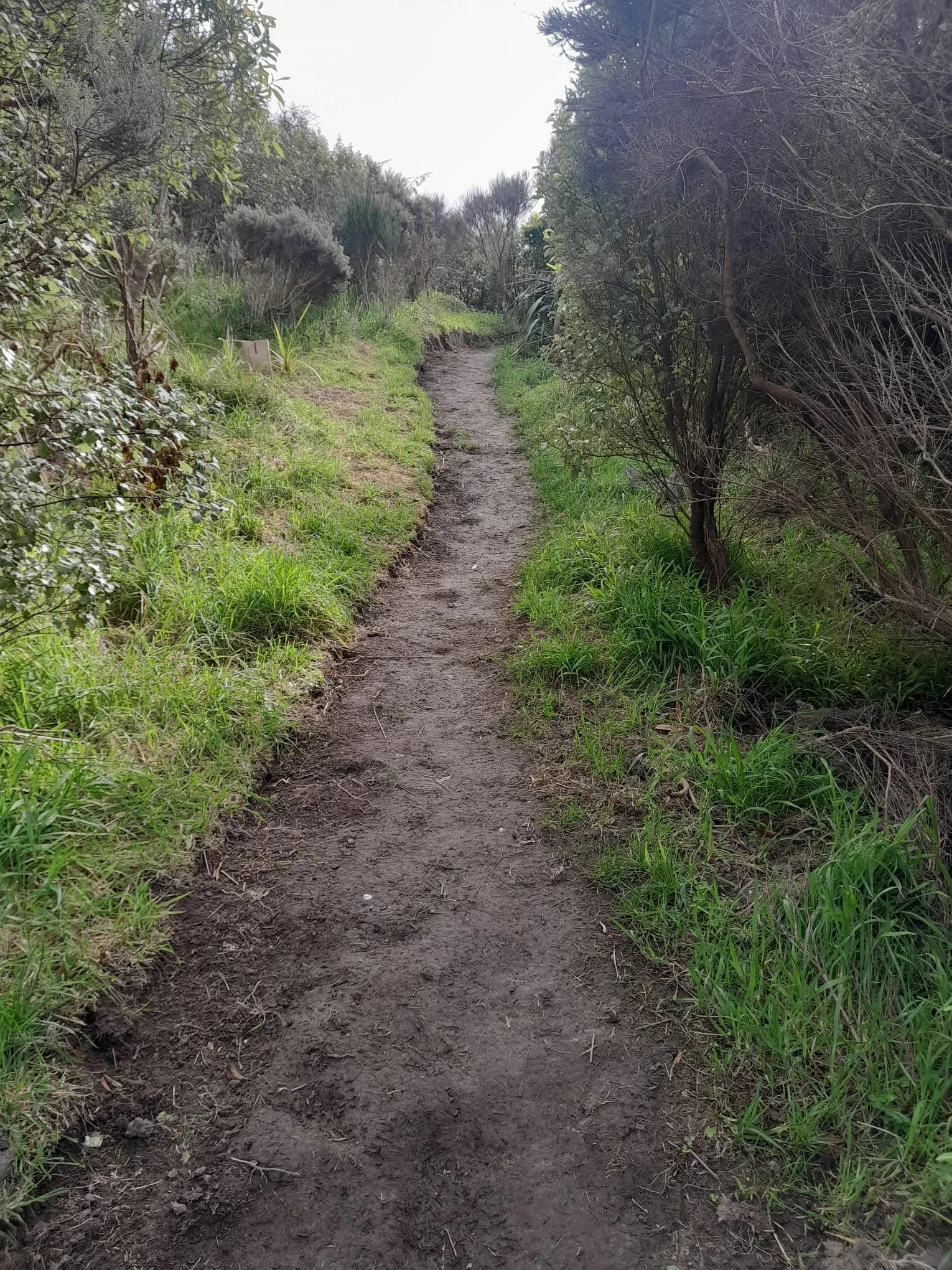
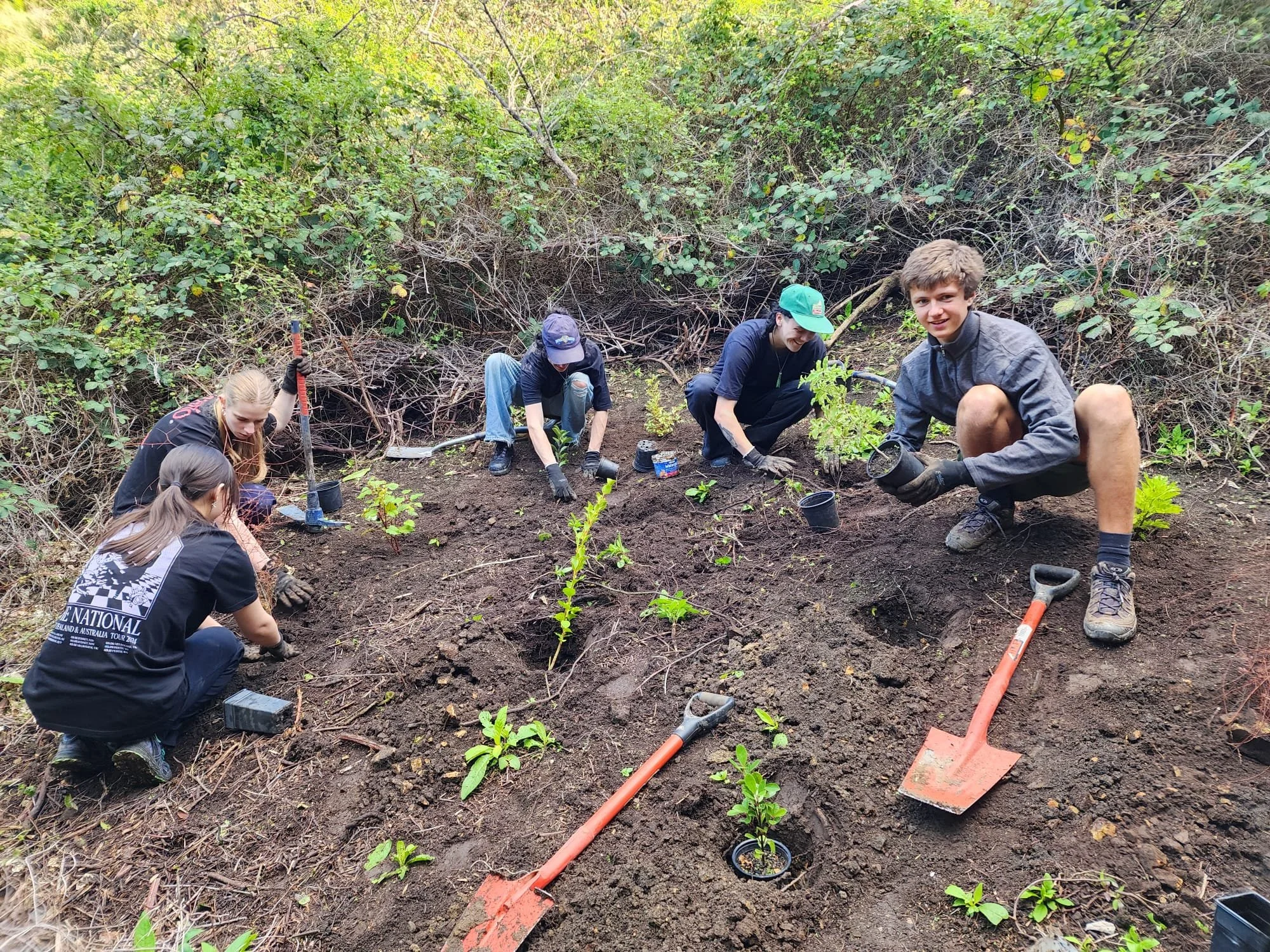
Firstly, we realigned some track to make it easier to walk on when the ground is wet. This runs through a small grove of totara. We then planted a few understorey plants such as pate and porokaiwhiri, future canopy trees such as totara, and several each of emergent species, matai and rewarewa.
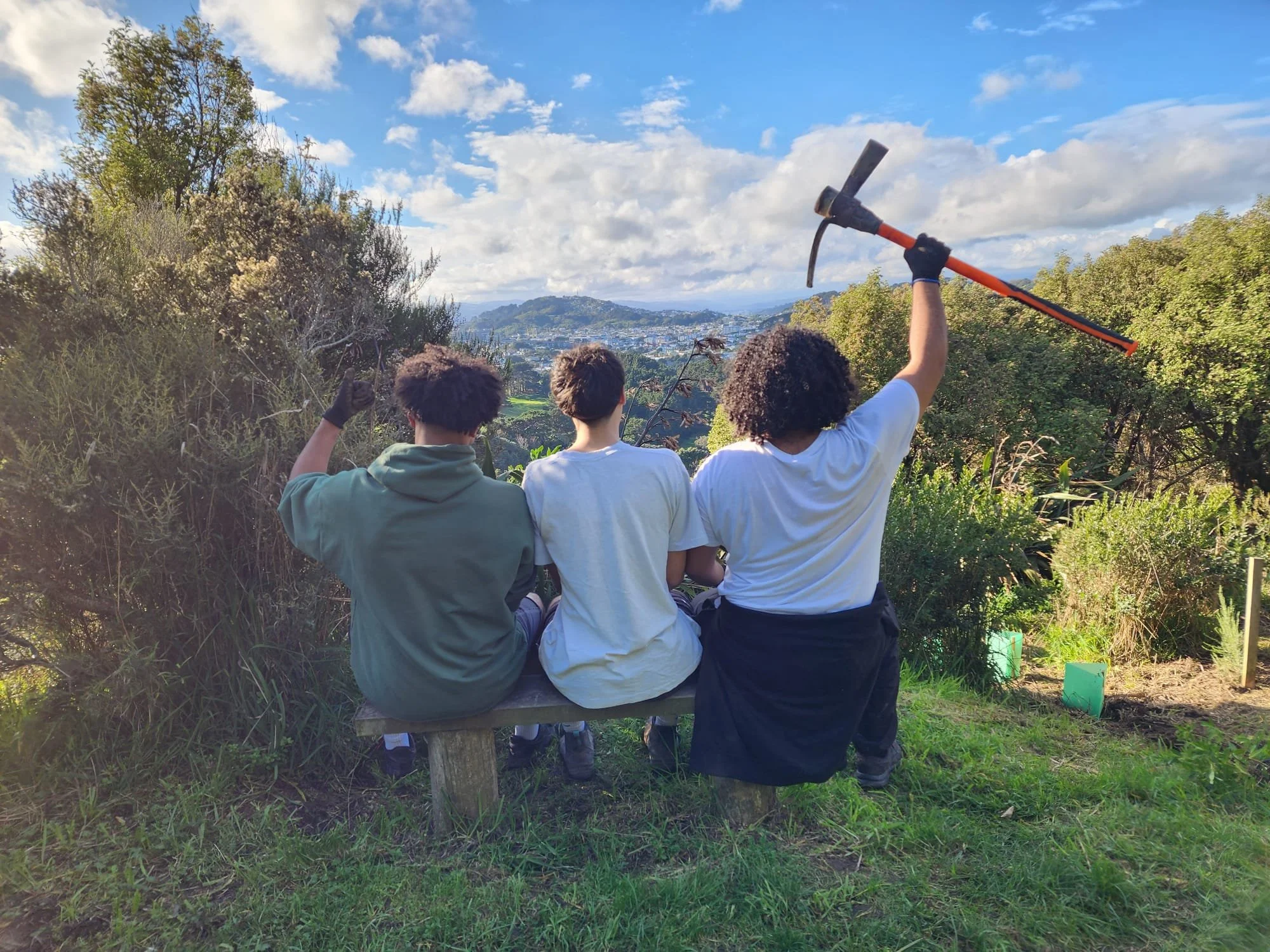
A few more low-growing shrubs were added around the seat at the north end of Moemoea, and at another viewpoint seat on Te Ahi Kaa.
3 late arrivals boosted our numbers to 12, and enabled us to get some more track improvements and planting done to the top end of Te Uma I Mokotia.
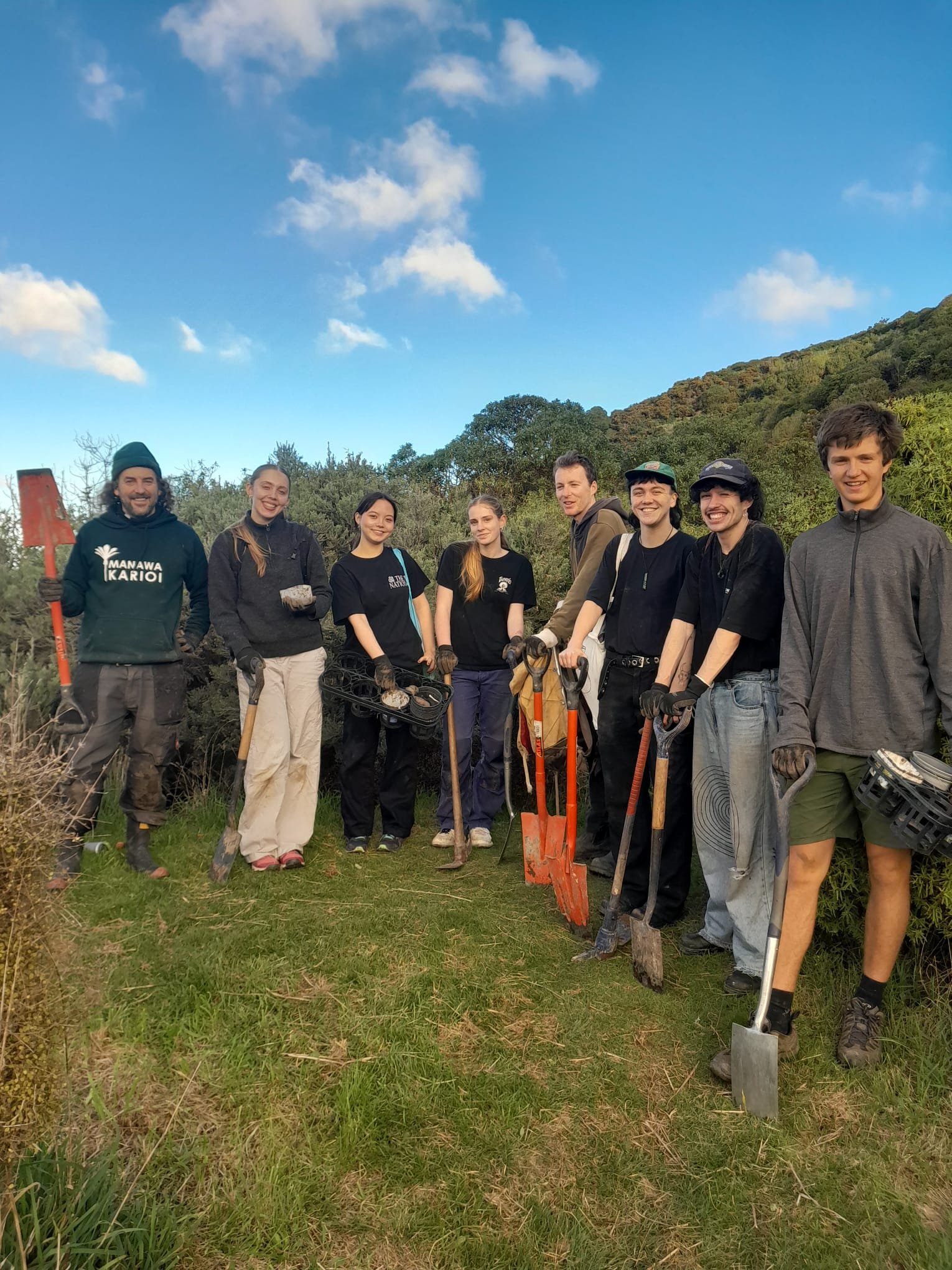
We had a complete reversal of the usual age demographic for a working bee - only 2 people over 50, with nearly everyone else being under 20!
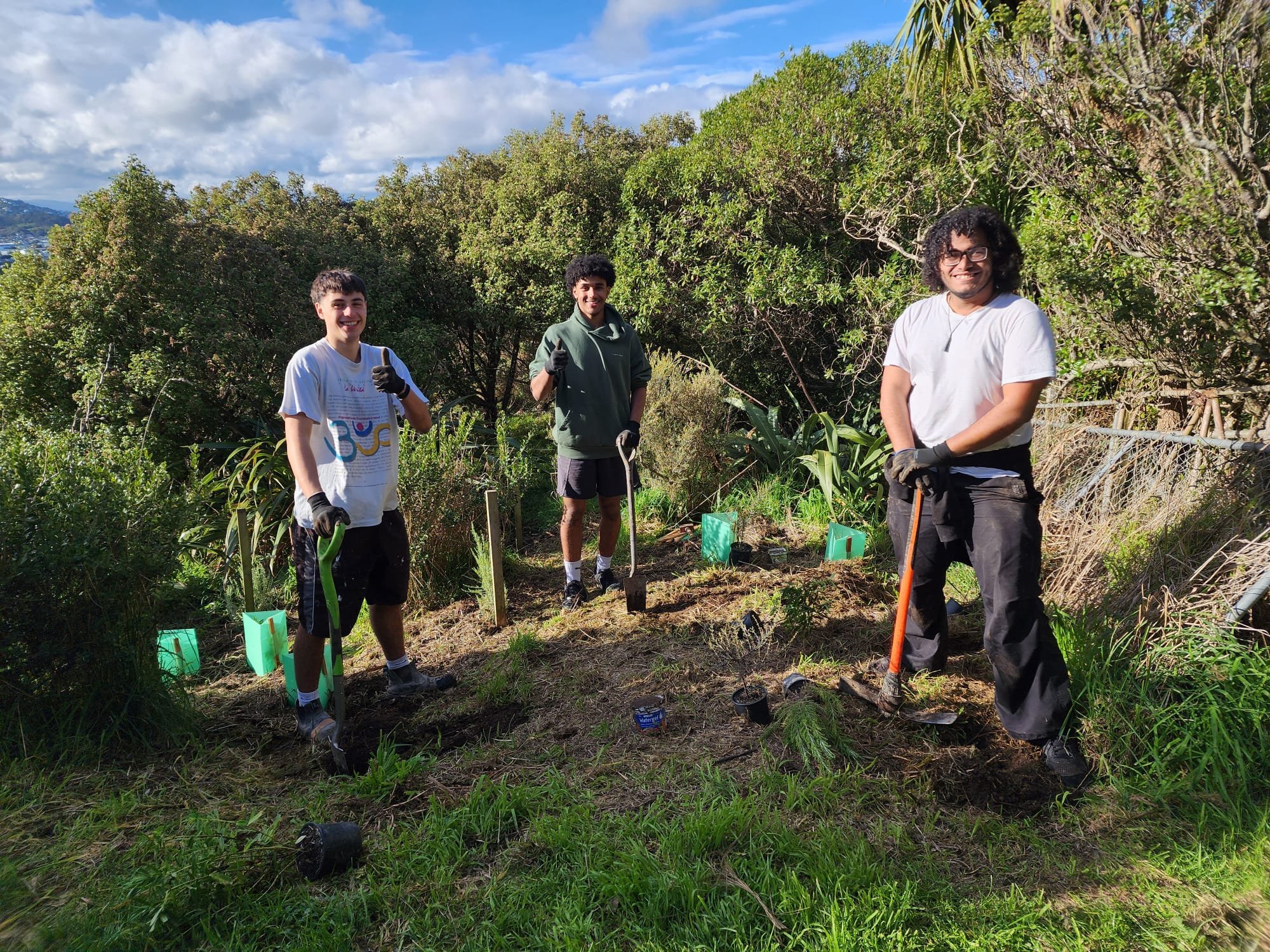
We're looking forward to having a rest during July. See you in August for more planting!
Nature Trail Opening
Press Release - Te Ara o te Wao Nui a Tāne / The Nature Trail - Opening Event.
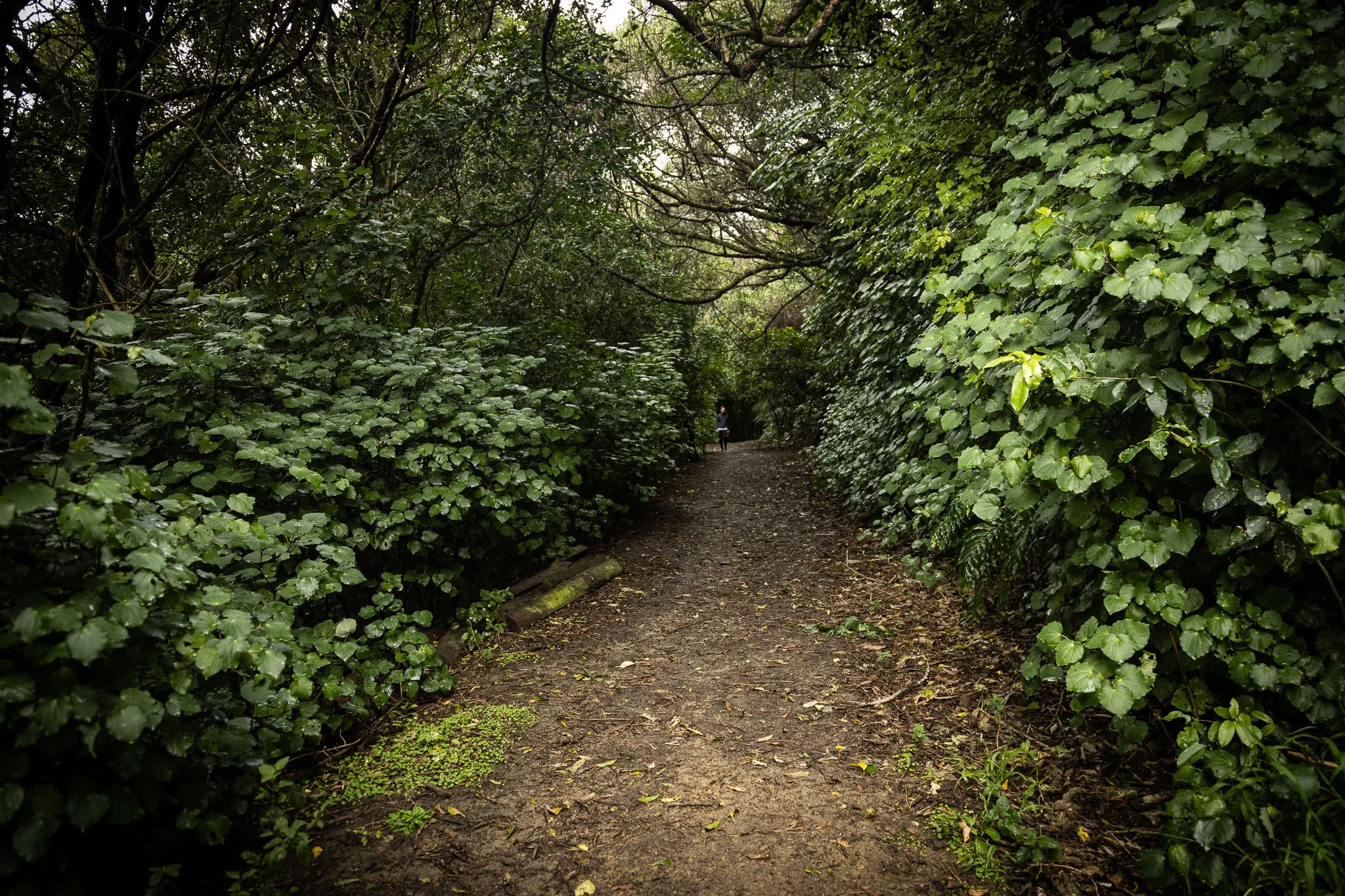
We are inviting the community to join the Manawa Karioi committee and Tapu te Ranga Marae trust in celebrating the opening of Te Ara o te Wao Nui a Tāne/The Nature Trail. Held on Saturday, 17th February 2024 from 1pm - 2.30pm as a part of the Island Bay Festival.
Te Ara o te Wao Nui a Tāne/ The Nature Trail
Running through the oldest area of the Manawa Karioi Ecological Restoration Project is a short loop track marked on the map as Te Ara o te Wao Nui a Tāne/ The Nature Trail.
The track has been planted over the last 35 years and the canopy is well overhead. This part of the reserve has been marked for development for seven years and thanks to a generous donation from T D Mankelow Family Charitable Fund, we are able to create a special track for children and adults alike.
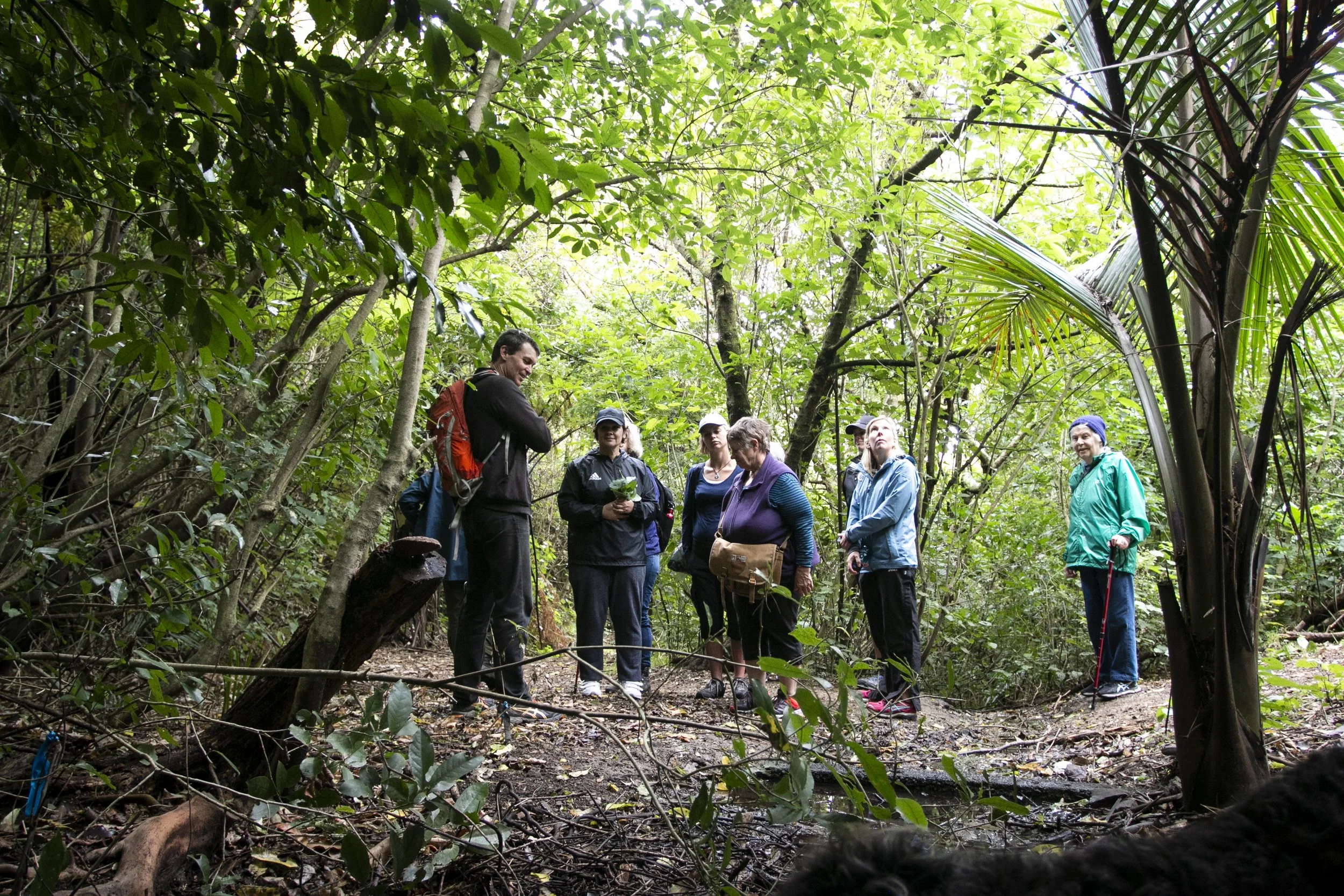
The Process of Developing the Trail.
We started the project by digging out some slips that had covered the track after the heavy rainfall in 2023, then we hired track clearing work to be done to open up the tracks.
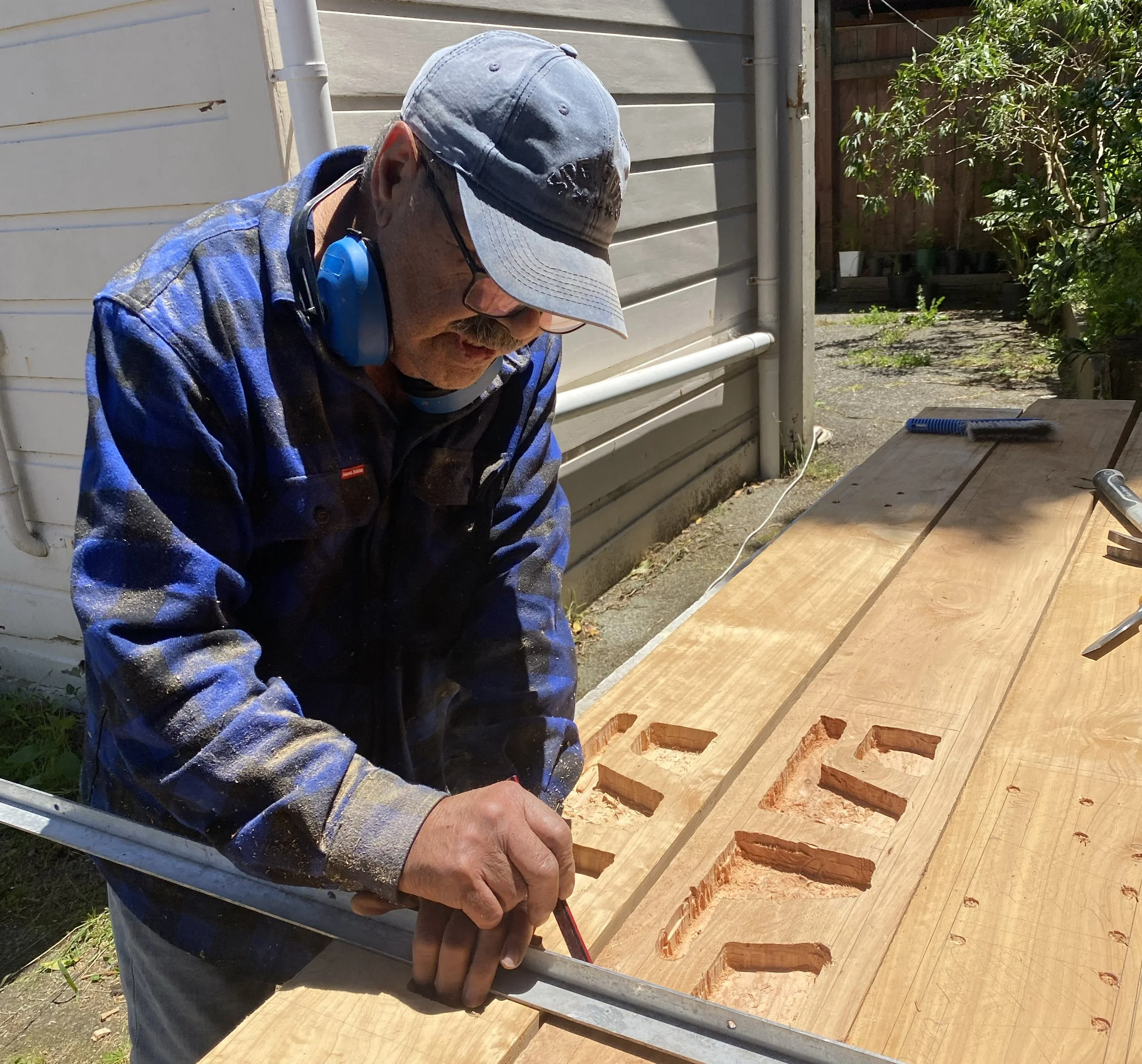
We commissioned three bug hotels to be made, which is a fun way for children and adults to engage with insects and see what lives inside.
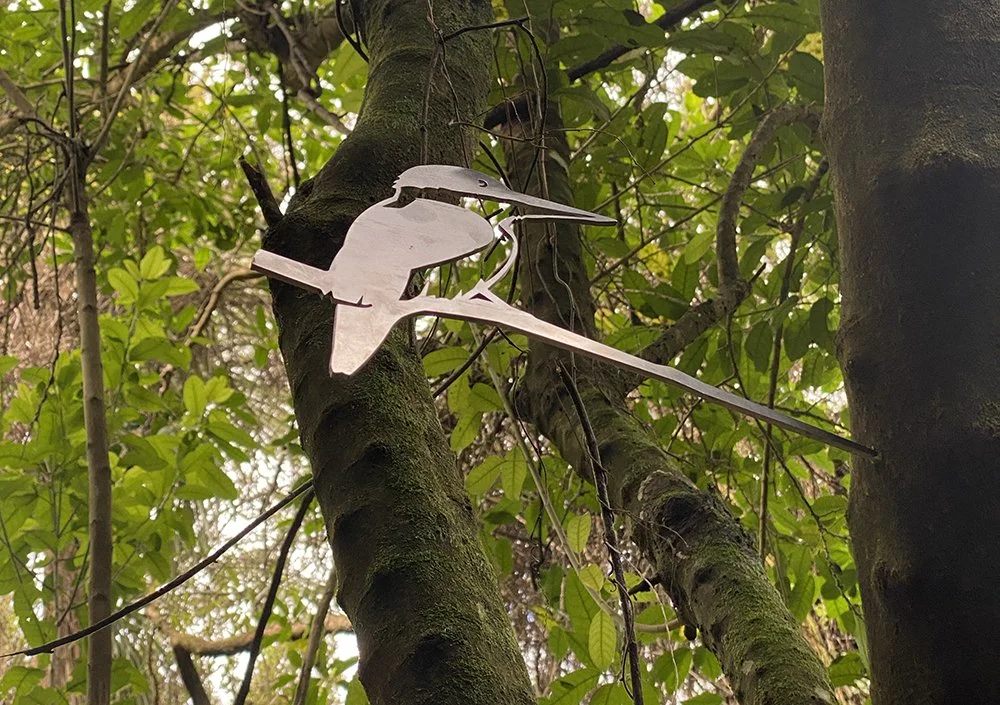
We have created a fun game of ‘Spot the Birds’ on the nature trail - we have hidden metal birds on the trail for people to find as they walk around, which encourages people to look up and see real birds too.
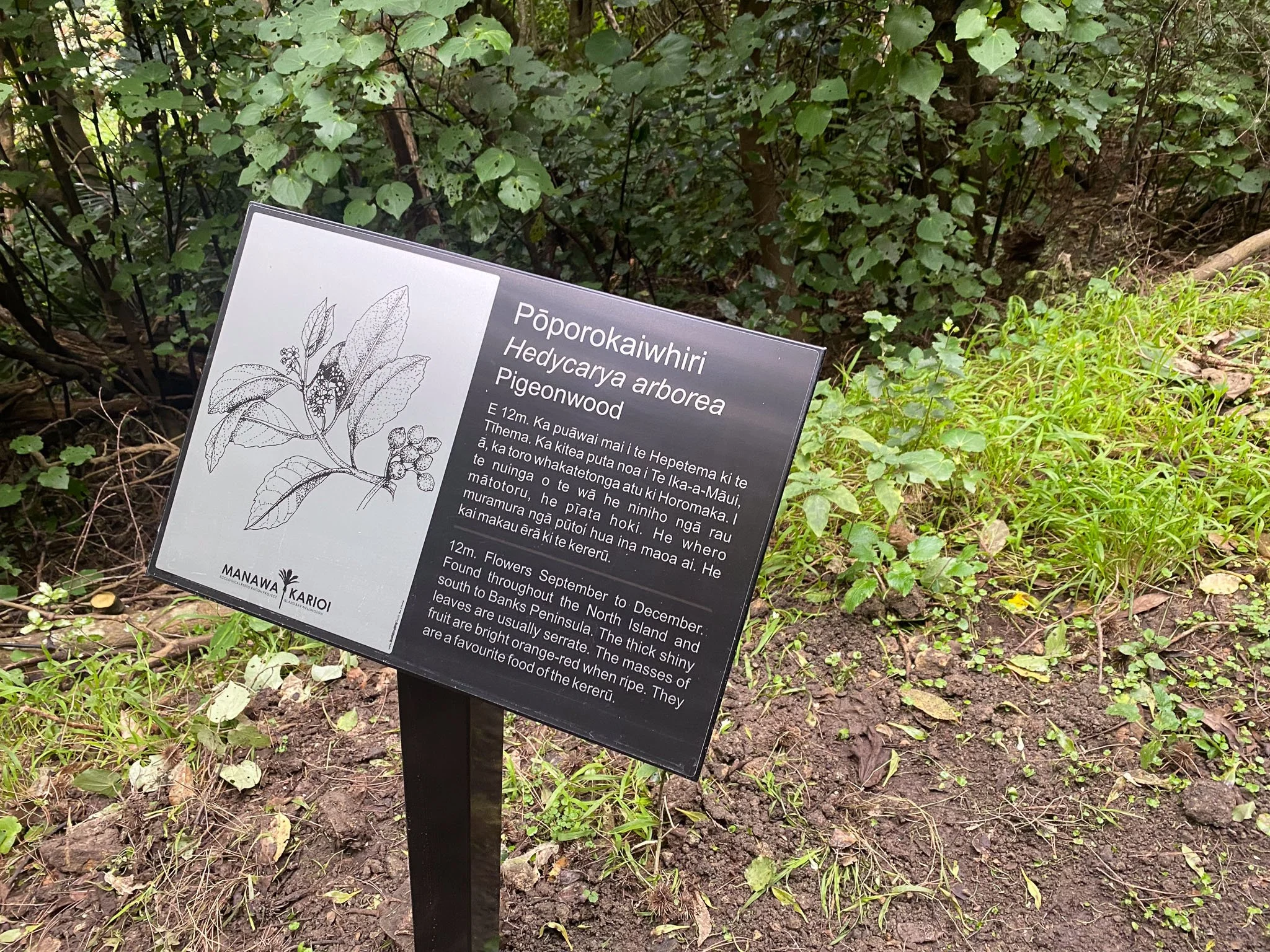
We worked with Metal Image signs and accredited translator Melanie Nelson to create large bilingual botanical signs to help identify some of the special trees on the track.
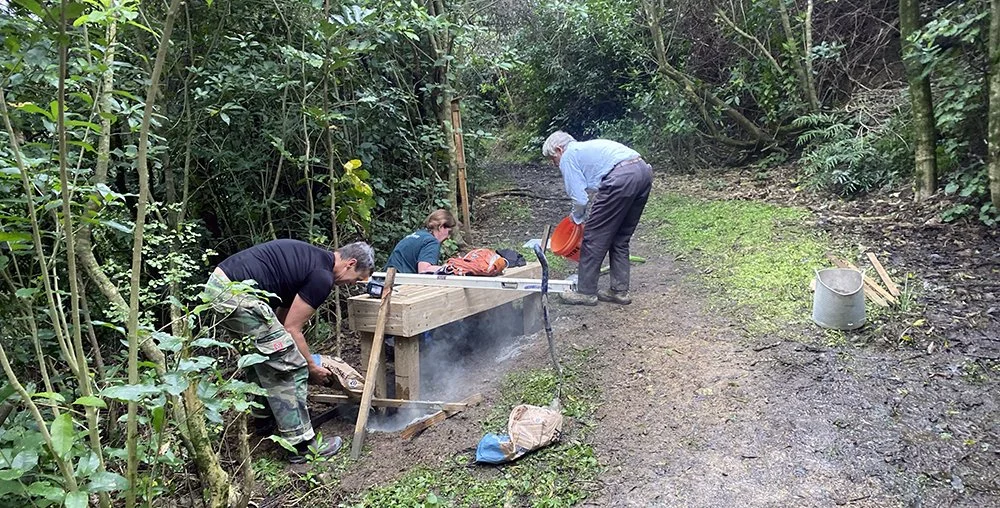
We have beautified the area around the spring-field stream with rocks, planting ferns and putting in new seats. It is a great place to sit, reflect and watch the baby fantails flit around the stream and pick out bugs.
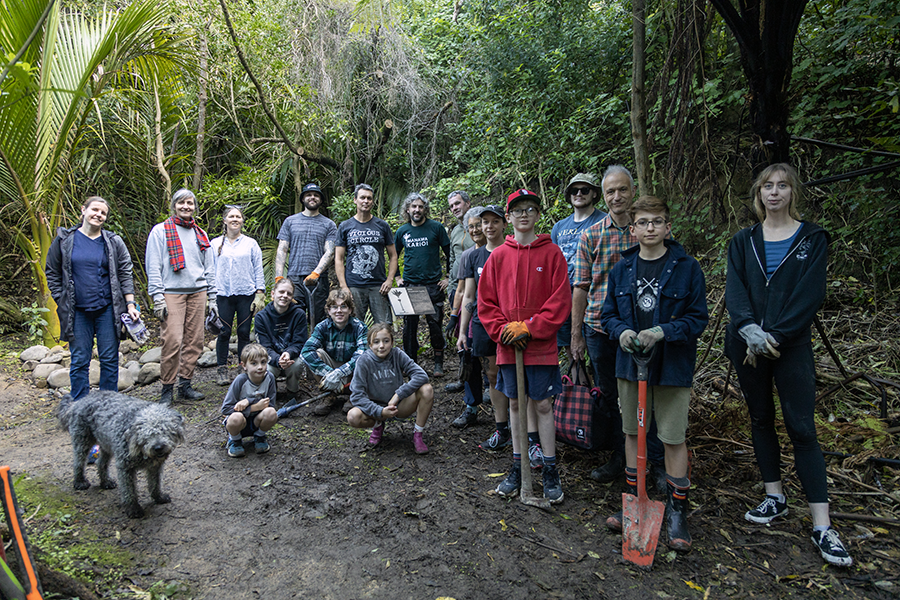
Working Bee on Te Ara o te Wao Nui o Tāne / The Nature Trail.
Te Ara o te Wao Nui a Tāne/The Nature Trail is a short loop that starts at the base next to the Tapu te Ranga Marae car park. The Nature Trail is marked #8 on our Trail map. It is a short easy walk taking approximately 15-mins to walk. The track is sloped but it is suitable for groups of younger children and buggies. It has fun educational features to discover along the track.
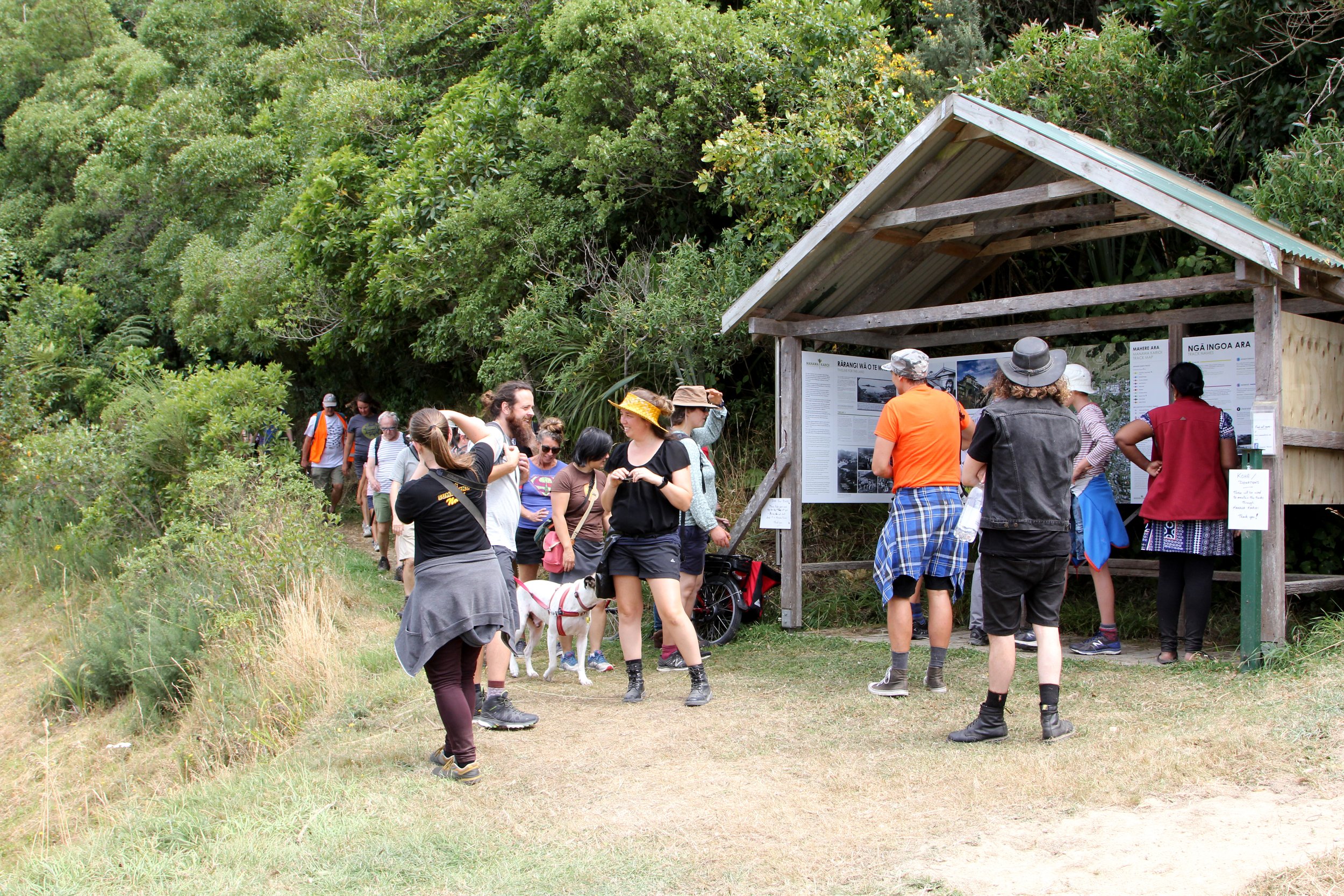
Event Listing:
We are inviting the community to join the Manawa Karioi committee and Tapu te Ranga Marae trust in celebrating the opening of the development of Te Ara o te Wao Nui a Tāne/The Nature Trail as part of the Island Bay Festival on Saturday, 17th February from 1pm - 2.30pm.
Date: Saturday, 17th February 2024
Time: 1pm - 2.30pm
Location: Manawa Karioi
Parking: Tapu te Ranga Marae Carpark, Bike Parks are available
CompassionFest - Honouring Kae Millar
CompassionFest seeks to remember and celebrate local heroes, this time focusing on Kae Miller who started the movement to replant native bush along the South Coast in the 1980s, when she herself was in her mid-70's.
She was a remarkable woman, and before doing this had set up NZ's second ever recycling center at the Porirua tip. Bruce Stewart joined her there and got the inspiration to use recycled materials for the marae from her. She then come to this part of the city to be close to him, he was possibly the first helper she had planting trees above Princess Bay, and he built her a meditation lodge out of recycled car crates up there which will be a venue for the festival.
It is a fascinating story, there is more about her is on the CompassionFest website if you want to read up.
See the CompassionFest program here. They have sessions on using Seaweed, customary dyeing techniques from native plants, and Kae's grandson Max Rashbrooke is ending the festival with a Symposium on her legacy at the Home of Compassion.
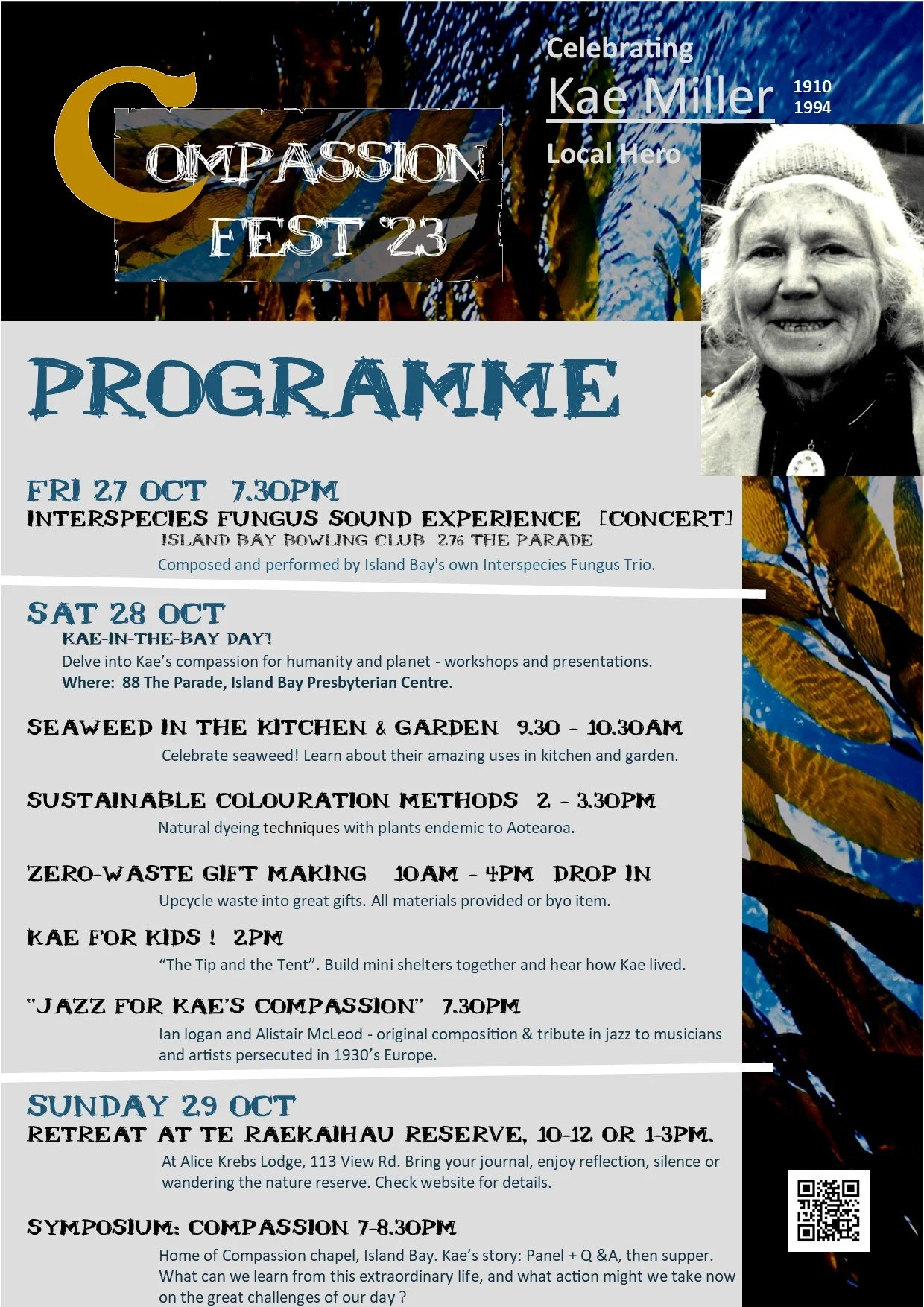
Kae Miller - the person we seek to remember and celebrate in our CompassionFest 2023.
As South Wellington locals, we especially celebrate her vision to replant native bush along the coast, starting with the Te Raekaihau Point above Princess Bay. A place we can all visit and enjoy today.