Weed Action Workshop
On a sunny Sunday morning in April, members of the South Wellington Weed Action Coalition (SWWAC!) met in the Voglemorn Community Centre for an exciting morning of weed work.
SWWAC!’s members (Manawa Karioi, Southern Environment Association and Paekawakawa Reserve group, Friends of Ōwhiro Stream, Ōwhiro Stream Team, Ōwhiro Bay Residents Environment Group, and Conservation Volunteers Wellington) are planning more and better weed control coordinated across the beautiful south coast of Wellington.
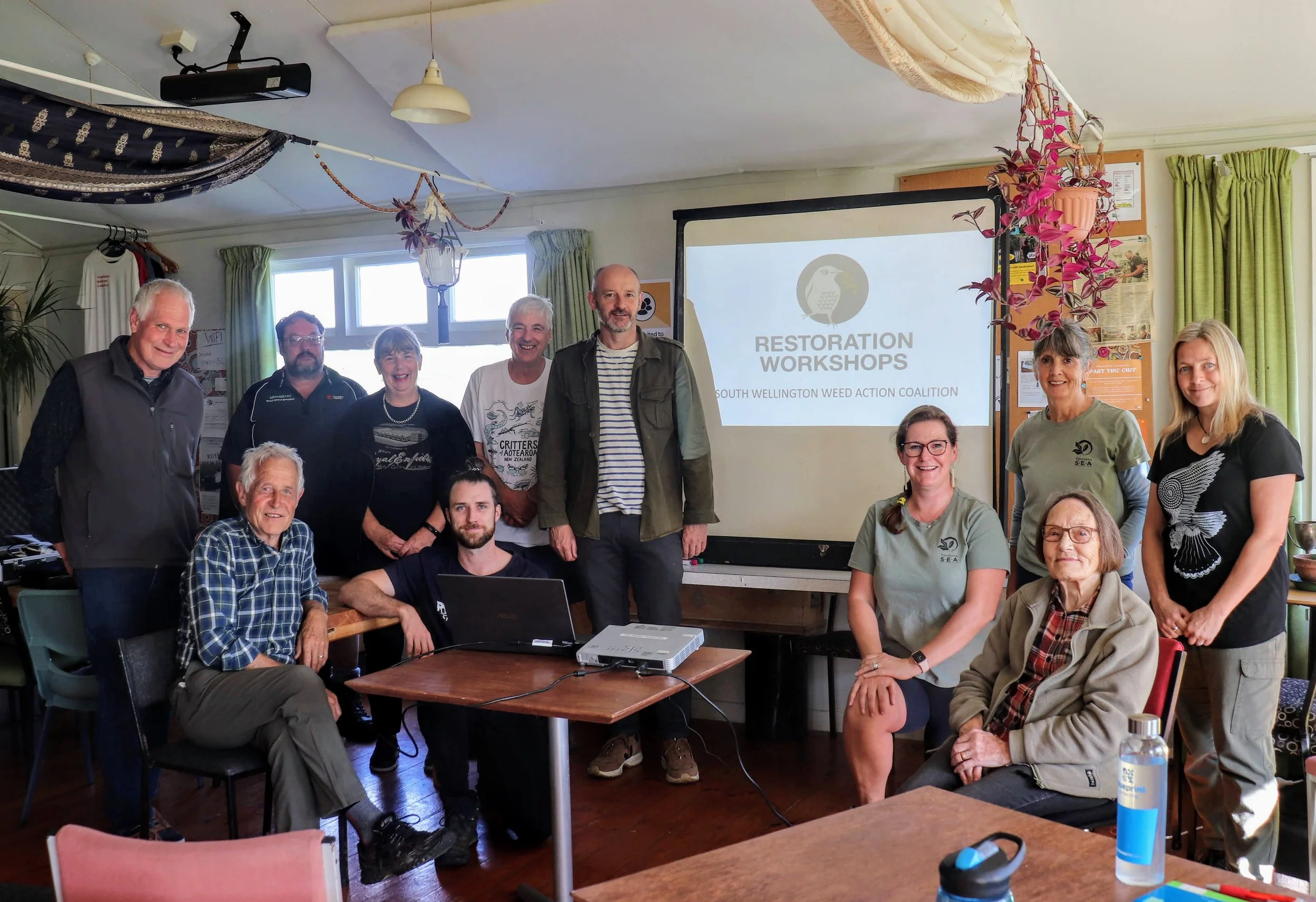
Darryl Kee and members of SWWAC at Vogelmorn Community Centre
With the support of the Wellington City Council, we were thrilled to have expert weed controller Darryl Lee of Weedworks run a workshop specifically tailored to the needs of our South Wellington conservation groups. And thanks to SWWAC member Paul for the morning tea overflowing with juicy feijoas! After the morning’s presentation by Darryl, the team went to Ōwhiro Stream for a while to talk more about the weeds we saw over lunch.
The main things we learned at this workshop were:
- We need to look at weed control as part of the overall environmental restoration mahi.
- We need to pay attention to the weeds that are emerging problems like climbing asparagus and another new weeds to the area, parsnip palm. Parsnip palm is suddenly quite conspicuous at Manawa Karioi, and now is a good time to stop it becoming more widespread.
- We need good survey information about which weeds are most problematic where – this will allow us to do our own control work, and also to be successful in getting the extra funding we are looking for. This is where the coordinated approach of SWWAC! is really helpful.
Manawa Karioi weed FAQs
What are weeds?
Weeds are often defined as an unwanted plant growing in the wrong place. We have plenty of these at MK, because we are trying to restore native forest and introduced weed species take up the space where we want to plant natives, or smother native species especially when they are young. Introduced weeds also often grow and spread faster than native species and, without control, become more and more of a nuisance over time.
What are the most troublesome weeds in Manawa Karioi?
Japanese honeysuckle which can look nice but spreads fast and definitely can smother native growth
Old Man’s Beard which is widespread and very spreading
Climbing asparagus has not been around for long but forms very dense strangling patches and can ringbark and kill some native species
How can I help with weed control?
Learn how to identify the weeds mentioned and pictured here and keep an eye out for them. If you are confident that what you’re looking at is a weed – and not a native species - don’t hesitate to pull out the little ones from beside the track or where you are walking! You can then take them home whole and disposed of in the rubbish or commercial green waste. This will help limit their spread.
30th Anniversary Celebration and Pub Quiz
Manawa Karioi – 30th Anniversary Celebration and Pub Quiz
After a postponement due to Covid, a very successful 30th anniversary celebration and fund-raising pub quiz for Manawa Karioi was held at the Parrotdog Bar in Island Bay on 19 October 2021.
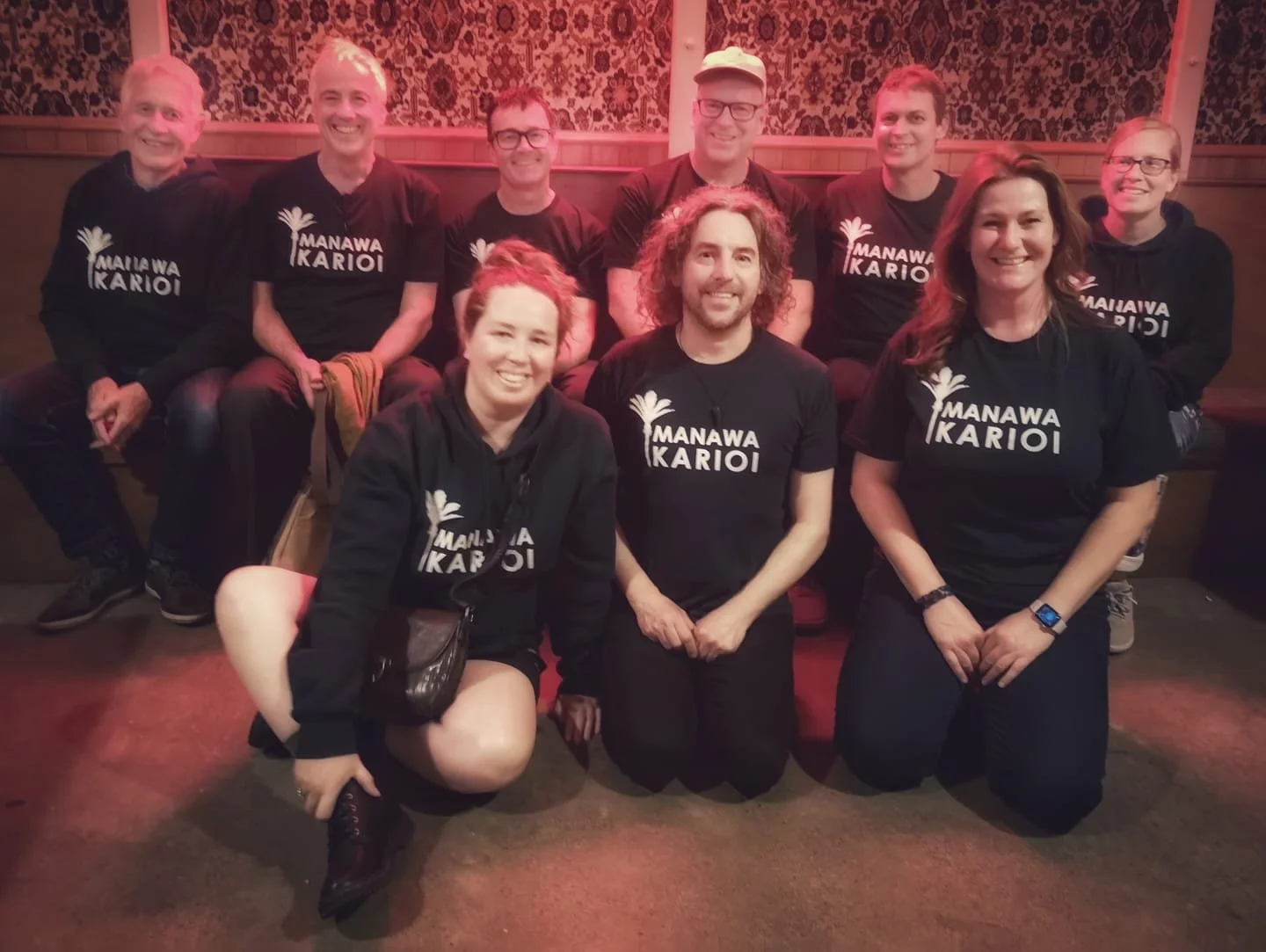
It was a fun evening with the quiz, spot prizes, silent auctions and a raffle. A slide show showing volunteers at work (and rest) and various aspects of Manawa Karioi including the change in vegetation over the decades and the facilities for visitors such as the signage and the picnic table screened continuously throughout the evening. Manawa Karioi Society Chairperson Chris Livesey gave a short talk about the Manawa Karioi Ecological Restoration Project: its genesis through Koro Bruce Stewart and the Sisters of the Home of Compassion, its relationship to the Tapu Te Ranga Trust, what has been achieved over the 30 years since the first tree was planted, the vision for the Project and the critical role of dedicated Komiti members and the many volunteers who give their time to the Project.
Amongst the almost 120 people present were several honoured guests, people whose contribution has been crucial to the success of the Project over the years: Sister Margaret Anne and Sister Sue from the Home of Compassion, Marion Sanson and Chris Horne. Chris Livesey noted that unfortunately Jim and Eve Lynch and Sally Bowman who have all made major contributors had hoped to attend but were unable to do so at the last minute. Similarly, Pare Sannyasi from the Tapu Te Ranga marae whanau but intended to be there but was unable to make it at the last minute. Chris also noted the major contributions of Peter Russell and the late Barbara Mitcalfe to the Project.
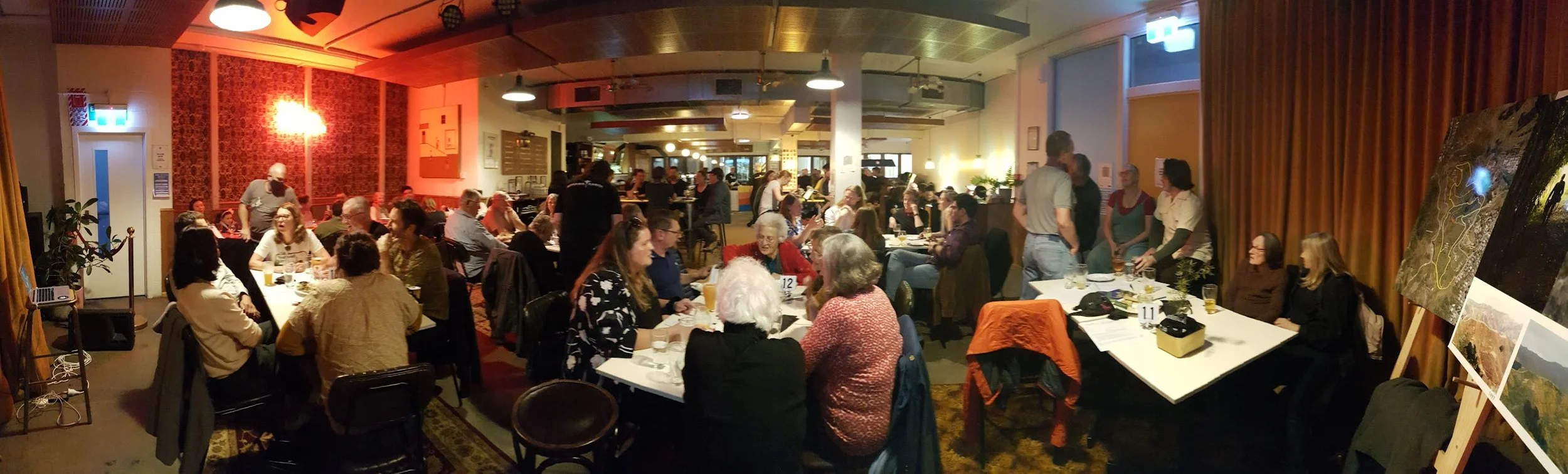
The evening raised about $4,043.70, a tidy sum that will cover the operational expenses at Manawa Karioi for a year or two and assist with some special projects. A number of attendees at the celebration also took the opportunity to support the Manawa Karioi Society by signing up to become members.
Our deep thanks go to Parrotdog for their very generous support of the evening, to all the donors of the items for the silent auctions and the raffle prizes, and to the members of the Manawa Karioi Komiti who worked with Parrotdog and organised the evening.
Onwards with the next 30 years!
Lockdown Weed Eradication - We would love your help!
We hope you are all doing well during Level 4 lockdown. You may find that you’re spending some time in the garden, and here’s a way you can help us with our ecological restoration project without leaving your property.
At Manawa Karioi as with all similar projects, controlling environmental weeds is a high priority. These are weeds that can take over an area thus preventing natural regeneration of native plants, or even kill off fully-grown native plants. This is especially true of vines, which will wrap themselves around trees and smother them.
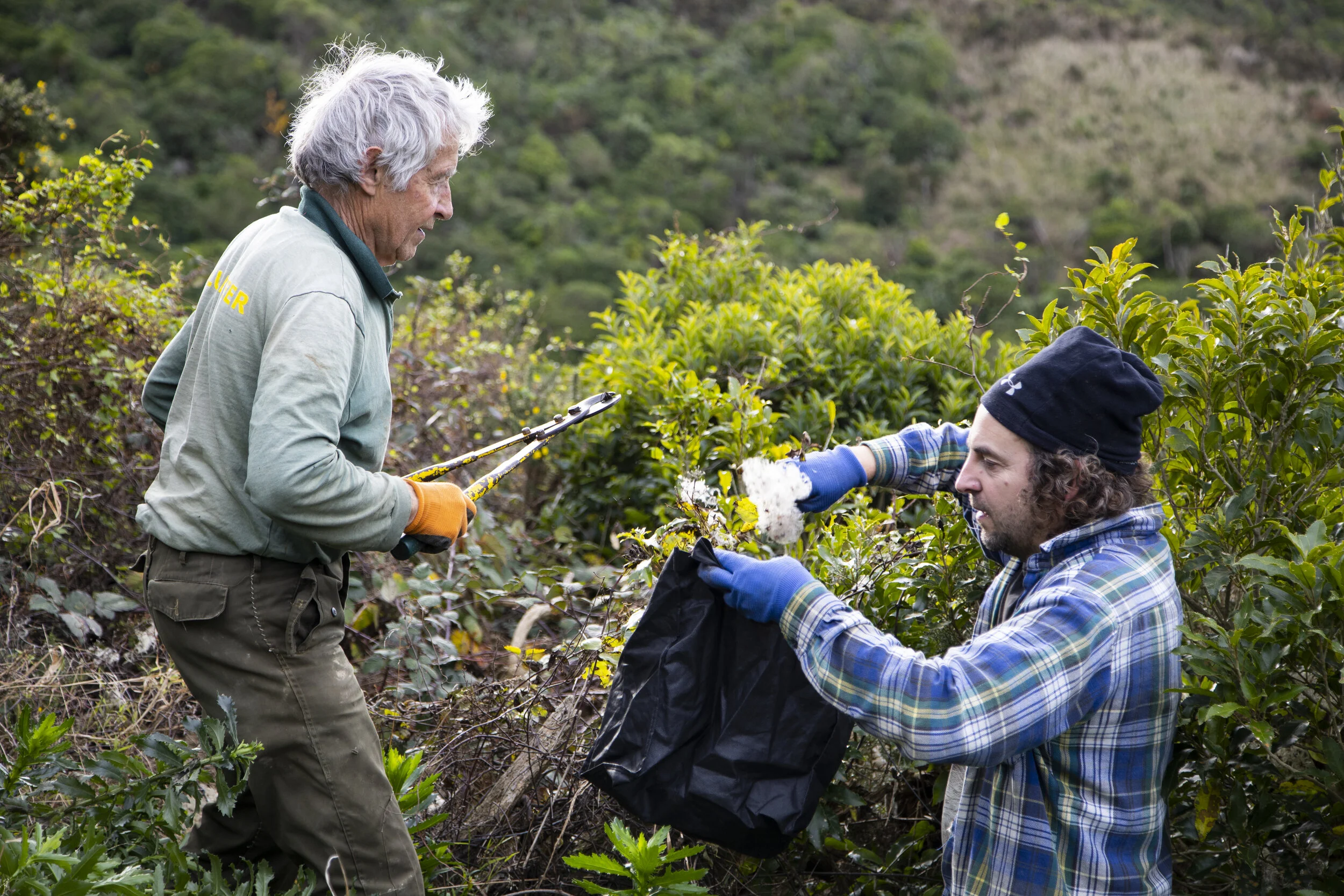
Chris Livesey and Tom Box removing the Old Man’s Beard weed found at Manawa Karioi. See more photos on the NZ weedbusters site.
We have spent more than 20 years knocking back some major infestations of Japanese Honeysuckle and Old Man’s Beard. In the last 5 years we have had to start doing the same with Climbing Asparagus, which has made an unwelcome appearance in a few locations.
We are doing well in reducing these 3 weeds at Manawa Karioi, and neighbouring reserves and groups such as Tawatawa Reserve, Paekawakawa reserve and Friends of Owhiro Stream are also knocking them back. We would love your help.
We can eliminate these weeds, but if they are found in the gardens of properties on or near our boundaries, the seeds of these weeds can keep on reinvading. Take a look in your garden and see if they are present. If they are, try eradicating them. This will help prevent them from spreading to your neighbours and our reserve. Below is a brief description of these weeds, information on how they spread, and how to eradicate them.
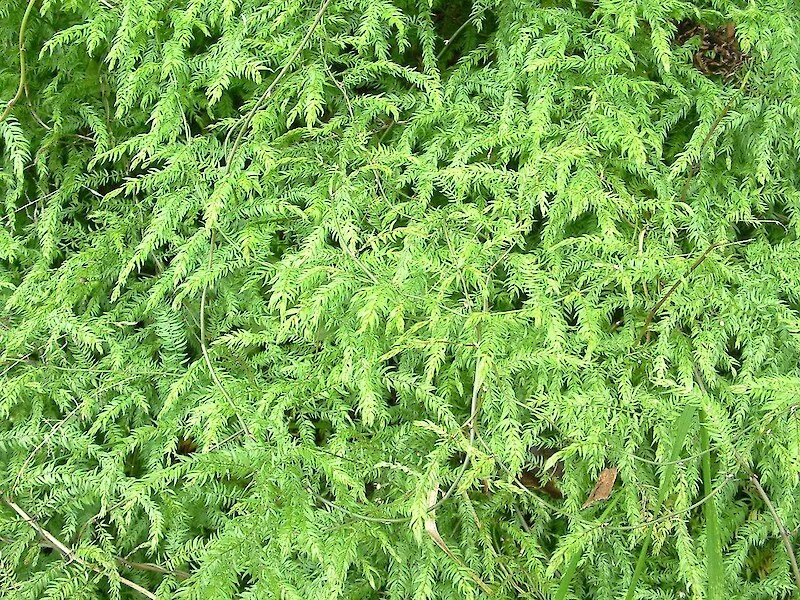
Climbing Asparagus - Photo: Carolyn Lewis. See more photos on the NZ Weedbusters website.
Climbing Asparagus (Asparagus scandens)
This is a vine that originates from South Africa. It tolerates deep shade and can invade even established forests. It grows quickly and can strangle smaller trees and shrubs. In open areas, it can form a dense mat and prevent seedlings from growing.
Tiny white flowers appear from Sept-Dec, followed by small round berries that change from green to red-orange when they ripen. Birds can eat the berries and spread the seed in their droppings.
If you find it in your garden, you need to make sure you dig the plant out by the roots using a garden trowel. Smaller vines can be carefully plucked out of the ground. If the stem snaps off at ground level, the vine will grow back. Climbing asparagus material with seeds should be bagged and put in a landfill. Whereas the plants without seeds can be hug up to dry then composted or put in the greenwaste after the tubers are completely dried out.
Some herbicides for vines can also be used from September-April when the weather is warmer and the plants are experiencing active growth.

Japanese Honeysuckle - Photo: Carolyn Lewis. See more photos the NZ Weedbusters website.
Japanese Honeysuckle (Lonicera japonica)
This weed was once commonly grown as an ornamental plant for the garden, sold in garden centres. Its’ stems grow more than 2 metres a year, smothering all in its’ path. It produces Creamy-yellow flowers from Sept-May, followed by black berries 5-7mm in diameter. Birds eat the berries, thus spreading the seed. Cut stems (sometimes dumped by lazy gardeners onto public reserves) can re-sprout and create new infestations.
It needs to be dug out by the roots, with stems and roots hung up to dry or disposed of in a rubbish bag or at the green waste section of the southern landfill.
Some herbicides for vines can also be used from September-April, when the weather is warmer and the plants are experiencing active growth.
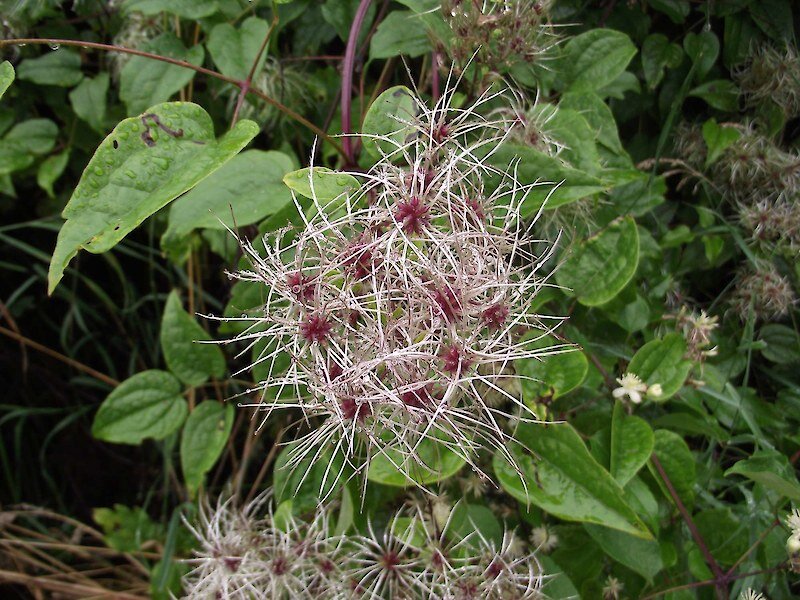
Old Man’s Beard - Photo: Carolyn Lewis. See more photos on the NZ weedbusters site.
Old Man’s Beard (Clematus vitalba)
This weed was once commonly sold in garden centres, and has spread into the wild in many parts of Aotearoa. It can be controlled by cutting stems and digging out the roots. Hang cut stems and roots up to wither and die, or dispose of in a rubbish bag or at the green waste section of the southern landfill.
Some herbicides for vines can also be used from September-April, when the weather is warmer and the plants are experiencing active growth.
If you can please have a look for these weeds in your garden and use this gardening time to get rid of them. Let us know what you’ve done too, it helps us monitor where these weeds are found outside of our boundaries.
If you know of occurrences of any of these weeds close to Manawa Karioi and you are unable to deal with them yourself (if they are not on your property, or they are on your property but the infestation is too large for you to deal with) please let us know. We are developing plans for extensive weed control in and around the areas of Manawa Karioi, Tawatawa Reserve, Paekawakawa Reserve and Owhiro Stream and a first step is to map the occurrence of these weeds in the area - any information you can provide will be very useful.
You can contact us here - manawakarioisociety@gmail.com
Written by Ross Gardiner
Manawa Karioi 30th Anniversary & Pub Quiz Fundraiser
Please join us for a fundraiser quiz night at Parrotdog to celebrate Manawa Karioi Ecological Restoration Project's 30th anniversary! Your ticket includes a free pint and snacks, spot and winning team prizes, an informative presentation about the Ecological Restoration Project, and a great pub quiz! We’ll also have a cash raffle with great prizes from Island Bay and Wellington region businesses. Parrotdog’s bar and restaurant will be open for additional purchases.
The money raised by this event will help pay for the tools, materials, and community outreach that is necessary for ongoing planting, weed control, animal pest control, track development, and maintenance mahi.
August Working Bees
Our August planting and track maintenance sessions will see us continue with our planting along sections of Te Ahi Ka - the main loop track around Manawa Karioi. For many years gorse and blackberry had been a major problem, spreading onto the track and making large sections impassable for a few years. A lot of work was put into opening the tracks up again, which allowed us to get on with our planting. As gorse and blackberry don't grow well in shade, the best way to prevent them from spreading is to create a 'hedge' of native plants along the track edges.
Along the sections of Te Ahi Ka furthest away from the Manawa Karioi nursery, this hedge has been a little patchy to say the least! Some areas were almost only gorse, while others had a light barrier made up of ngaio (which had been planted) and mahoe (which has been rapidly self-establishing itself at Manawa Karioi). In the more open areas with poor soil, subject to strong winds and becoming very dry in summer, we have been planting hardy species such as puka, taupata and akiraho. Where there is a bit of established native canopy we have been underplanting with small trees such as wharangi and kawakawa. These smaller trees fill in the gaps underneath and prevent weed species from establishing. This is especially important in the totara grove near the top of Te Uma i Mokotia.
Where Te Ahi Ka has better soil we are making sure to plant other species that are now uncommon in south Wellington. This includes rewarewa in the sunny spots and titoki in the lightly-shaded areas. These two species often grow together on north-facing slopes - you can see an example of this on the canopy walkway at Otari native botanic garden. Where the track crosses shallow gullies with established trees we underplant with kohekohe, which was once the dominant canopy tree in coastal areas.
Along with the planting we will take some time to do track maintenance work. This will include cutting back branches from the track edges and digging drainage channels to lessen the effect of water-runoff eroding the tracks.
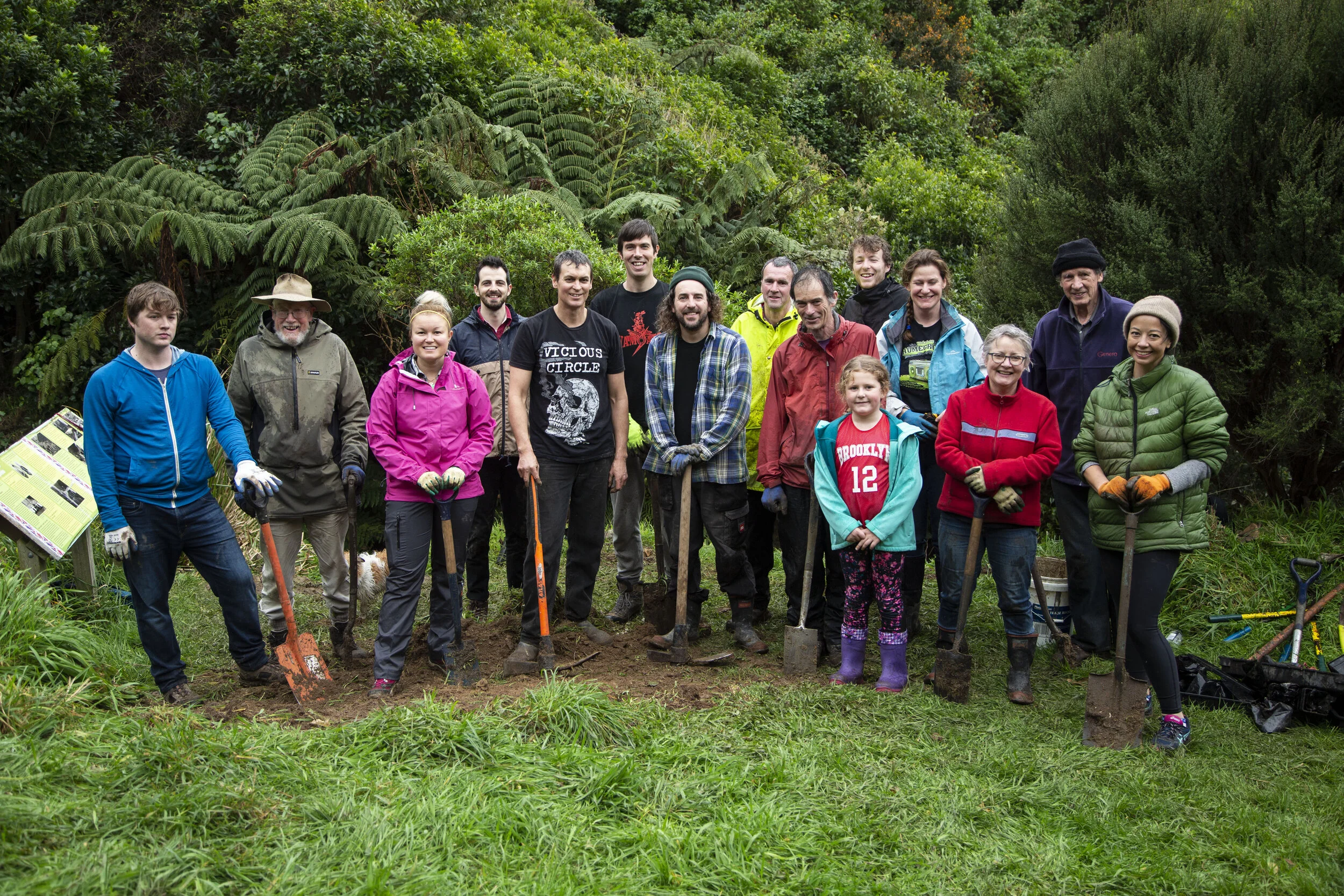
Our next working bees are planting, release weeding and track maintenance which will be
Sunday 1 Aug 2021, 1:00pm–3:00pm
Sunday 8 Aug 2021, 1:00pm–3:00pm
Sunday 15 Aug 2021, 1:00pm–3:00pm
Sunday 22 Aug 2021, 1:00pm–3:00pm
Sunday 29 Aug 2021, 1:00pm–3:00pm
Meeting at the Information Shelter in the Tapu te Ranga carpark at the end of Danube Street in Island Bay.
Register for our August working bees here.
Ministry for the Environment - Volunteer Day
We interviewed Charissa Billings and the team from Ministry for the Environment about their volunteer day organised via Volunteer Wellington.
How did the Ministry for the Environment's session at Manawa Karioi clearing tracks come about?
The Ministry are working with Volunteer Wellington on a pilot volunteering programme for teams. I assume following this first round of volunteering sessions, we will decide whether this is something the Ministry wants to continue doing in the future.

Tell me about your volunteer session, how was the experience for the group?
The team all expressed their enjoyment in getting out of the office and into the bush. Most of us had not visited Manawa Karioi prior to this, and were impressed with the history of the reserve.
Why was it important for The Ministry for the Environment staff to participate in the restoration project and what do you think the group got out of it?
This session was great for our team’s wellbeing, and helped us to feel connected to the environment which we work towards protecting and restoring. It was a great practical exercise to see the fruits of your efforts immediately.
Would you recommend the experience for other corporate groups/companies, for what reasons?
Yes, for the reason that making people more aware of local efforts to restore the environment can help enable people to feel they can make a small difference in their backyard towards restoring te taiao.
Tapu te Ranga Marae Documentary
Ruth Korver and I had limited resources to make this special story about Tapu te Ranga Marae come to life. It has been a huge buzz having the documentary feature on The Spinoff.
Thanks to Charlotte Muru-Lanning for this well-written article that brings the story up to date.
Ness Patea
Trappers Needed
Manawa Karioi is Wellington's oldest restoration project and we need your help to control introduced predators such as rats, stoats and weasels that threaten our native birds and lizards.
Whilst Stage 2 of Predator Free Wellington's rollout is from Island Bay to the CBD, is does not
include Manawa Karioi. We want a safe environment for our visiting Kererū, Kākā and Kārearea so they can nest safely in the reserve and we can help the recovery of these precious taonga.
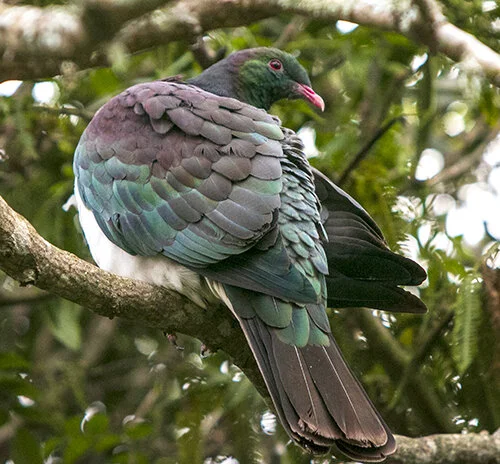
We are seeking volunteers to help clear and monitor trap lines in Manawa Karioi. Full training will be given by Wellington City Council.
If you are keen to help bring back the birds to Manawa Karioi please contact Annie on annieontour74@hotmail.com or call/text 027 440 0129.
Students visit Manawa Karioi
Our chairman Chris Livesey had a busy time with groups visiting Manawa Karioi lately. We are really happy with the recent community engagement as it aligns with our mission statement. Here is a report that was written by Chris Livesey about the busy week.
———-
Last Thursday teachers brought 85 children from Sacred Heart Cathedral School in Thorndon for a visit as part of their learning about the environment. They all arrived in a double-decker bus, I gave them a talk about Bruce, the marae and Manawa Karioi and then they went off to walk around Te Ahi Kaa. At the end of my talk, I was told that the children had been raising funds for us and they presented us with a donation of $100.
On Friday a group of Third Form Rongotai College students and three teachers came to do volunteer work on the student's annual Social Action Day - I put them to widening the top section of Whakaturanga and then a section of Moemoea towards the Golf Course. This is the third year that Rongotai College students have come to us on their Social Action Day.
On Saturday, I had 5 boys for 2 hours doing volunteer work as part of earning their Duke of Edinburgh award - they did track maintenance work on the track called Wawata.
On Sunday, I had a group of students (and their lecturer, Rebecca Priestley) from Victoria University. They came as part of the new Sustainability course that Rebecca is running. We did a bit of track widening and vegetation trimming on Union Road, some weeding of the new plantings around Greens Lookout and some track maintenance on Wawata.
When setting up the visit, Rebecca had said that they would like to give us a koha and said that the easiest thing for them was to give a gift voucher - I said that a gift voucher for fuel would be very useful. At the end of the day, Rebecca gave us a $100 fuel gift card for the scrub bar that we use to mow the tracks to keep them easily passable.
Manawa Karioi Society Inc. - Chairperson’s Report 2019 - 2020
(The on-site aspects of this report cover the period 1 September 2019 – 31 August 2020 so that all the 2020 planting activity is covered; the financial aspects cover the Society’s financial year, 1 July 2019 – 30 June 2020.)
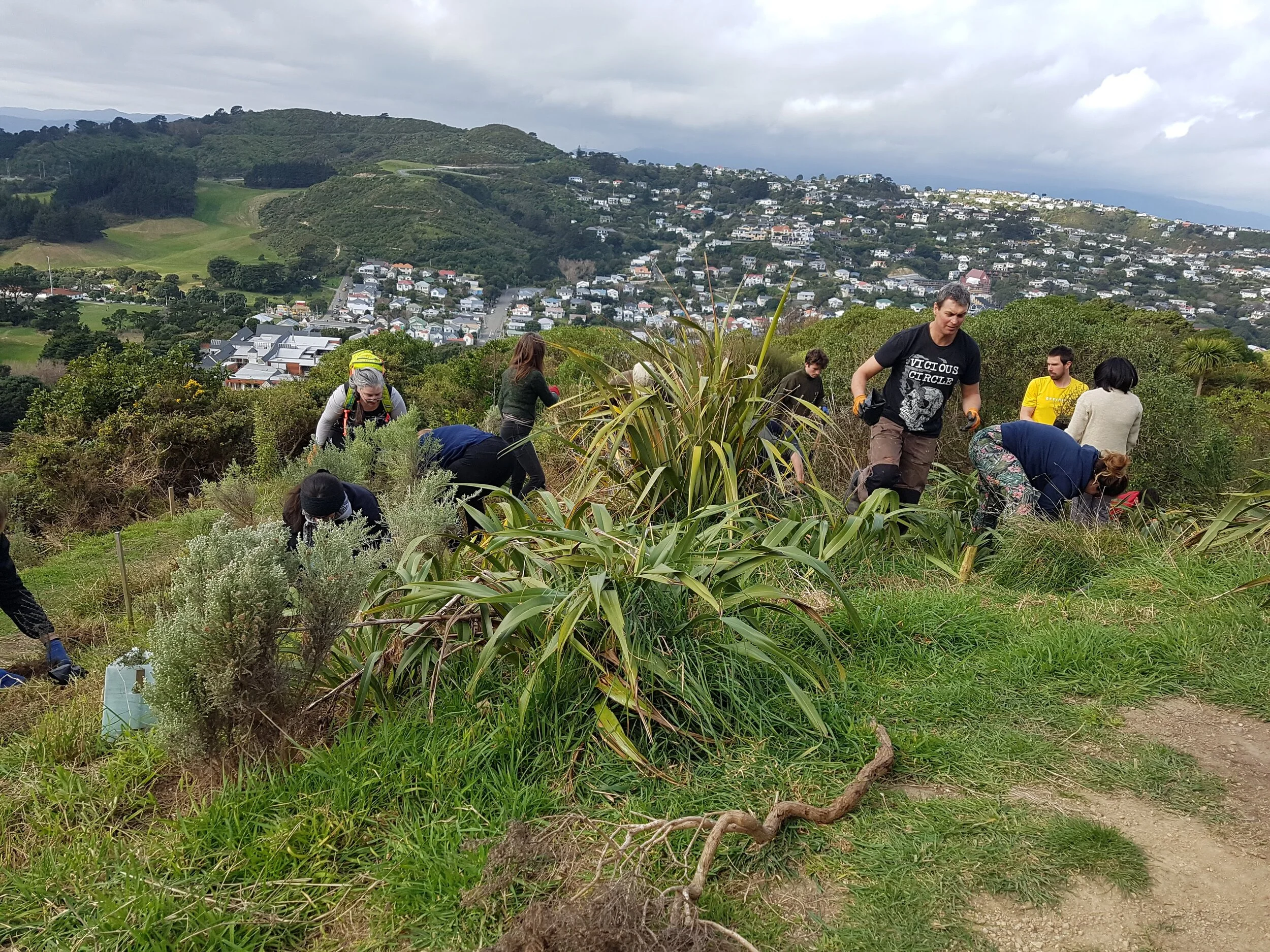
Once again I am pleased to report that the Society has had a very successful year.
The tragic fire in the marae buildings in June last year still leaves a huge hole, both physically and mentally. As I noted in my report last year, Kaumātua Bruce had always been clear that Manawa Karioi is part of the marae and until rebuilding takes place, Manawa Karioi continues to be the primary visible face of Bruce’s vision for the marae.
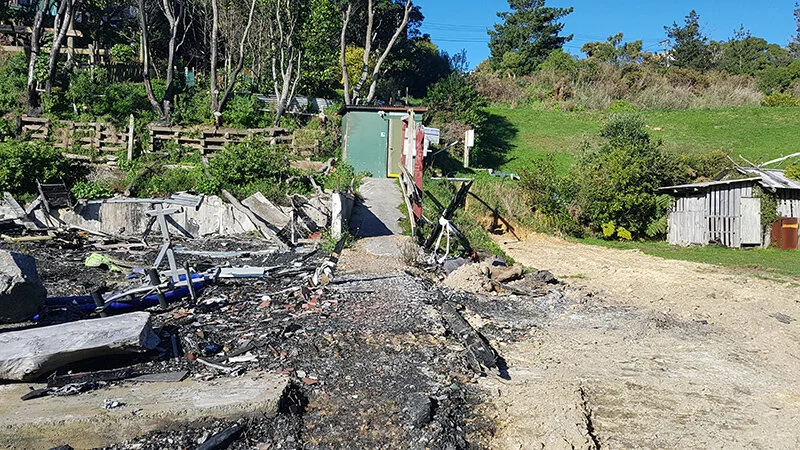
Relations with the Tapu Te Ranga Trust and the marae whānau
The Society has enjoyed constructive contact with the marae whānau throughout the year and has maintained communication with the Trust, as required, through Dean Stewart (General Manager, Tapu Te Ranga marae). The whānau have frequently expressed their appreciation of the mahi done by the Society.
During the year the Trust has been developing a master plan for the rebuild and consulted with the Society regarding a proposed wetland and a risk assessment for the marae, including Manawa Karioi.
The Komiti and members of the Society
Once again I would like to acknowledge the major contributions made over the year by the members of the Society’s Komiti (Ross Gardiner, Vanessa Patea, Tom Box, Tim Owens, Kevin Thomas, Mary Thomas, Paul Blaschke, Papri Paul, Jerry van Lier, Johanna Knox) – these people’s efforts are absolutely critical and are what drives and enables everything that we accomplish at Manawa Karioi.
I would also like to acknowledge all other members of the Society – your membership is a valuable form of support for us.
Volunteers
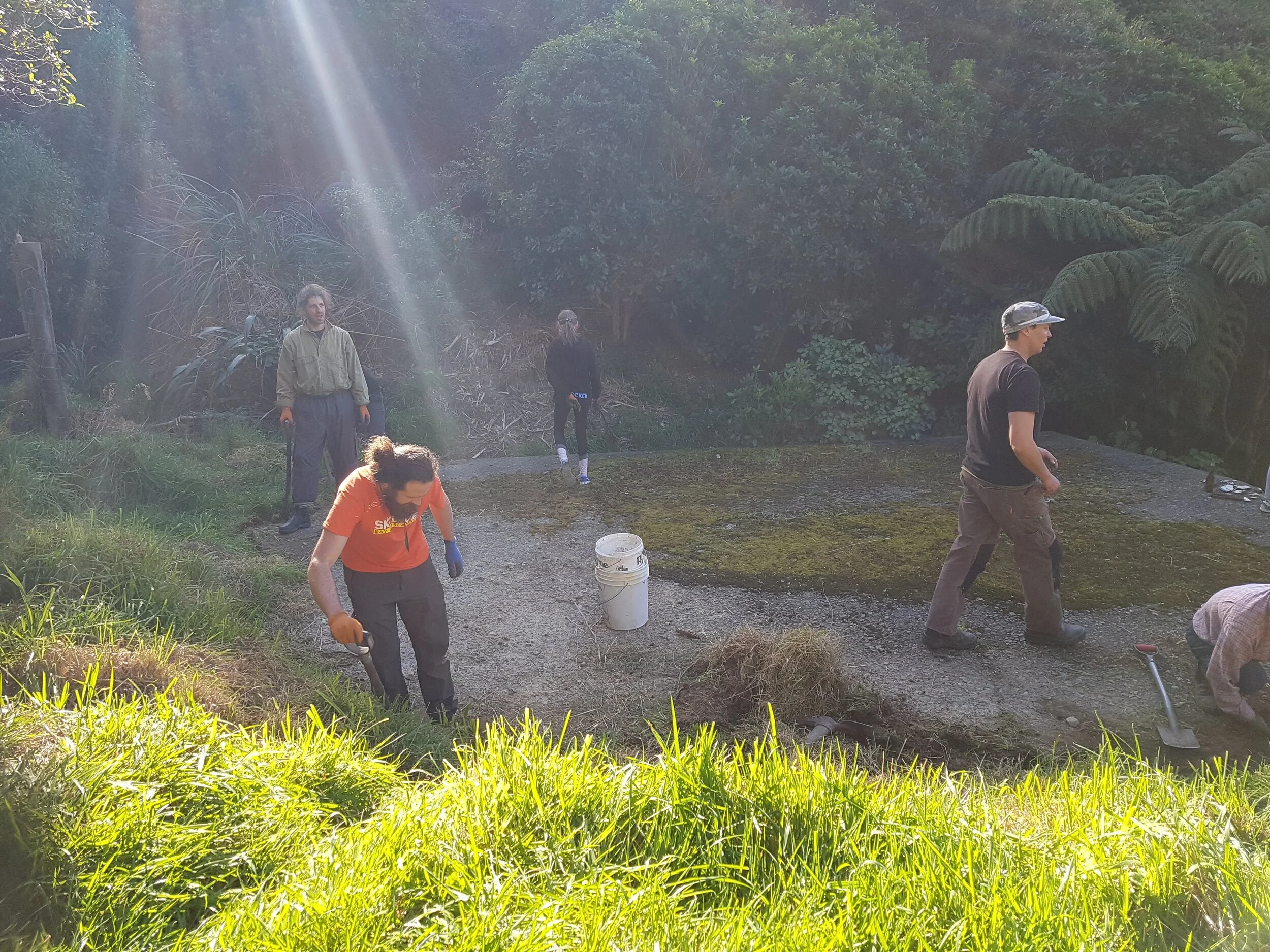
As always, we are critically dependent on volunteers. Ross Gardiner’s write-ups to publicise our working bees, Mary Thomas’ follow-up emails re. working bees and Ness Patea’s attention to the website, fabulous photography and mastery of social media have resulted in a steady stream of volunteers.
Our membership of Volunteer Wellington has also been important for bringing volunteers to Manawa Karioi. During the year we hosted three groups of volunteers arranged through Volunteer Wellington: staff from Z Energy, Treasury and Ministry of Foreign Affairs and Trade. We received a Volunteer Wellington award for excellent hosting of groups.
In addition, we had a volunteer group of staff from Xero (organized by Kevin Thomas) and once again, a group of Rongotai College students on their Social Action Day.
In 2019-20 we recorded over 600 hours of on-site volunteer labour (worth at least $15,000 @ $25/hr): at least 500 volunteer hours at working bees and more than 60 volunteer hours from Komiti members at other times. Turnout at working bees ranged from 12 – 30.
In addition to their on-site work Komiti members have contributed substantial amounts of time organizing activities, keeping the accounts, fund-raising, collecting information for the signage project, etc.
Planting
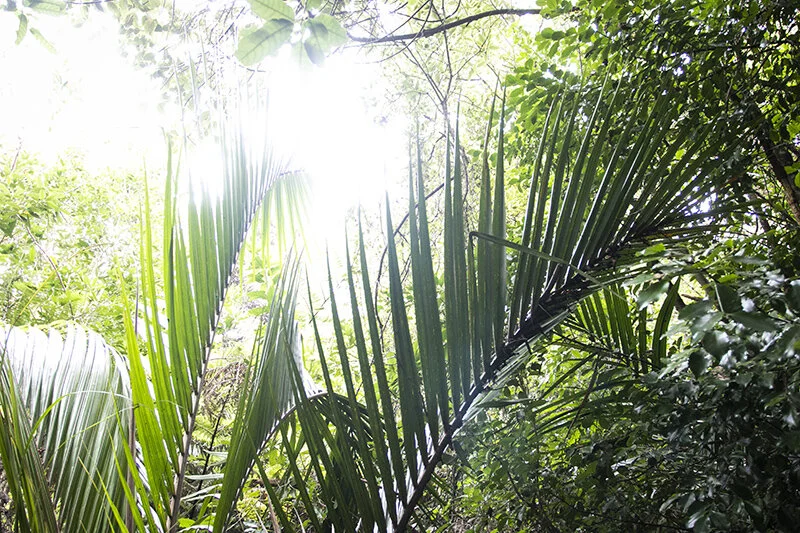
Ross Gardiner again ably identified our planting needs and arranged for the supply of trees. As I noted in last year’s annual report, now that canopy cover has been achieved over most of the plantable area in Manawa Karioi, the focus is shifting from mass plantings of pioneer species to selective planting of late- succession and climax species.
Planting during 2020 saw at least 1150 trees planted during four planting bees in June and five in August.
Once again almost all of our trees for planting came from the WCC Berhampore Nursery – a very big ‘thank you’ to Wellington City Council for that – with a smaller number coming from Forest & Bird’s Highbury nursery and from the Southern Environment Association (SEA) – a big ‘thank you’ to Forest & Bird and SEA.
Rabbits
In the open, warm area around Greens Lookout rabbits are a problem: they have decimated many of the plantings done there this year. I have retrofitted some homemade protection devices and, in consultation with Ross Gardiner and Paul Blaschke, have purchased a pack of 25 plant protectors. Hopefully these will enable most of the rabbit-damaged plants to recover.
I think that we should consider investing in a further 100 plant protectors before the 2021 planting season so that we can effectively protect our plantings in rabbit areas.
Whenua plantings
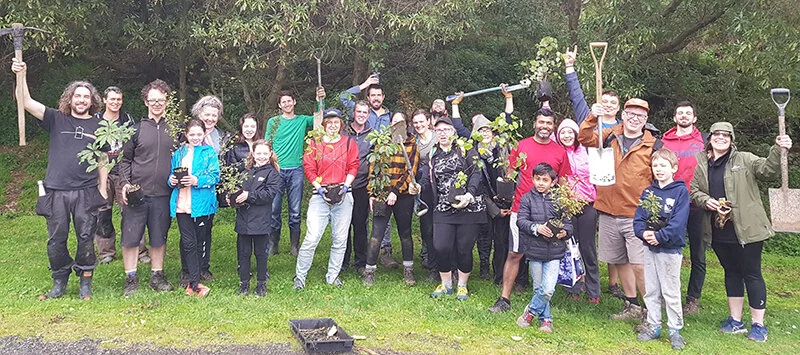
One whenua burial and planting was made during the year and the family involved gave a very generous donation to Manawa Karioi. The fact that whenua plantings are welcomed at Manawa Karioi is now on the Society’s website.
The need to record the location of whenua plantings has been agreed on for several years and is something that I think we need to actually do over the next year. I envisage a digital database that would be able to be accessed by the Tapu Te Ranga Trust, designated officers of the Society and the families involved – details around exactly who would be able to access how much of the information would need to be worked out.
Releasing of climax plantings
I am increasingly concerned that significant numbers of climax species plantings in Manawa Karioi may be in danger of being suppressed or dying from lack of light. If this is correct I think that we should aim to recruit and train a small group of volunteers to recognize at-risk situations and cut back surrounding vegetation appropriately.
Weed control
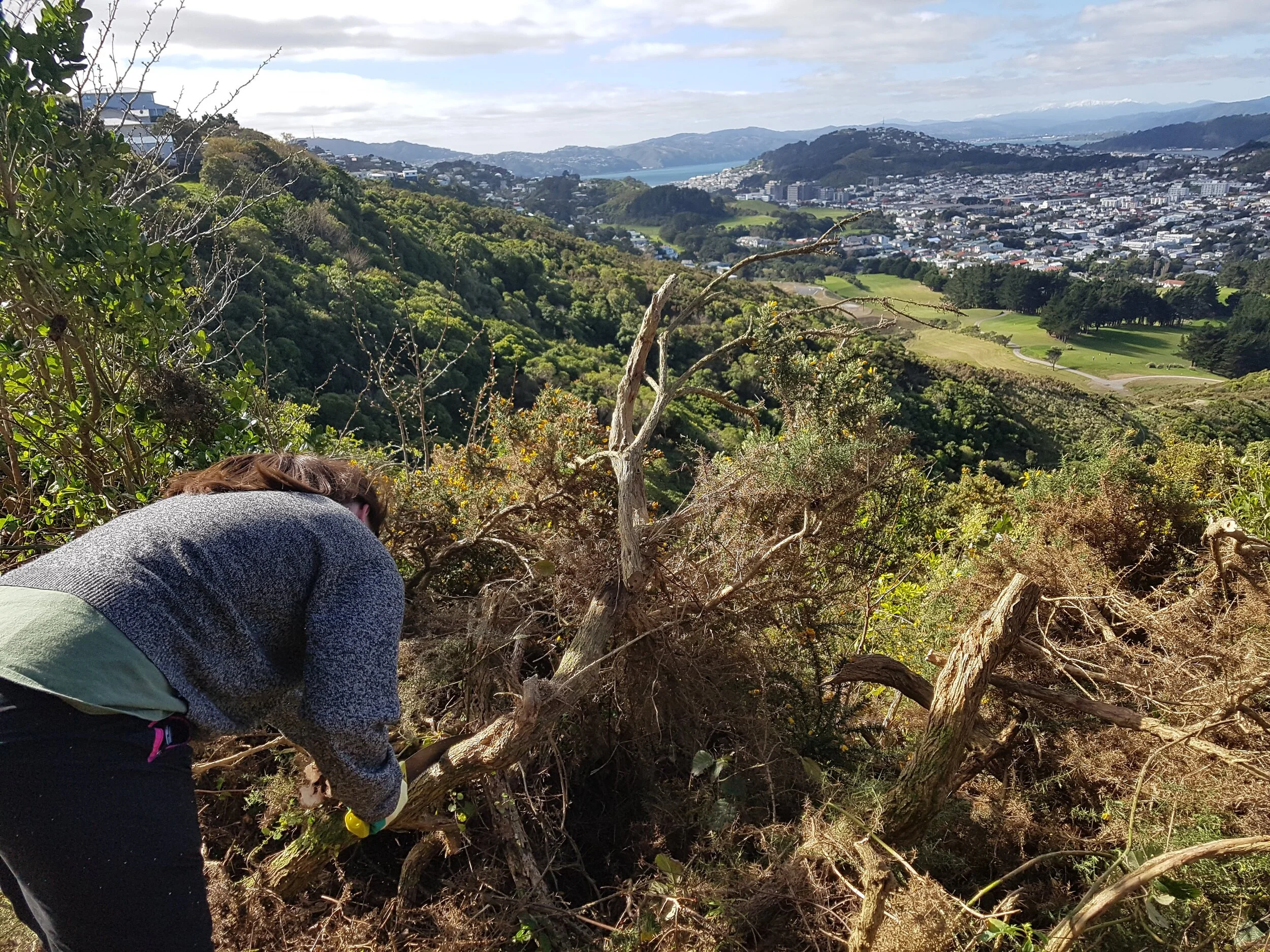
Ross Gardiner has continued his excellent work controlling weeds – primarily blackberry, Japanese honeysuckle and tradescantia – and I have continued poisoning wild cherries. Several infestations of climbing asparagus fern have also been dealt with.
During the year Paul Blaschke has advanced the concept of a Southern Suburbs Co-ordinated Weed Control Strategy involving Manawa Karioi, Paekawakawa Reserve, SEA (Tawatawa) and Friends of Owhiro Stream.
In December members of the four groups travelled to Matiu/Somes for a weed control workshop with Peter Russell and in July we had an afternoon of field visits to each of the areas that the groups work in, followed by a discussion session. That session established an Action Group that was asked to report back to the larger group by the end of October.
We have informed Taranaki Whānui (Port Nicholson Block Settlement Trust, Wellington Tenths Trust and Palmerston North Māori Reserves Trust, Te Rūnanganui o Te Āti Awa ki te Ūpoko o te Ika a Māui), Ngāti Toa Rangatira and also the two Paekawakawa Ward city councillors, of the Co-ordinated Weed Control Strategy initiative.
Control of animal pests
Chris Walsh, a resident of Rhine St and active supporter of Manawa Karioi, continued his modest trapping operations in Manawa Karioi with traps supplied by Predator Free Island Bay.
Note: in early September 2020 a grant of $7.6M to Predator Free Wellington (PFW) was announced as part of the Government’s Jobs for Nature programme and PFW outlined its plans to rid the Wellington Peninsula of predators in 5 Phases over 5 years. Phase 1, the Miramar Peninsula, is almost completed and Phase 2, scheduled for 2020-21, is to be Island Bay to the CBD. Manawa Karioi is included in the area to be covered by Phase 2 but I am not clear yet whether PFW will actually do the trapping and monitoring at Manawa Karioi or whether they will just provide the equipment.
The work we are embarking on in collaborative weed control may well be helpful in working towards a coordinated approach to trapping and animal pest control in our four areas and adjoining areas.
Encouraging recreational use
Track maintenance
Our team of track mowing volunteers put together by Ross Gardiner continued their great work throughout the year using the new scrub bar.
This year the last two sections of track formation were completed: the section of Whakatūranga linking the top of Seed Source Gully to Te Uma i Mokotia, and the section of Te Uma i Mokotia linking Greens Lookout to Moemoeā.
There will be ongoing work to widen some of the tracks and to cut vegetation back to keep the tracks easily and safely passable.
My observations suggest that water flowing down the tracks after heavy rains may be starting to erode some of them – I wonder whether this is being aggravated by mountain bikes using the tracks. I think we need to monitor this closely and where it is an issue, establish appropriate drainage before any significant erosion takes place.
Signage project
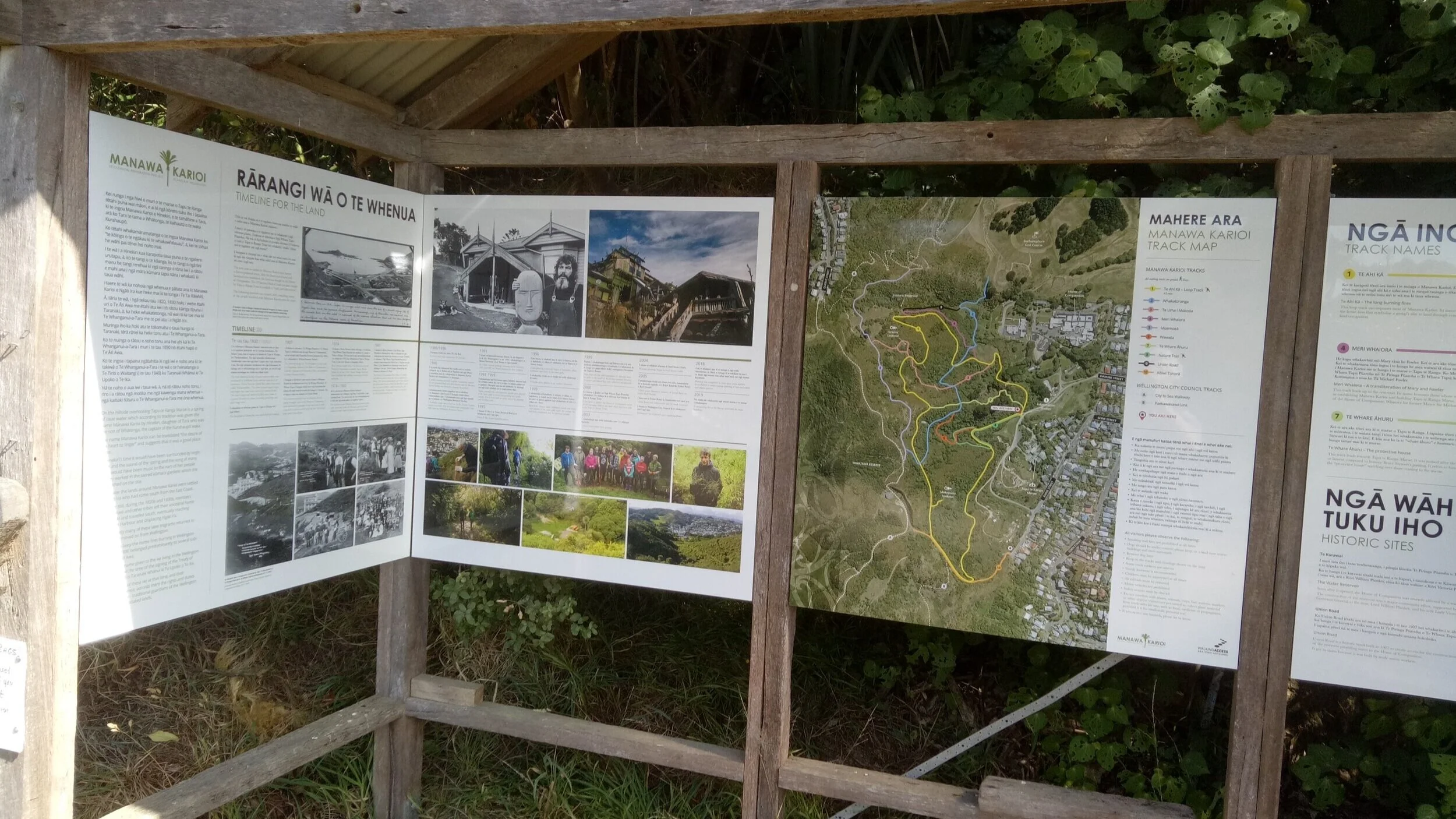
During the year Ness Patea again put a huge amount of work into pulling together the text and images for the new map panels, the new panels for the Information Shelter, the new panels for Seed Source Gully, the new panels for the reservoir and the track markers.
Two members of the Wellington MENZ Shed helped me install map panels at each of the six entrances to Manawa Karioi and at the reservoir. Various volunteers helped me install the new panels in the Information Shelter, one of the Seed Source Gully panels and all the track markers.
Two Seed Source Gully panels, two ‘Put your dog on a lead’ signs and the new reservoir panels are still to be installed.
In 2018 the Walking Access Commission approved a grant of $5000 towards our signage project and feedback from the Commission on the completed work was very complimentary.
Also, a number of us have received very positive feedback on the map, the information panels and the track signs from people we have met around Manawa Karioi.
Facilities development
The picnic table was installed by the reservoir in September 2019.
Covid-19 and recreational use
Covid-19 has been a great threat and challenge throughout the country since early 2020 but one of the upsides for us is the large number of local people who discovered Manawa Karioi during lockdown. Our tracks were extensively used during lockdown and I met many people who said “We had no idea that this was here – we only discovered it during lockdown”.
Health and Safety (H&S)
Covid-19 has been the big H&S issue this past year. We stopped all work at Manawa Karioi during Level 4 lockdown and developed appropriate protocols and practices for working there during Levels 3 and 2. No working bees were held during Level 3.
H&S briefings were given at the start of each working bee and at Level 2 this included collecting contact details of all volunteers.
We had no Health and Safety incidents during the year.
Capturing the history of Manawa Karioi
The Manawa Karioi project was kicked off at a dawn tree planting ceremony in June 1991 so in June next year the project will celebrate its 30th anniversary. All the key people involved in the early days of Manawa Karioi are getting older (some have passed away) and now seemed an appropriate time to capture both the natural and the cultural history of Manawa Karioi to date.
Johanna Knox, Paul Blaschke and I have developed a 2-phase project: Phase 1 (from now until the end of 2020) will collect the base information through interviews, written documents and images; Phase 2 (as long as it takes in 2021) would use that base material to craft ‘stories’ that would engage the interest of the public – what form the ‘stories’ would take would partly depend on what base material was available and would be decided at the end of Phase 1.
We have discussed the project with Dean Stewart (Tapu Te Ranga Trust) and Pare Sannyasi (marae whānau) and have their blessing to proceed. Johanna Knox has volunteered to undertake Phase 1.
Engagement with our neighbours
Paekawakawa
In October we joined with Paekawakawa and SEA for a joint working bee on the new track from Te Ahi Kā/Kōiwi Tohorā that links Tawatawa Reserve with Paekawakawa Reserve. This track is now passable.
Southern Environmental Association (SEA)
We have continued to consult as necessary and work cooperatively with SEA who manage Tawatawa Reserve. SEA provided us with some plants and a very generous donation towards our track signage project.
Paekawakawa/SEA/Friends of Owhiro Stream
We are working with these three neighbours on the Southern Suburbs Co-ordinated Weed Control Strategy.
Wellington City Council
The Berhampore Golf Course and Tawatawa Reserve are Council land. Council officers have been involved with the early stages of the Southern Suburbs Co-ordinated Weed Control Strategy and the two Paekawakawa Ward councillors have been informed of this initiative.
Home of Compassion
The HoC held a Suzanne Aubert Heritage Centre Open Day on 3 November 2019 and as part of that Sister Margaret Anne and I took a guided walk up to the reservoir.
Engagement with the wider community
The Society now has 330 people on its email contacts list, all of whom receive notification of the regular postings (put together by Ross Gardiner and Ness Patea) on the Manawa Karioi website. This has been an effective way of attracting the volunteers on whom the Society depends for getting its work done.
Under the leadership of Mary Thomas, assisted by Tim Owens, we had a very successful stall at the Island Bay Festival’s Day in the Bay in February. In addition to displaying our map and publicity panels we sold donated baking and raised $321.40.
Once again we ran a Guided Walk through Manawa Karioi in February: this year it attracted about 25 people.
As mentioned above, one of the upsides of the Covid-19 lockdown for us was the number of local people who discovered Manawa Karioi.
Fundraising:
Sources of income, apart from the WAC and Trust House Foundation grants, during the year were:
Members’ subscriptions: $180.00
Members’ donations: $246.25
Give-a-little page online: $306.75
Koha: $604.20
Stall at Island Bay Festival: $321.40
Guided Walk (koha): $57.20
SEA donation: $300.00
DB Breweries (Karma Keg): $884.00
Tennent Brown Architects: $800.00 (in lieu of buying the trees)
Special thanks to Kevin Thomas for suggesting, negotiating and arranging the Karma Keg, and to Mary Thomas for organising the Karma Keg event at the Tuatara Third Eye.
Finances
The Society ended the 2019/20 year in a satisfactory financial position. At 30 June 2020 we had $1,088.89 in the bank and were waiting to receive the final payment of $2,386.47 from the Walking Access Commission for Signage Project costs.
This total of $3,475.36 is sufficient to cover the coming year’s ongoing operational expenses (which are estimated to amount to $700-$1,000) and to cover any modest unexpected one-off expenses. However, we will need to raise further funds this year for operational expenses beyond 2019/20 and for any special projects that we may embark on.
Special thanks to Papri Paul, our Treasurer, who has again kept track of our finances over the year and prepared the annual accounts. And thanks also to Maria Kerensiana who has done an extremely thorough job of reviewing the annual accounts.
Research and monitoring activities
There were no new research or monitoring activities at Manawa Karioi in 2019-20. Our involvement in the Waikato University-led People, Cities & Nature research programme continues “and we look forward to getting relevant results next year, the final year of the programme”.
Registration of Manawa Karioi under the NZETS
Nothing further has been done directly on this during 2019-20. However, I am involved in the registration process for a similar Wellington re-vegetation block and will utilize the experience I gain there to progress the registration process for Manawa Karioi.
The year ahead
Apart from:
the ongoing activities of weed control, the Southern Suburbs Co-ordinated Weed Control Strategy, the History project, planting and track maintenance
the likely involvement in Phase 2 of Predator Free Wellington’s programme
the three matters that I have mentioned above (establishing a database of whenua plantings; releasing at risk climax species plantings; assessing possible erosion on some of the tracks)
The following are matters/projects that the Society may wish to address over the coming year:
Developing facilities/programmes to help people, especially children, develop their relationship with different elements of nature
Kaumātua Bruce always emphasized that he wanted Manawa Karioi to be a place that helped people, especially children, come to understand that they are part of nature and to develop their relationship with different elements of nature.
As a first step towards this, in 2018-19 we gave a visiting French volunteer, Camille Eme, the task of researching how best to facilitate giving visitors, especially children, an in-forest educative experience. As part of this Camille interviewed a number of people in Wellington who have experience in this area. Camille provided us with a report setting out her findings.
On the new map panel showing the Manawa Karioi tracks we have identified an as yet undeveloped Nature Trail.
Developing a sculpture trail at Manawa Karioi
This idea was raised at the 2018 AGM and could be further progressed.
Discussion of whether, given the changes over the last 30 years, a Charitable Trust would now be a more appropriate form of governance for Manawa Karioi rather than an Incorporated Society
an Incorporated Society is based on membership, with members paying an annual subscription. To conduct its business in a way that meets the requirement of the law an Incorporated Society has to have a minimum number of financial members present at its annual (and other) general meetings and has to elect its officers (Chairperson, Secretary, Treasurer, Committee) each year at its annual general meeting.
in today’s world, formal membership and attending meetings are unattractive to many, especially younger, people who use social media extensively.
a Charitable Trust is not membership-based. Trustees are appointed when the Trust is formed and they, as the Trust Board, are then responsible for running the organization. Only members of the Trust Board are required to attend annual general meetings of the Trust, but the Trustees can invite whomsoever they wish to attend the annual general meeting or any other meeting of the Trust Board. Generally, the power to appoint additional, or replacement, Trustees lies with the Trustees.
Chris Livesey
Chairperson, Manawa Karioi Society
26 September 2020
Annual General Meeting - Manawa Karioi
Our Annual General Meeting will be held at 155 Washington Ave, Brooklyn, on Sunday 27th September at 1.30 pm. All Welcome.
20 Years Restoring the Forest - Q & A with Ross Gardiner.
Ross Gardiner has been volunteering at Manawa Karioi Ecological Restoration Project for 20 years, starting in early 2000. He is our resident expert on local planting, his knowledge of the site and history of the project is invaluable. We asked him some questions so we could record and share some of that expertise with other restoration enthusiasts.
Photos by Ness Patea

Why is this restoration project important to you?
It's come to be important for an increasing number of reasons. I initially got involved because for a number of years I had been thinking of getting involved in a tree-planting scheme because it seemed like the right thing to do. When I was a child a remember hearing of the devastation wreaked on the kauri forests (I grew up in Auckland, which contained a remnant of kauri forest in the Waitakere Ranges) and felt that one day I would like to do something to reverse that damage.
After I moved to Wellington in the mid-1990s I heard of a tree-planting project on Matiu island, but I didn't know how to get involved. No-one had websites back then, so finding a contact for a project could be difficult.
I went overseas for 18 months and when I returned I was determined to find a tree project to get involved in. Within a couple of months, I found out that a friend was living at Tapu Te Ranga marae and that he was a key person involved in the planting of what marae founder Bruce Stewart had deemed a "bush and bird reserve". It was then that I realised that when I had stayed at the marae for a few days 10 years earlier, the planting project back then had only just begun.

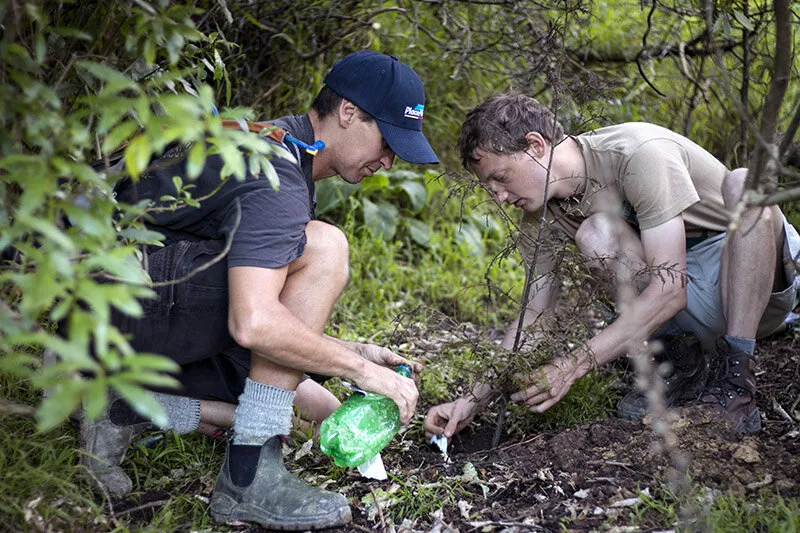
I didn't have much knowledge of forest ecology but was keen to learn. At that stage, most of the people involved in starting up the project had moved on, but there were a few knowledgable people around so I listened to what they had to say. That gave me a good grounding in the basics, and over the years I learned a lot by trial and error. I read as much as I could on the subject of native plants and did the Open Polytechnic course on Native Plants/Ecological Restoration (I passed with straight A-pluses!)
After a few years of involvement, I began to realise that there were a whole lot of other aspects of the project that were important that I hadn't necessarily been aware of at the start. Firstly, it wasn't just a tree-planting project, or even a "bush and bird reserve". It was far wider than that so we adopted the concept of being an "ecological restoration project". This acknowledged the concept that we weren't planting just a narrow range of trees, but we were making sure we were planting as many species that had become very rare in the Wellington area, thus restoring a balance there. We also understood that an ecosystem also involves lizards and invertebrates.
The spill-over effect of birds moving outwards from Zealandia (the "halo effect") has added another factor. I never thought that one day it would be common to see kaka flying around Wellington, and they have been making Manawa Karioi part of their range for almost 10 years now.

The sense of community has been another aspect that has become important to me. I liked Bruce's idea of "setting the land free" by making it accessible to the community, and by involving the community. This gives people a sense of belonging, and it has really paid off as we now get a lot of volunteers from the local community who have come to appreciate a great community asset in their neighbourhood.
What changes have you seen over the years?
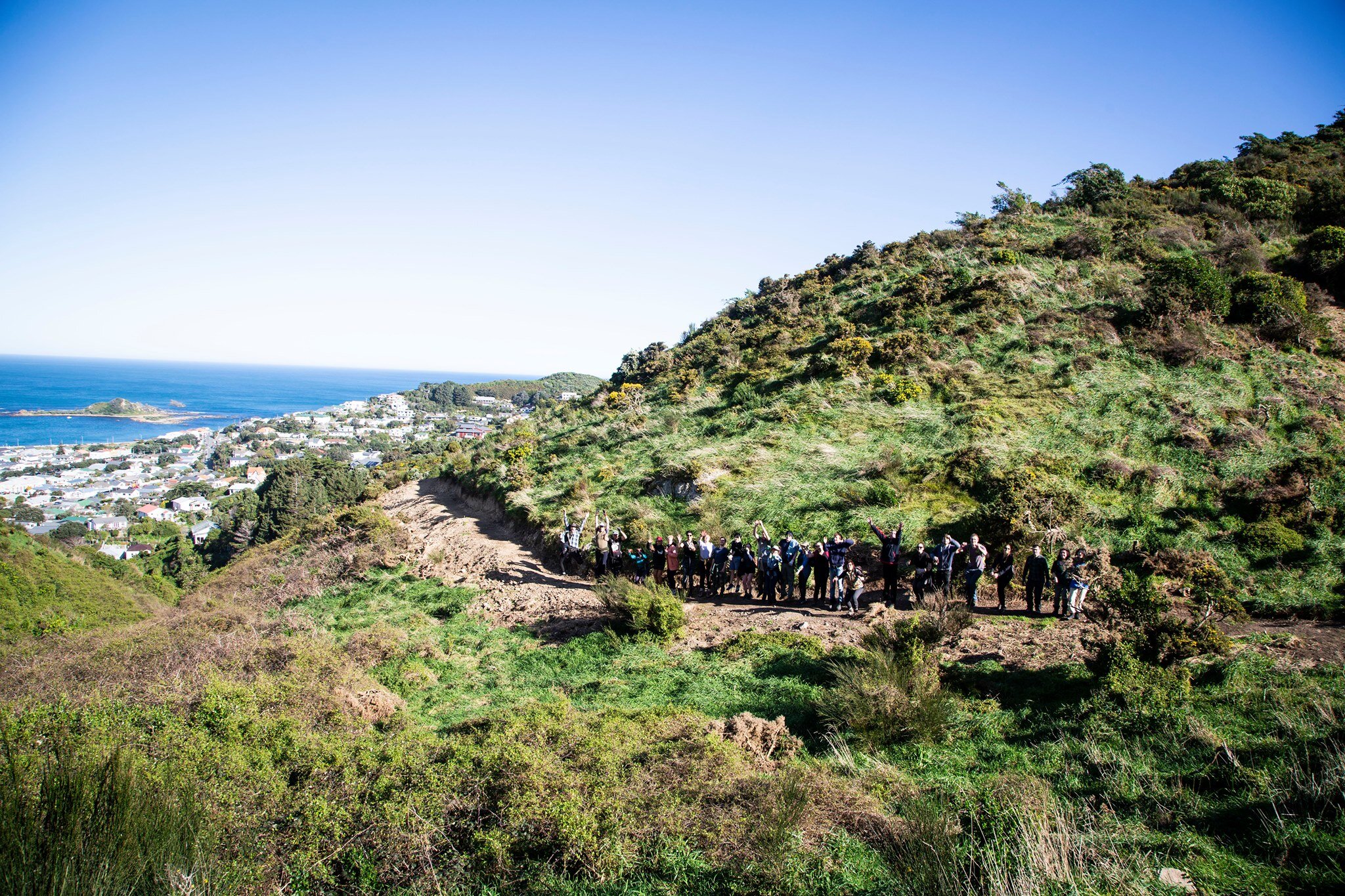
When I first got involved, it was largely a hillside covered in gorse and blackberry. Much of Te Ahi Kaa was overgrown with those plants, and was impassible in some areas. There were few other tracks. Most of our time was spent (wasted) cutting back the gorse and blackberry by hand, which was like sweeping the tide back with a broom. In 2004 we got a tractor in with a flail deck (a hardcore mowing attachment) which laid waste to the track-blocking weeds and suddenly our work got easier. We spent years planting fast-growing trees along the track edges to create a hedge to shade out the gorse and blackberry, thus keeping the tracks passable. We cut a few new tracks too. I had been involved long enough to view the project as being one of trying to eradicate the gorse, and never viewed it as anything but that. I largely viewed it in terms of 'where to attack the gorse next?'.
It wasn't until about 8 years into the project that I ran into a guy who had been involved in MK around the time I started, but whom had not been involved for several years. He told me that he had been for a walk there and described it as being 'like a park'. This made me step back and take a fresh look at it, and I realised that he was right. Instead of the main tracks being paths cut through the gorse, they were now more like a bush walk. We had begun to plant some of the rare and unusual species along the track sides and at track entrances so that as soon as people entered the site they could get the feeling that the bush was a lot different from surrounding areas of natural regeneration, which typically have a smaller range of plant species. In turn, this increase in forest complexity has seen an increase in bird species too, with kaka, kereru and karearea now being seen there; and with common species such as tui and piwakawaka becoming more abundant.

Another change has been the increase in volunteer numbers. We really struggled through the 2000s, and our progress was slower than it should have been. But there was a huge explosion in public awareness of community-based ecological restoration (one Christchurch group described their project as "a mini-national park in your back yard") combined with a local community who appreciated having such a project that was open to them to visit and get involved in. All it took was having effective communication and easy access to the relevant information to get things happening.

What do you think is the most important thing that you have learnt since being involved in the project?
I think it was viewing the project as ecological restoration rather than simply being tree-planting. When a forest habitat is created, it has many knock-on effects both ecologically speaking and in terms of human involvement. People come to realise that "wilderness" isn't just something in a national park, but something that is all around them. I love the fact that Wellington is in a transitory phase right now. The widespread clearing of forest (mostly by fire) in the 1880s created a city divorced from ecology, with only tiny pockets of bush and few native animals. People now would be surprised to know that in the early 1990s there were only about a 10 or so breeding pairs of tui around Wellington city. The Remutaka and Tararua Forest Parks were there, but they were a place you travelled to if you wanted to experience wild nature. Now due to the vision of a few people (including Forest & Bird Society) and support from Wellington City Council, we have a situation where that wilderness is now enclosing the city. Eventually it will reach the situation where it will be like the city is within a huge forest, rather than the forest being seperate and far away.

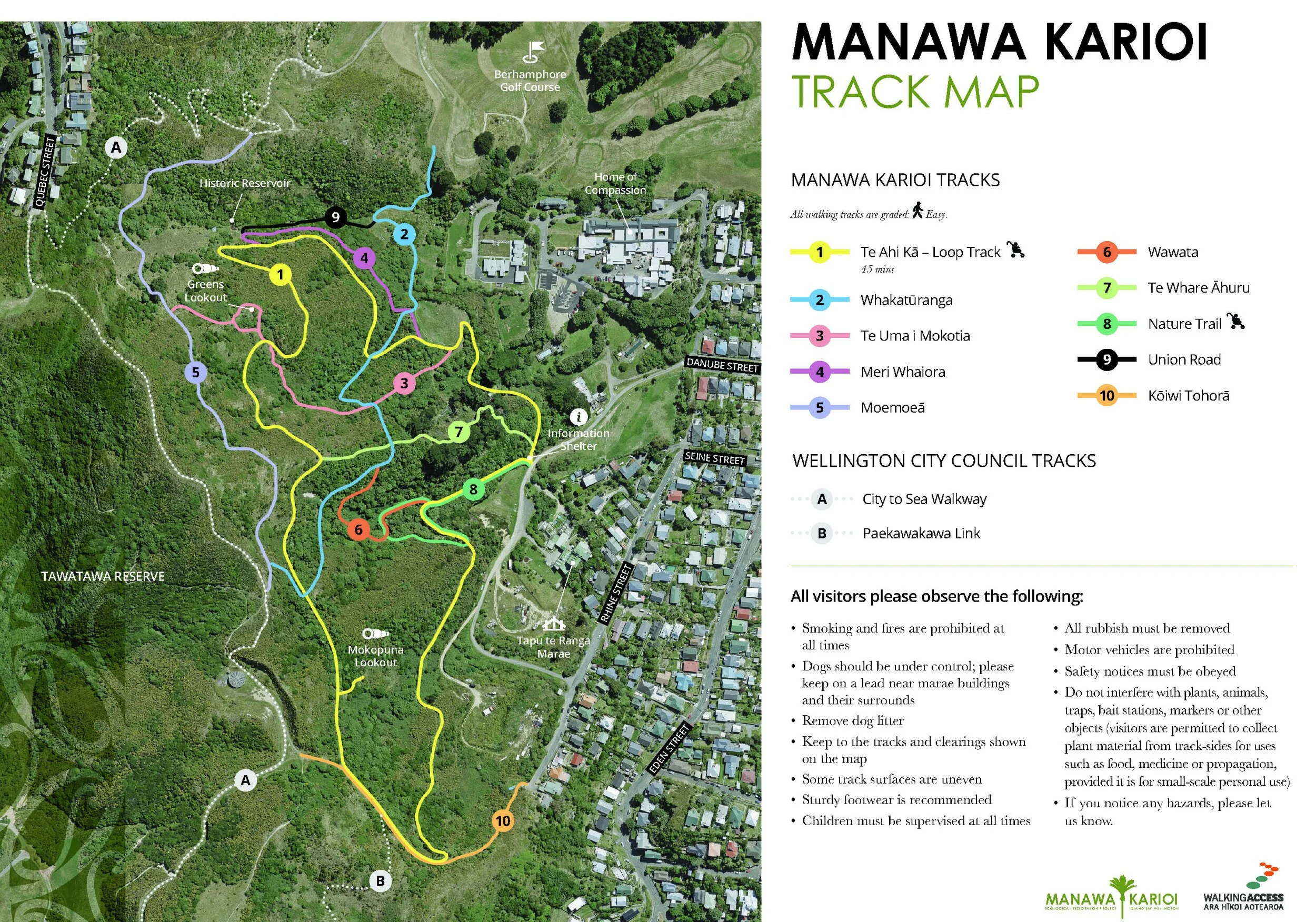
What tracks do you recommend for new people visiting Manawa Karioi?
To start with, walk around Te Ahi Kaa, and stop at the various view-points. Several of these have seats so you can site and take in the view. Once you have done this several times, you will begin to become familiar with how it connects to surrounding roads and reserves. Then start to explore the smaller tracks. Now that we have map boards at all the entry points, there is much less chance that you will get lost!
What do you think makes a successful restoration project?
A combination of things. You have to start with a clear aim. Plan out tracks. Things to consider when doing this include (in no order of importance) what are the best viewpoints? What areas need easy access for planting and for doing control of noxious weeds/pest plants? How can we involve the community as individuals and as existing groups? Establish effective communication with supporters via an email list, a website and social media. Make your working bees fun! They will sometimes involve hard and unpleasant work such as cutting gorse and carrying trays of plants to hard-to-reach spots, so combine those tasks with a bit of planting where you can. Many volunteers think that planting is all that a project involves, and it is certainly the task that people find the most rewarding. We learned that people will turn out in droves to do the planting, but aren't so keen to spend an afternoon cutting tracks through the gorse. By combining the two, we found that people were ok with doing the unpleasant tasks so long as they also got to do some planting too. This makes sense as people will come back to admire the growing forest; no-one comes back to admire the well-cut gorse!

What are your hopes for the future?
To see the project move on to the next phase. Our planting schedule will eventually wind down, but persuing the goal of eradicating mammalian predators will see native wildlife populations explode. As some larger species of birds such as kaka and kakariki need old trees with rotten hollows for nesting, we will need to start installing predator-proof nesting boxes for them so that they can start breeding on site. It will be at least 100 years before some of the podocarps (that's the forest-giant trees such as totara, matai, miro, kahikatea etc) get big enough to start providing suitable nesting sites for those birds.
2020 Guided Walk

We are hosting a unique environmental event, a guided walk through one of Wellington's oldest restoration projects. The walk is approximately one-hour duration and is suitable for people with a reasonable level of fitness.
We will be meeting at the information shelter, next to the Tapu te Ranga Marae carpark to commence the walk at 11am. Please bring good walking shoes, some water to drink and wear sunscreen or a hat.
This event is open to the public so please bring your friends or family. Dogs are welcome on a lead. Tracks are suitable for baby buggies.
Paekawakawa Link Track - Working Bee
Paekawakawa Link Track - Working Bee
Sunday 20 October: 2 - 5pm
Meeting end of Rhine Street
We're looking forward to helping our friends from Tawatawa Reserve and Paekawakawa Reserve complete the track that links the three reserves on Sunday, Oct 20.
The idea of the track was discussed between the 3 groups a couple of years ago, and with a lot of help from WCC (who own the land that makes up Tawatawa Reserve) and Conservation Volunteers NZ, the link track is already well underway.
The working bee will be starting an hour later than our usual time and will run from 2 pm - 5 pm on Oct 20.
We will not meet at our usual spot and instead will meet at the top of Rhine St, where it is just a 150m walk up Koiwi Tohora to the start of the new track.
There is plenty of parking on the side of the road, and if you bring a bike you can bring it up to the worksite.
Wear suitable shoes and clothing (it may be exposed to cool breezes). All tools and gloves are provided.
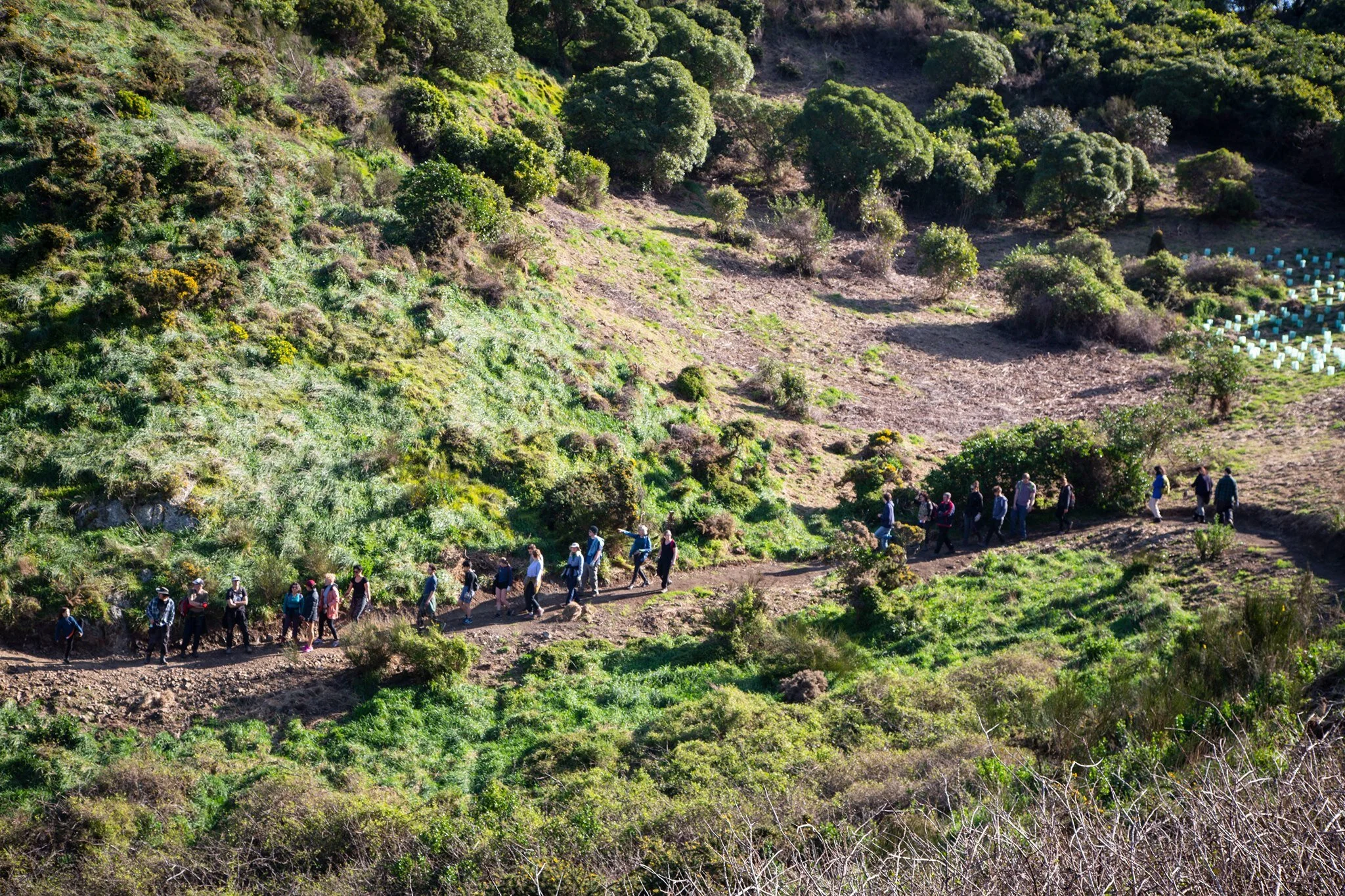
Like Manawa Karioi, Paekawakawa Reserve is privately owned. You can learn more about it here.
Manawa Karioi is only about 10 hectares, and Paekawakawa is even smaller.
Both reserves border onto Tawatawa (over 200 hectares) and also have a link track down to Owhiro Stream, which has its' own restoration group.
This creates an unbroken link of stream and bush from Owhiro Bay up to the highest peaks in the southern suburbs.
This is like a small version of Hinewai Reserve on the Banks Peninsula. For a bit of inspiration on how our reserves can grow together, watch this wonderful film "Fools and Dreamers".
A report from our Chairman - Chris Livesey

Manawa Karioi Trust Chairman, Chris Livesey has written a detailed report about the planting season and a summary of the activity and progress made at the reserve over the financial year.
The report includes information about the volunteer numbers, working bees, planting and weed control, facilities and track development, engagement with the community, fundraising, a financial report and some exciting plans for the future.
Tennent Brown Architects plant 200 trees
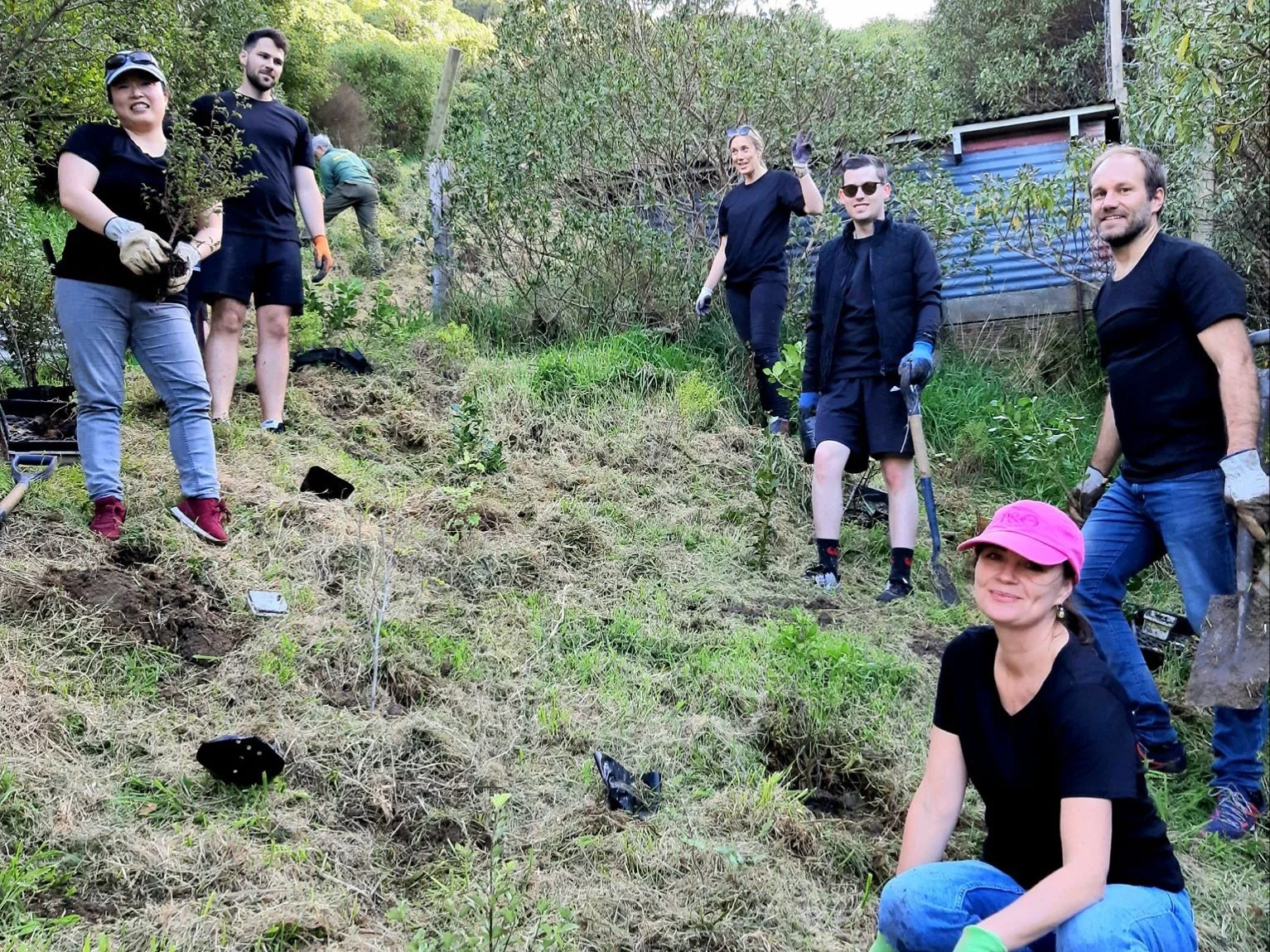
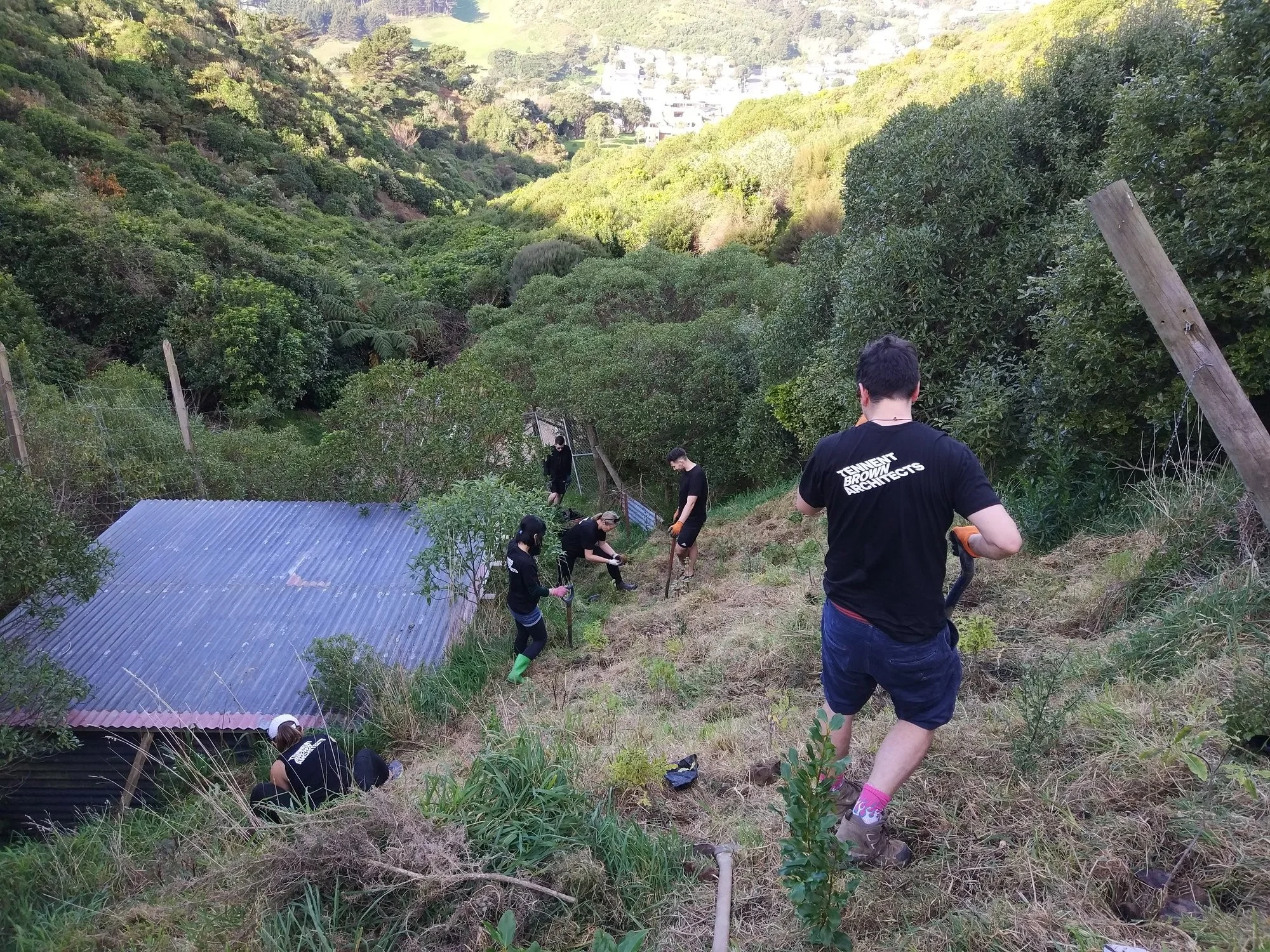
Caitlyn from Tennent Brown Architects got in touch with us to organise a tree planting session to offset their emissions for the financial year of 2018-19. They had a beautiful spring day, planted 200 trees and enjoyed a day outside as a team. We asked Caitlyn a few questions about the planting.
You have been to Manawa Karioi a few times now, what are your impressions of the place?
I have actually only been twice! The first time was to plant trees on a Sunday and the second time was with Tennent Brown. I was excited to see the marae the first Sunday I went, but sadly the very Sunday I came that first time was the day the marae burnt down.
The group of us planted trees on a hilly track on the other side that day and we could see the smoke from where we were planting. I was very sad about the marae and that I did not get to see it. With Tennent Brown we planted on the other side and my impression was that the bush was lush and verdant with variety in the layers, rather than windswept and exposed as on the hill on the other side.
You could see Home of Compassion from where we were planting. The brick housing and Mother Aubert’s chapel were designed by my director, Hugh Tennent. It is a beautiful, peaceful place to wander through the tracks. We can see the decades of care by Manawa Karioi and that there is still more to be done.
How did your planting session with Tennent Brown Architects come about?
One of my tasks at Tennent Brown Architects is to calculate the carbon footprint for the office for the previous financial year. We have been doing this for the last five years so far actually and you can see some of this here.
I was researching and found that to offset our carbon footprint (and a bit more) for the last financial year we could plant 200 trees. I thought, well our group on Sunday planted 200 trees in a few hours, it is doable. So I suggested to Ewan and Caroline that our firm plant trees at Manawa Karioi and they thought it was a great idea and that is how it came about.
Tell me about your planting session, how was the experience for the group?
I would say it was a hit. We loved getting out of the office, it was such a lovely sunny day and there was no wind. We are used to a sedentary, desk job in front of a screen, so being in a natural setting doing a physical task was a treat and it was great to experience teamwork amongst our colleagues in a different sort of way.
Chris Livesey, our guide, taught us well and was a wonderful host, telling us of the history the place before we set out, demonstrating how to prepare a seedling and inviting us to come back, whether to plant again or to enjoy a walk amongst the native flora and fauna.
Why was it important for Tennent Brown Architects to participate in the restoration project and what do you think the group got out of it?
We as a firm were one of the founding signatories of Architects Declare, which you can see at www.architectsdeclare.nz. It begins, “The twin crises of climate breakdown and biodiversity loss are the most serious issue of our time. Buildings and construction play a major part, accounting for nearly 40% of energy-related carbon dioxide (CO2) emissions whilst also having a significant impact on our natural habitats…” so by planting at Manawa Karioi we feel we can make a positive impact on two things we care deeply about as a firm, climate change and biodiversity loss.
It is about taking responsibility by reducing our carbon footprint where we can and offsetting where we cannot, and showing others that by taking action there is hope to combat our ecological crises. I think the group not only enjoyed the whole exercise, they could see themselves that it did not take much to take charge where most of the news regarding sustainability is wearisome doom and gloom.
I think that they could see themselves coming back to plant again in their spare time, we are an active bunch and it is a way of being active while taking care of nature and future generations at the same time.
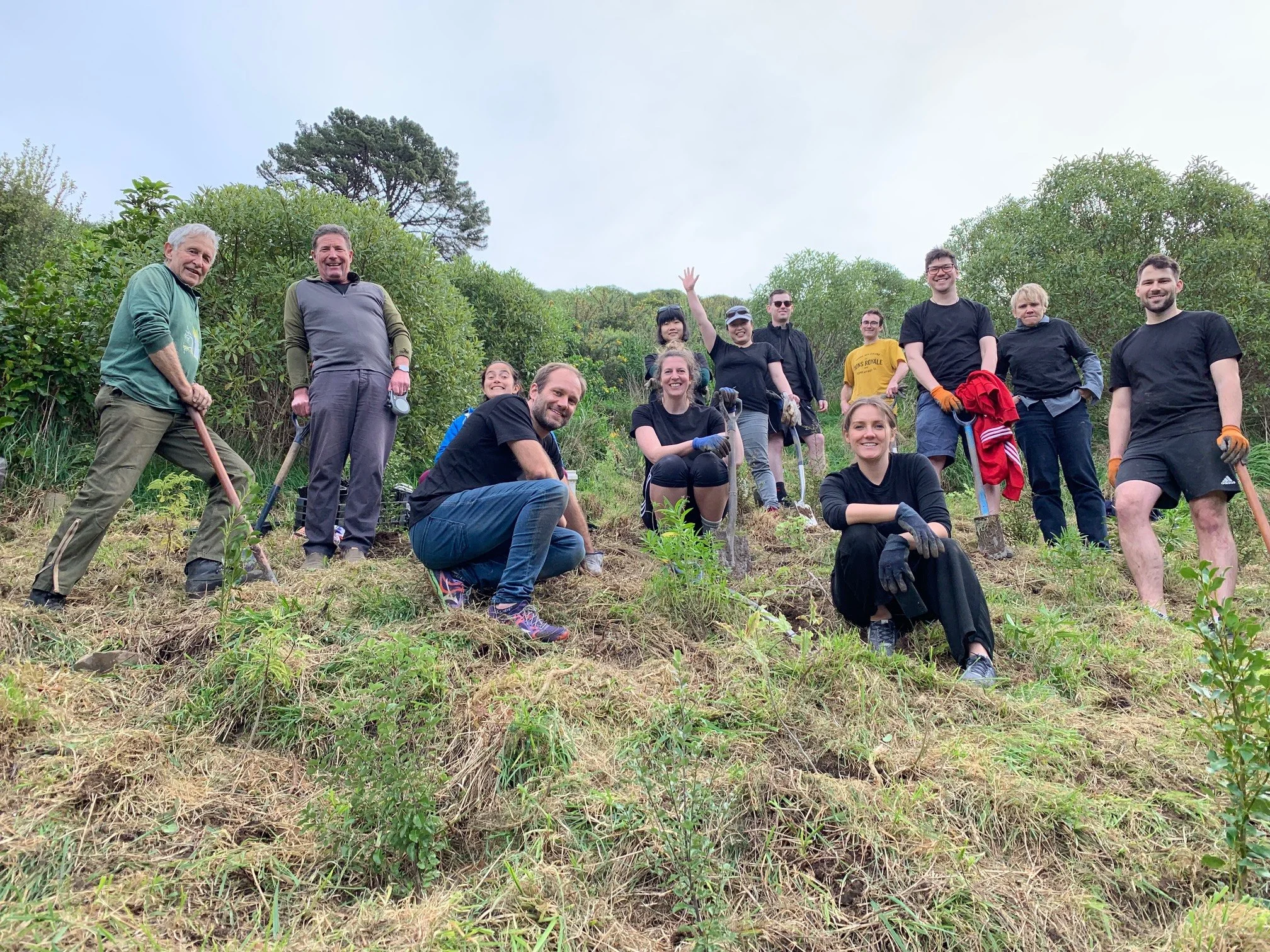
Tennett Brown Architects with Chris Livesey planting the bottom of the goat paddock.
Would you recommend the experience for other corporate groups/companies, for what reasons?
Absolutely. The work is not finished at Manawa Karioi. There are carbon calculators available for corporate groups and companies to calculate their office carbon footprint. If everyone takes care of what they have emitted by flights, car travel, bus travel, energy, waste etc. and more we will see the Paris climate goal reached.
By restoring the native bush we will see an increase in biodiversity. Not only that, you will have a great afternoon also.
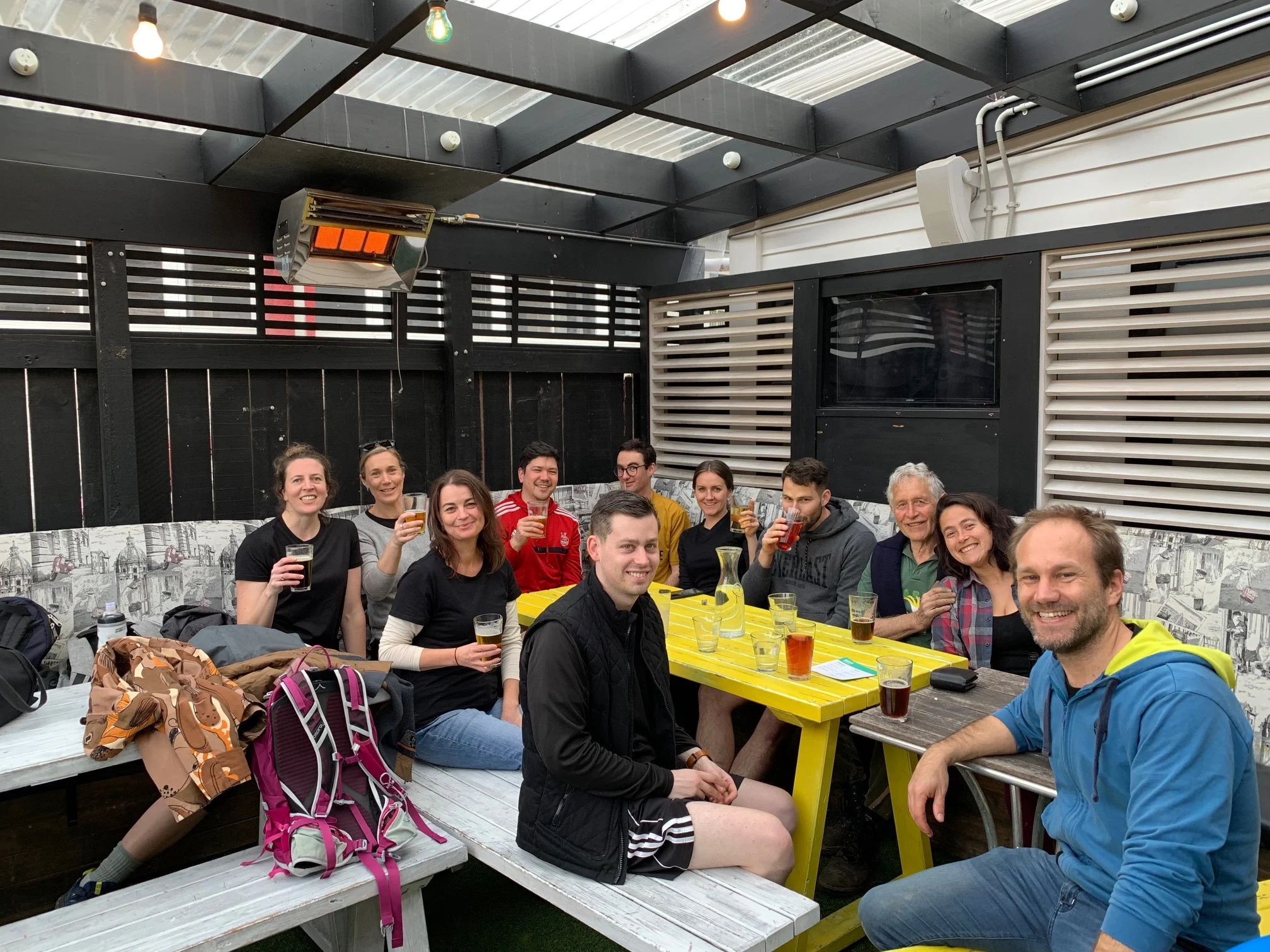
Do the mahi get the treats! A beer at the Island Bay pub with colleagues after a day planting.
If you would like to get in touch with us, to talk about how your company could participate in the project please email us: manawakarioisociety@gmail.com.
Plants we have planted at Manawa Karioi
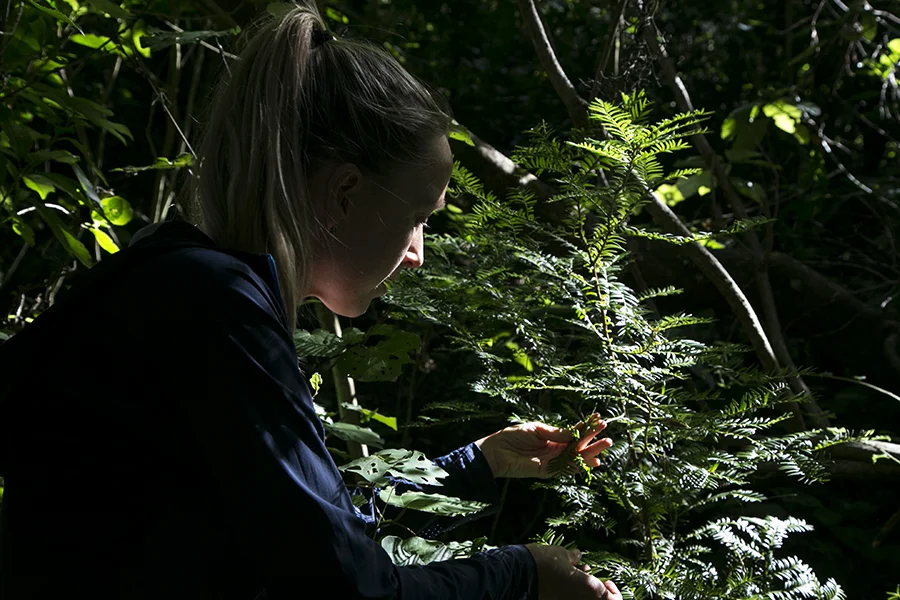
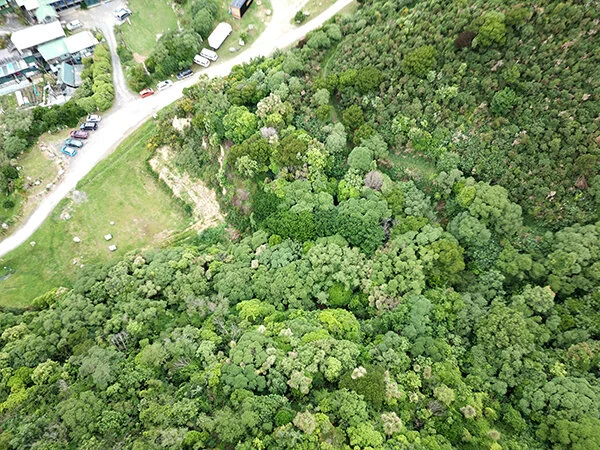
Manawa Karioi was once host to a range of vegetation types. Our medium term goal is to restore a range of plants appropriate for the site and then allow nature to take over – with minimal ongoing intervention.
The upper slopes and ridges will become shrublands typical of the northern Cook Strait coast. Trees and shrubs such as tauhinu, mingimingi, coastal flax and kōkōmuka tāranga will be planted as they can tolerate salty wind, drought and low soil fertility. This vegetation may be limited to a height of two to five metres, but taller vegetation may develop in time.
The lower slopes are more sheltered but usually quite dry in summer. Drier, north-facing slopes will host only some of the taller trees like rewarewa, rāta and tōtara. Kohekohe will form the main canopy on the damper, south-facing slopes.
In the gullies the bush will consist of five layers typical of forests further inland. A key difference is the presence of kohekohe, a frost-sensitive tree not usually found more than 10km inland.
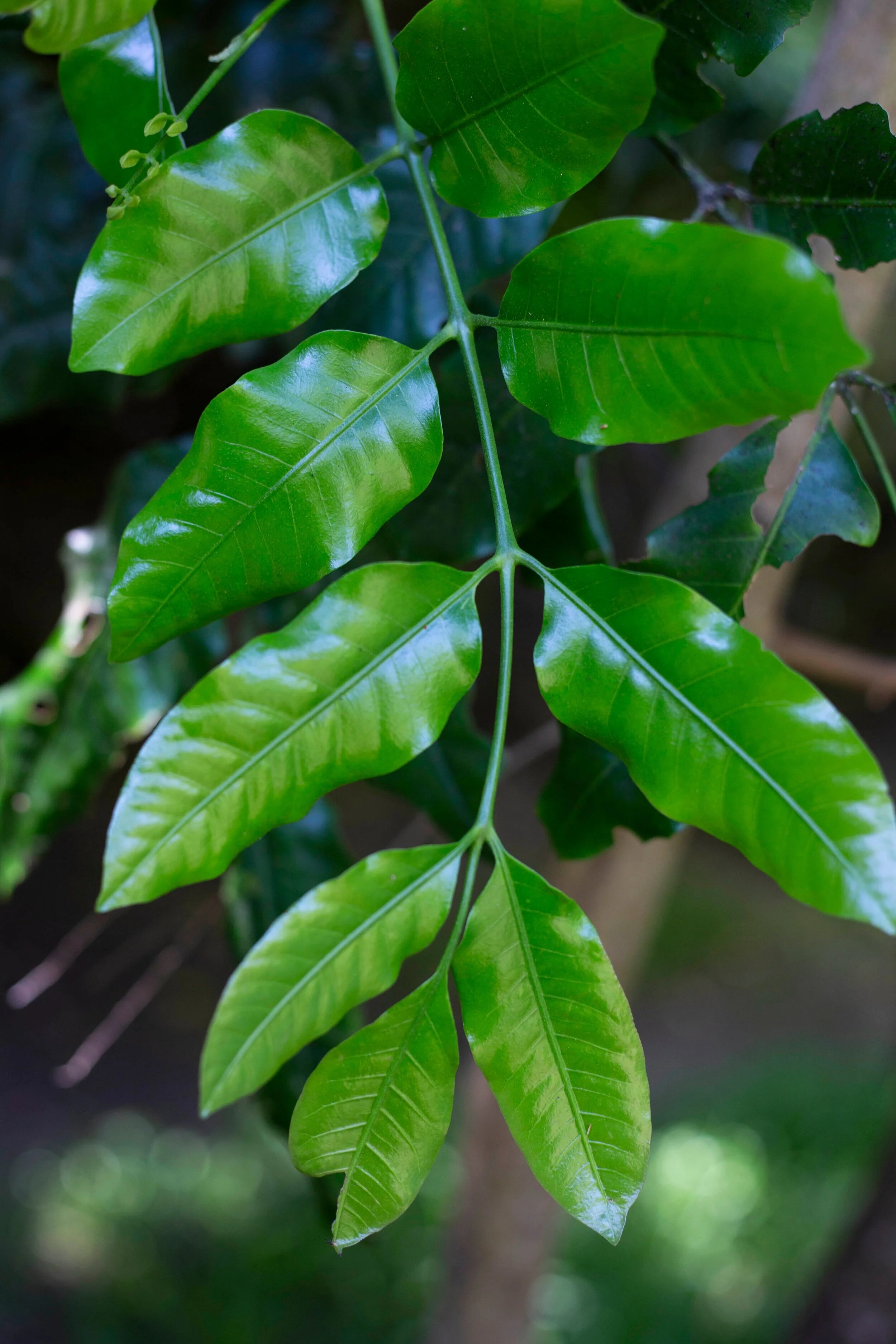
Leaves from the KoheKohe Tree at Manawa Karioi
The 5 Layers of the Forest
The emergent layer
- Scattered trees often over 30 metres tall that tower over the lower canopy trees
- Ancient forests often contain slower growing podocarps (cone-bearing species that evolved millions of years before flowering plants) such as rimu, tōtara, miro and mataī
- Regenerating forests often contain faster growing, flowering trees such as rewarewa
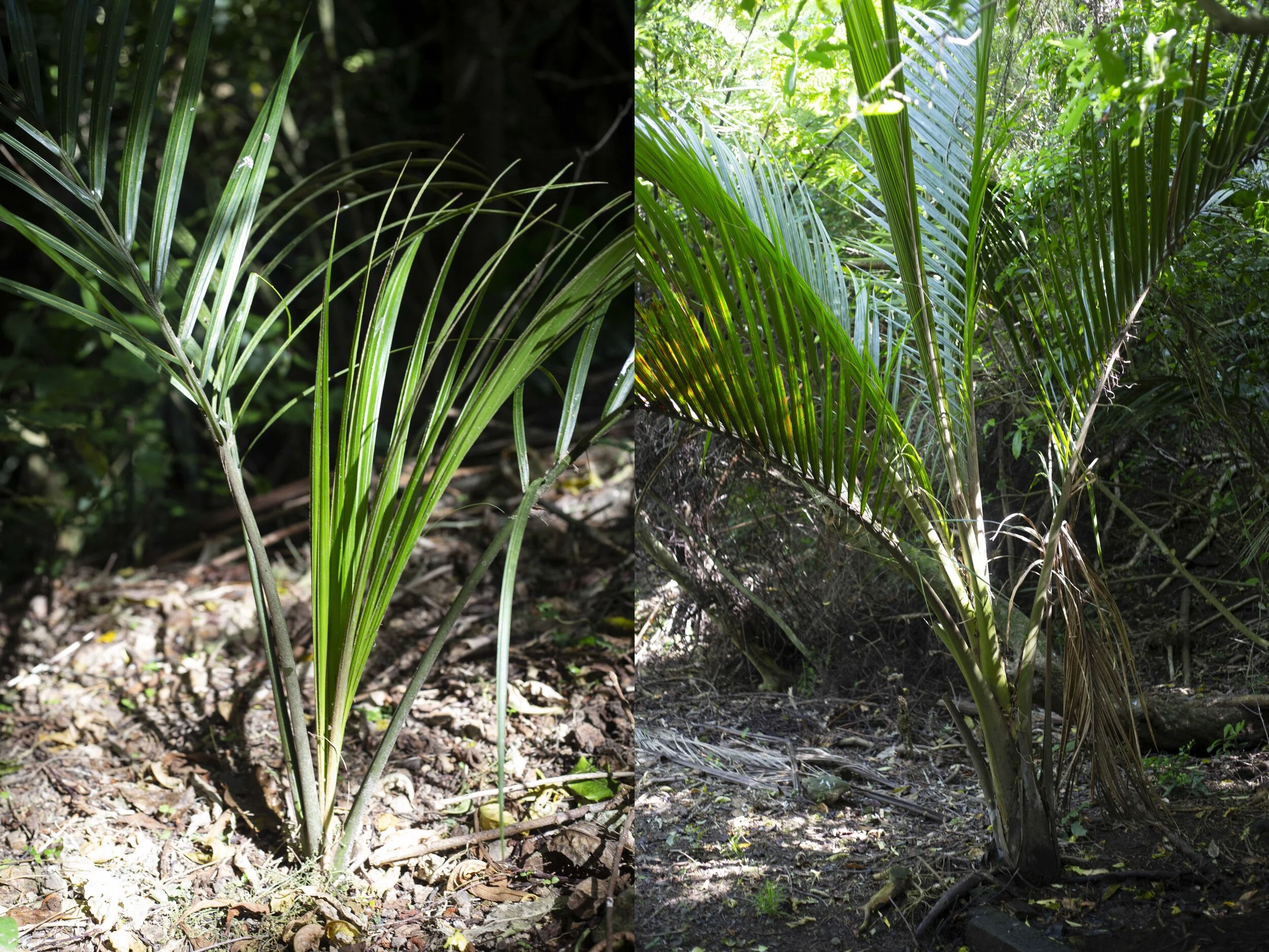
Baby nikau and a nikau that was planted by Ross which lives next to the stream.
The canopy
- The roof of the forest: trees in this layer form dense foliage, filtering rain and sunlight for the layers below
- Typically a height of around 20 metres tall
- Includes tawa and kohekohe
The sub-canopy
- Typically includes various tree ferns such as mamaku and ponga, nikau, and small trees such as māhoe, makomako, whauwhaupaku and tarata
- Plants in this layer often grow to about ten metres tall
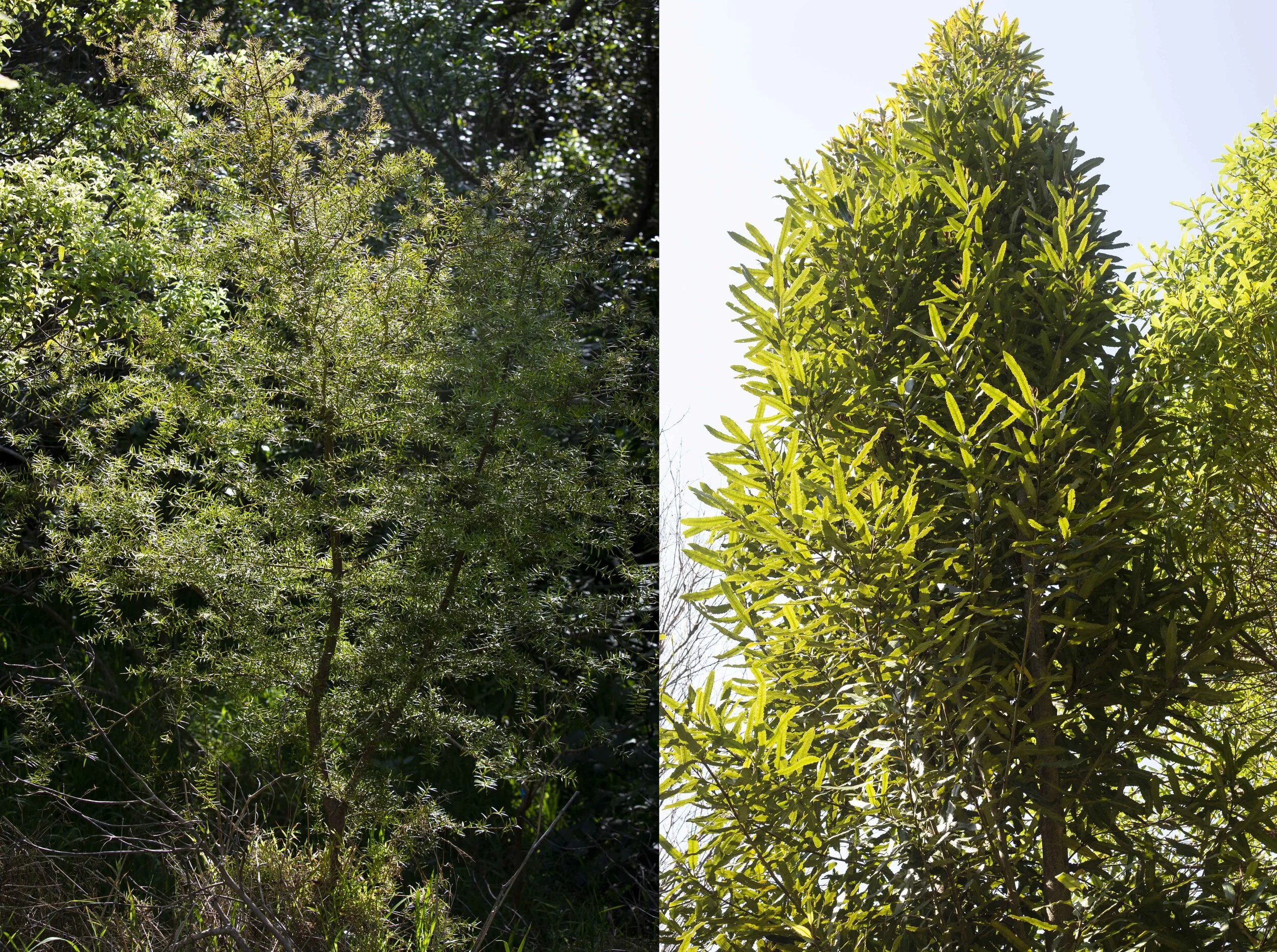
These young Totara and Rewarewa trees are doing well at Manawa Karioi.
The undergrowth
- Often consists of ferns, young trees, shrubs and vines up to about five metres tall
- Can be very dense and hard to walk through
- Often includes kawakawa, karamū, rangiora and tūrepo
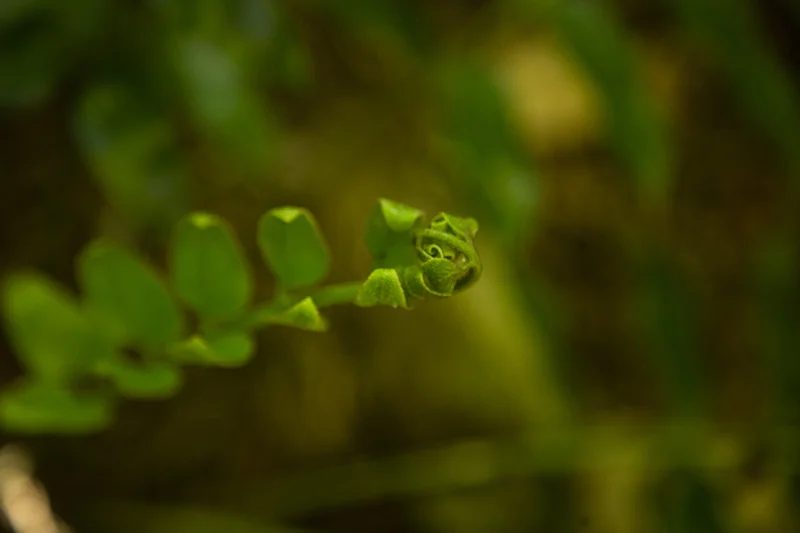
The forest floor
- Usually damp, but can dry out in summer
- Consists of ground covers such as grasses, sedges, ferns, mosses and fungi
- Home to a wide variety of invertebrates including wētā, snails and ngaokeoke
- Important hunting ground for birds such as toutouwai and tīeke, as well as pekapeka
Creating a situation in which these five forest layers can develop is a challenging task. Hardy plants tolerant of drought, sun and wind exposure can generally be planted and left to grow. Other species require various amounts of shelter and shade, but also some sunlight and care. Our general approach is to create seed sources for a wide range of plants native to the local area, along with suitable vegetation for their seed to fall into, and then allow nature to take over – with minimal ongoing intervention (for example, weed control).
Planting Trees in Seed Source Gully - Working Bee on Sunday
Last Sunday's working bee was a great success. Even with a couple of brief but heavy showers people were still keen to keep on working after 3pm.
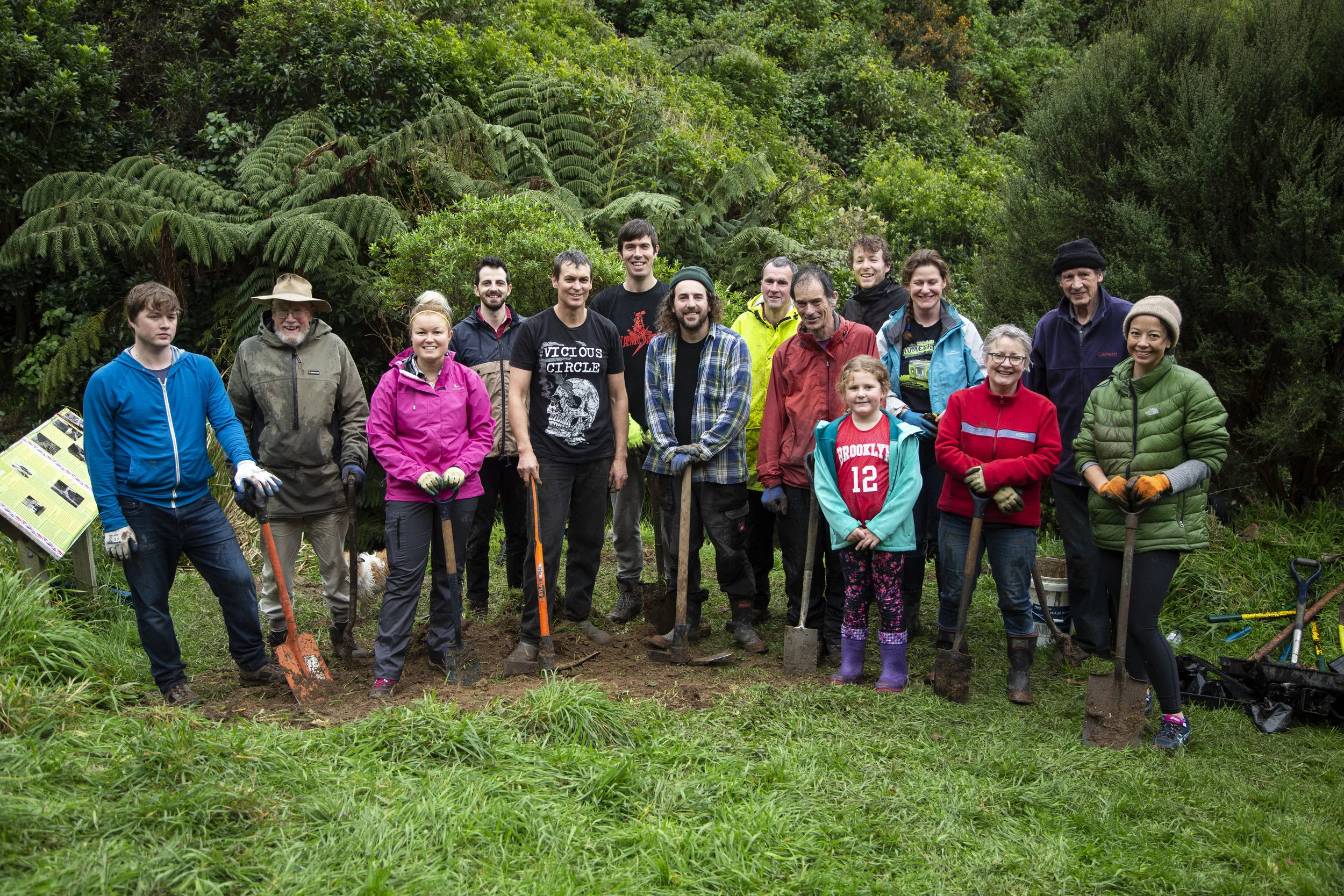
Sunday’s Volunteer Team
We cleared a whole lot of dead blackberry and other vegetation from around the historic water reservoir that was built in 1907 for the Home of Compassion and from the banks of the Manawa Karioi stream.
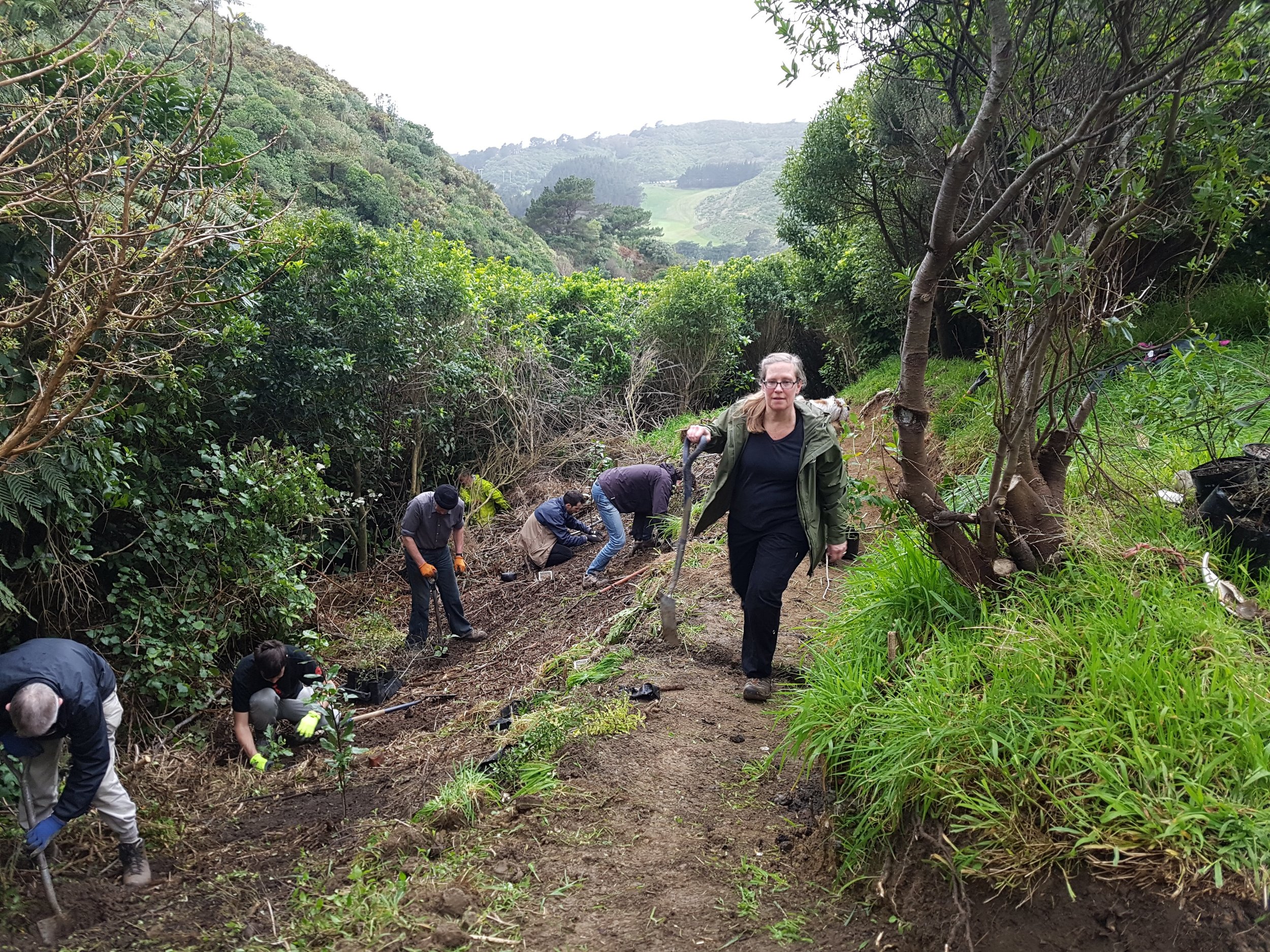
The last 30 metres of Union Rd was widened, and then we planted the stream banks with a mix of plant species.
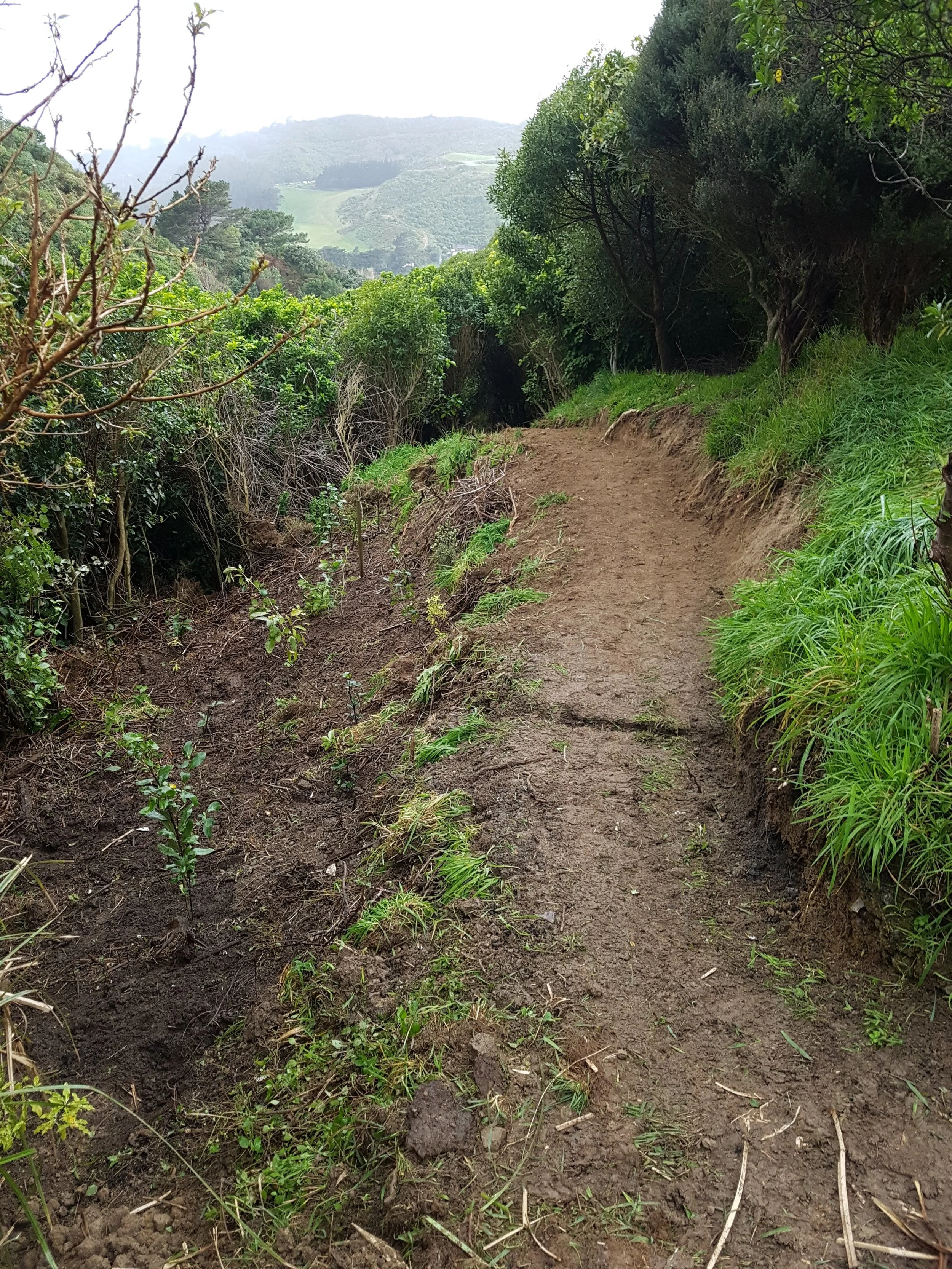
Reinstating the last section of Union Road - originally constructed in 1907 to build the reservoir.
In the near future we will finish clearing the soil from the roof of one corner of the water reservoir (from a small landslip 10 years ago) and install a picnic table.
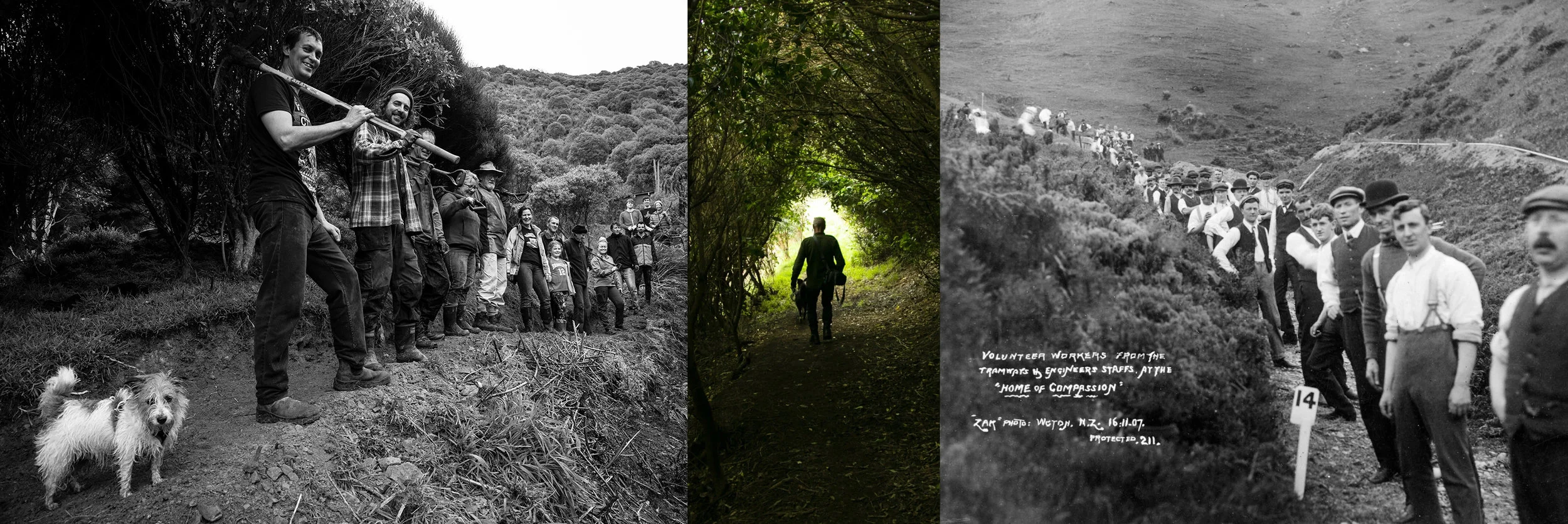
Building Union Road - Now (2019) and Then (1907)
On Aug 18 we will be planting in two areas. The first is a small area at the Danube St entrance of Tapu Te Ranga marae. We try to put in some of the locally-rare species at all our track entrances so that as people enter they notice that the bush looks different to that around most of the surrounding Town Belt tracks.
We will also be doing some planting around Seed Source Gully. This area was initially planted with hardy colonising species in 2002-2004.
Once the first trees had created a canopy we began underplanting. The intention is to put small numbers of a wide range of species in the gully to provide a seed-source to spread into surrounding areas.
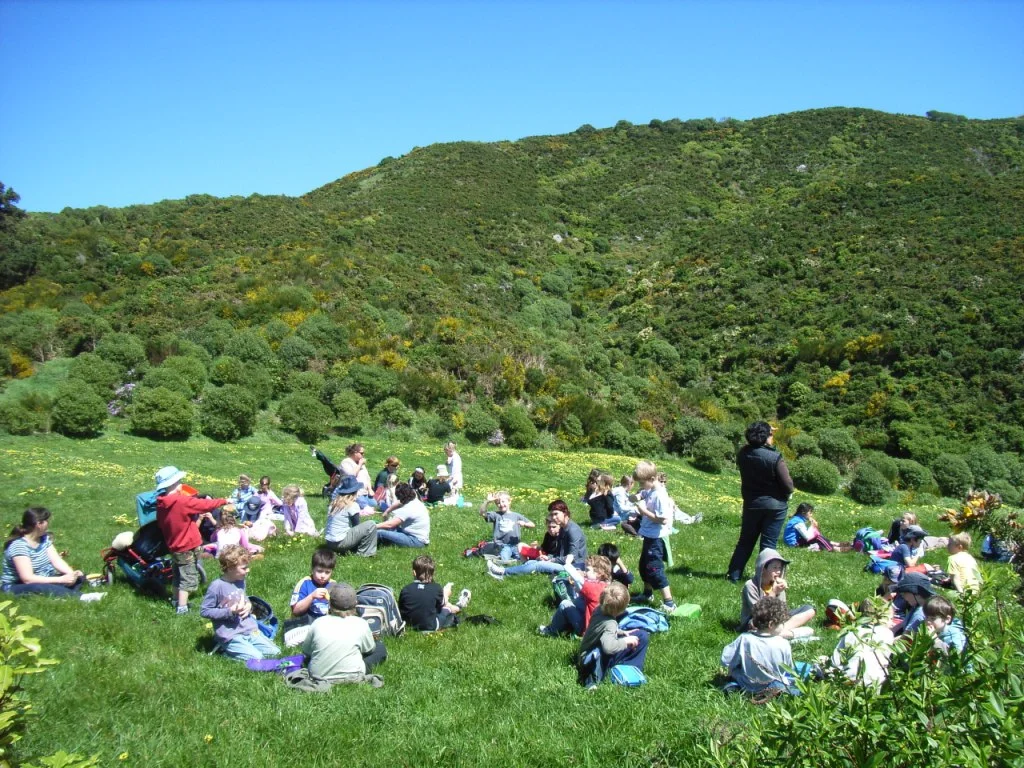
Seed Source Gully - Then
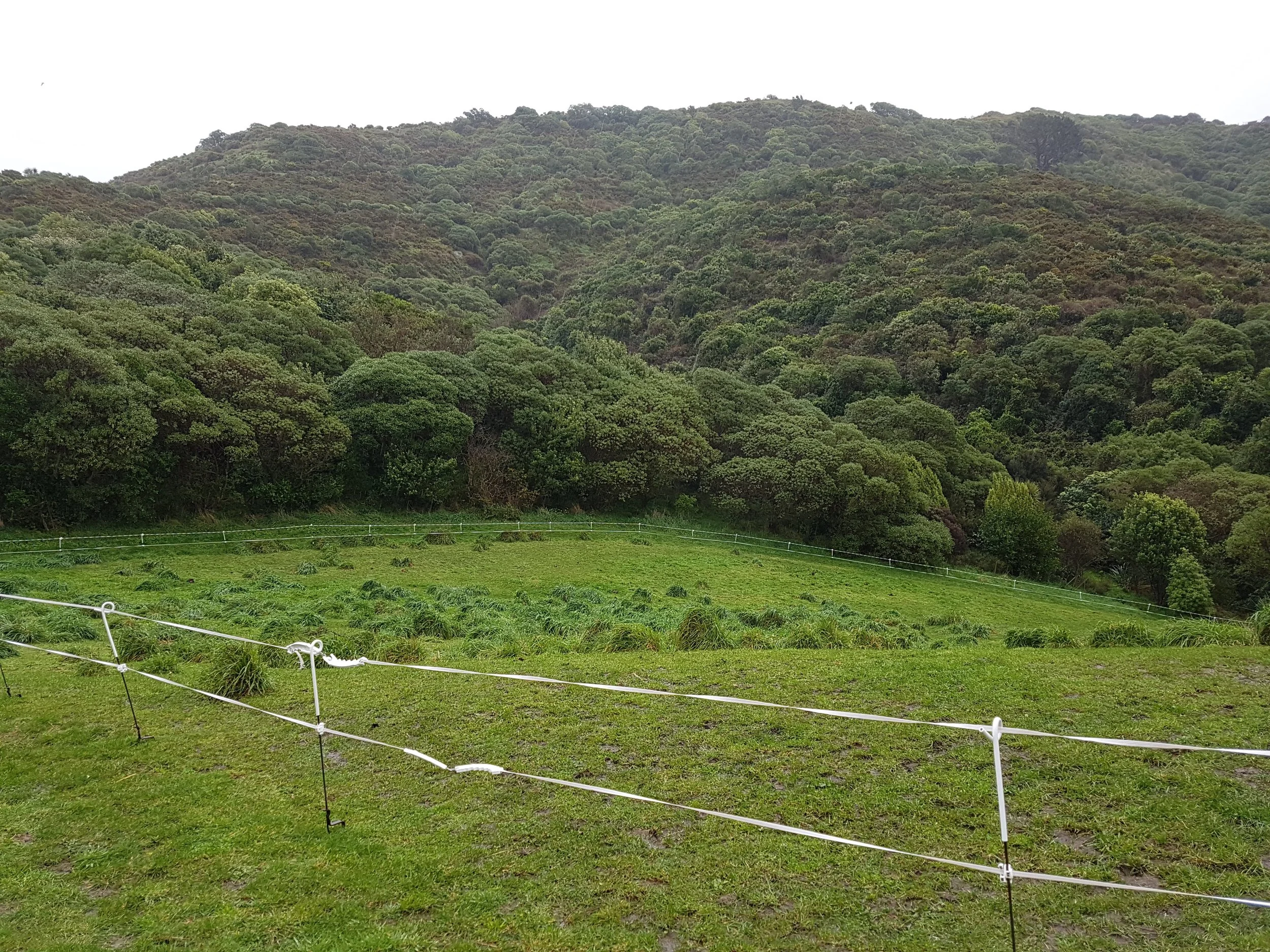
Seed Source Gully - Now
This Sunday we will put in some small understorey trees in the gully margins that have already had titoki, totara and rewarewa planted in them. Further up the gully, we will plant out an area that has been cleared of blackberry. The soil here is quite rich and holds moisture longer so is suitable for putting in some tawa, kohekohe, kotukutuku and putaputaweta. In previous years we have put in some rimu, totara and nikau. Many of these are now 3-4 metres tall.
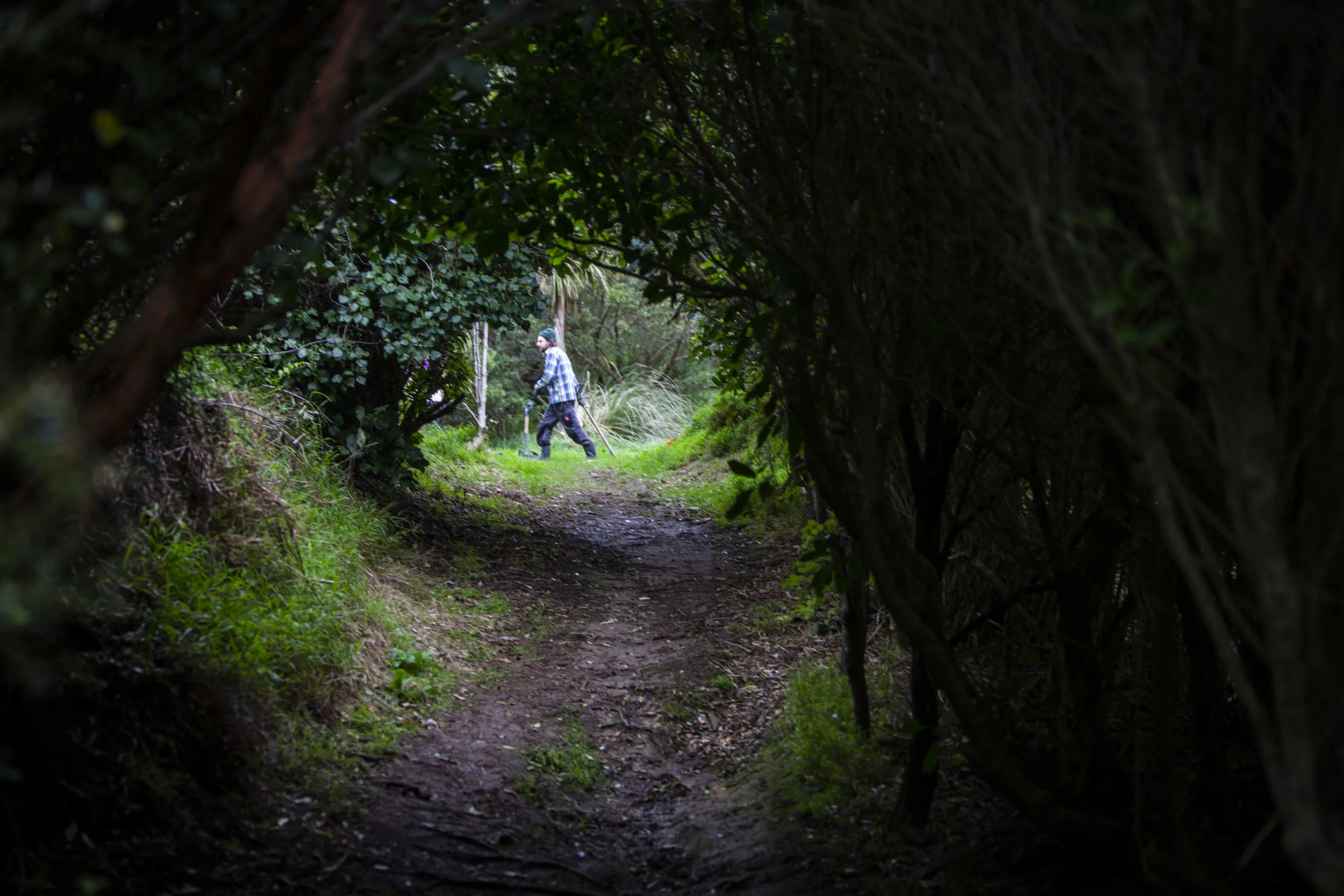
A tunnel of revegetating bush with the planned picnic area at the top
August Planting Days: Sunday 4th Aug, Sunday 11th August, Sunday 18th August, Sunday 25th August from 1pm - 3pm.
Sunday's working bee departs at 1 pm from the interpretation board shelter at Tapu Te Ranga marae carpark, signposted at the end on Danube St. Wear suitable clothes and shoes. All tools and gloves are provided.
After the Marae fire: Planting Work Continues
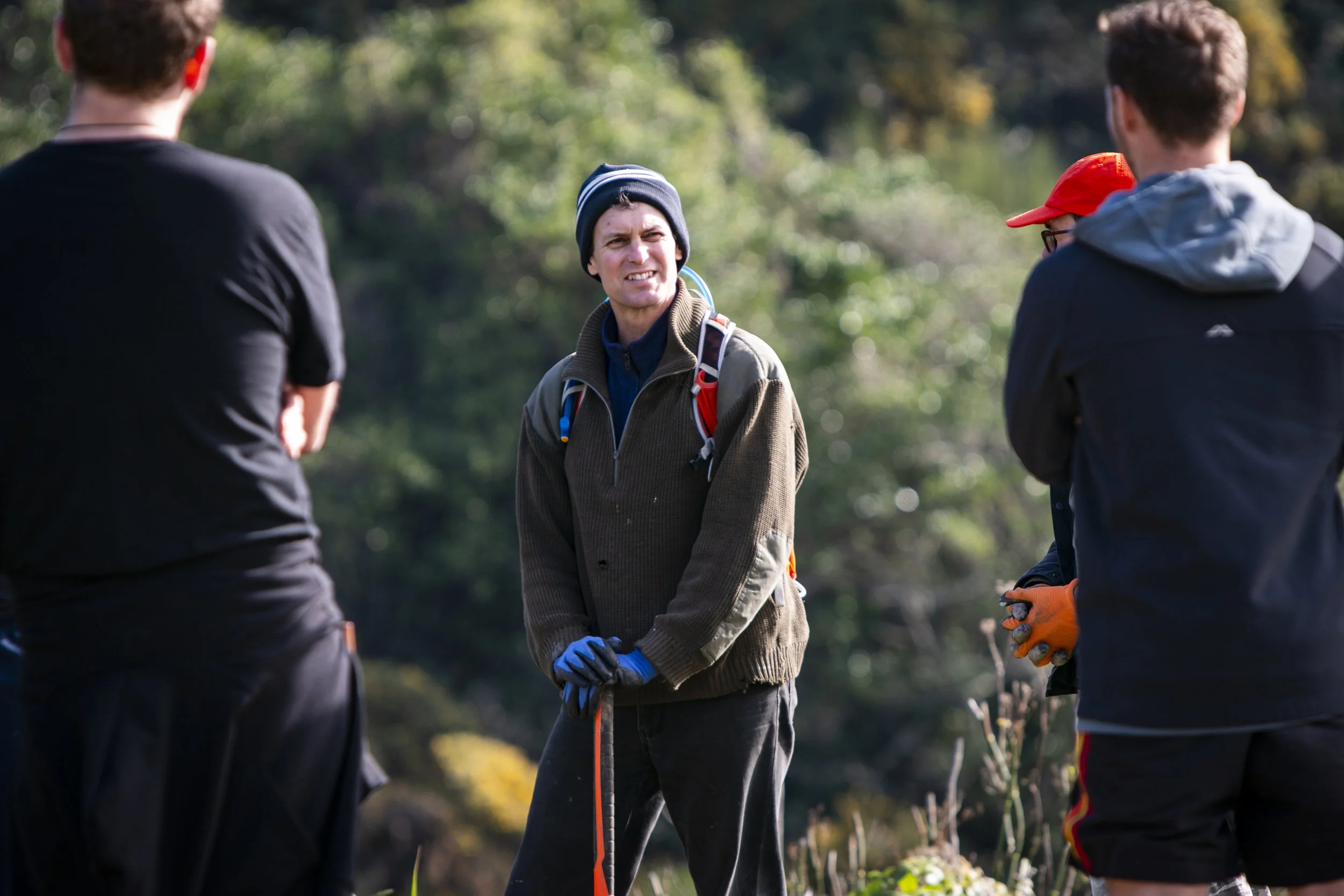
We received a delivery of 980 plants from Wellington City Council’s Berhampore nursery a couple of days prior to our first working bee.
A couple of nights later, disaster struck with a fire completely destroying the main buildings at Tapu Te Ranga Marae.
Despite the sad and sudden loss of the marae buildings, we decided as a committee that it was important to carry on with our work, especially as the June planting was all in areas along the boundary of Manawa Karioi and the access roads of the marae. The marae buildings can be replaced, and the Manawa Karioi forest will be growing even closer to them.
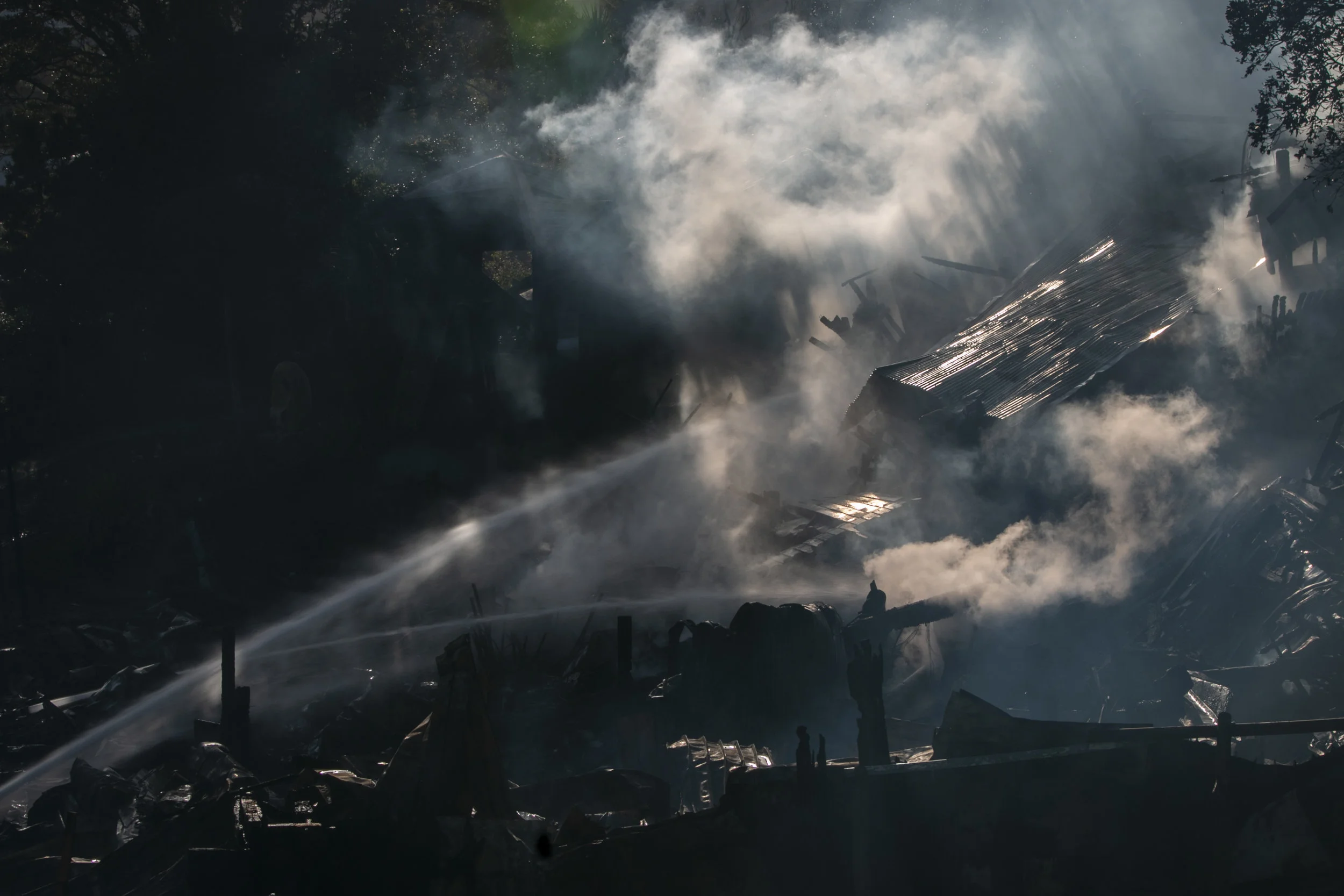
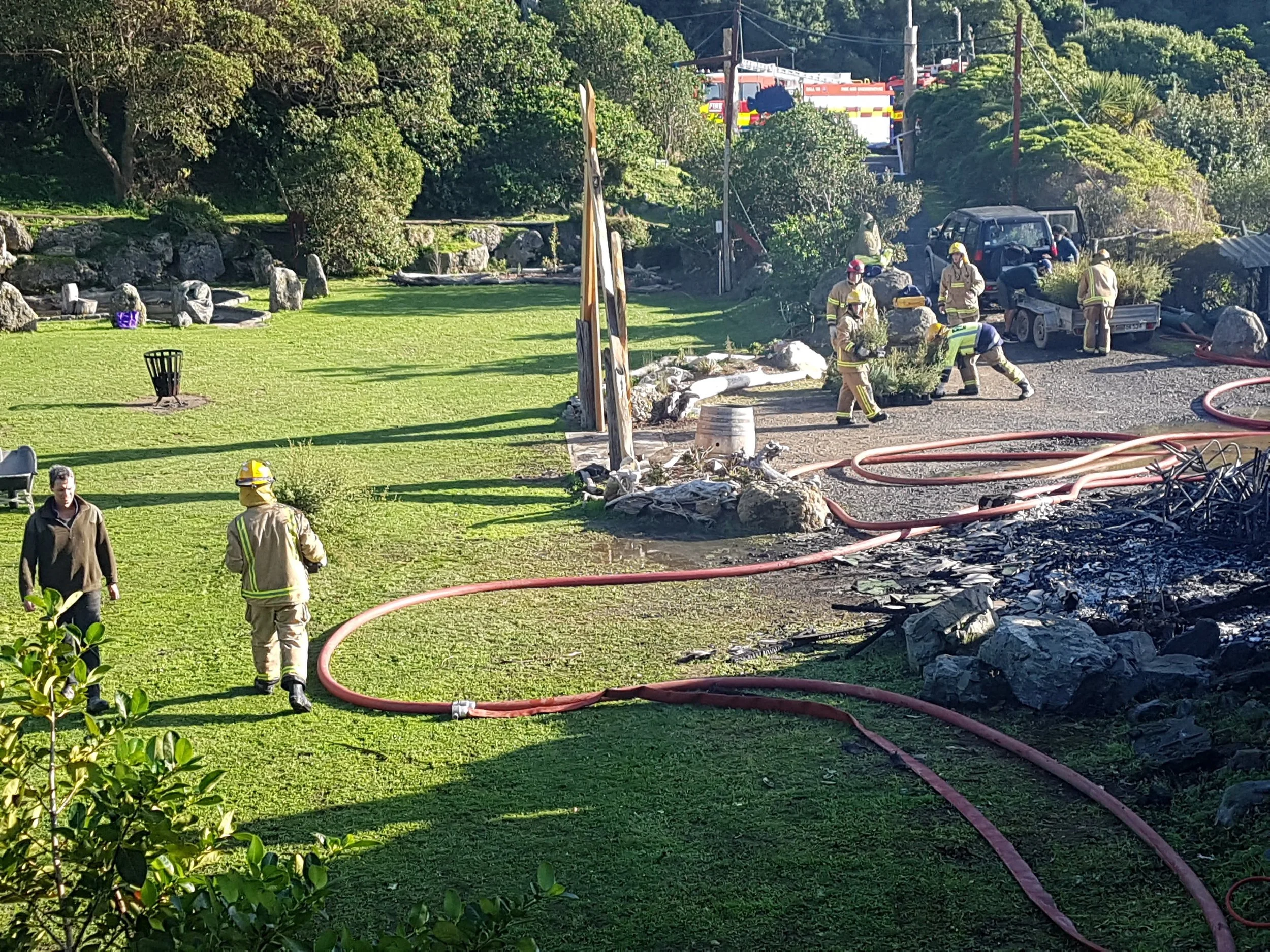
Our plants were very close to the buildings, but we only lost about 30 (all of this year’s porokaiwhiri (pigeonwood) and most of our pate (Schefflera digitata).
Most of the June plantings were in large blocks, using mostly hardy species that need open spaces. For August we will be taking a different approach, focussing on trackside planting and establishing future canopy and understory species.
This will be done in several different locations – we will continue with understorey planting along the marae driveway leading in from Rhine St, as well as planting hardy species along the upper slopes near our boundary with Tawatawa reserve.
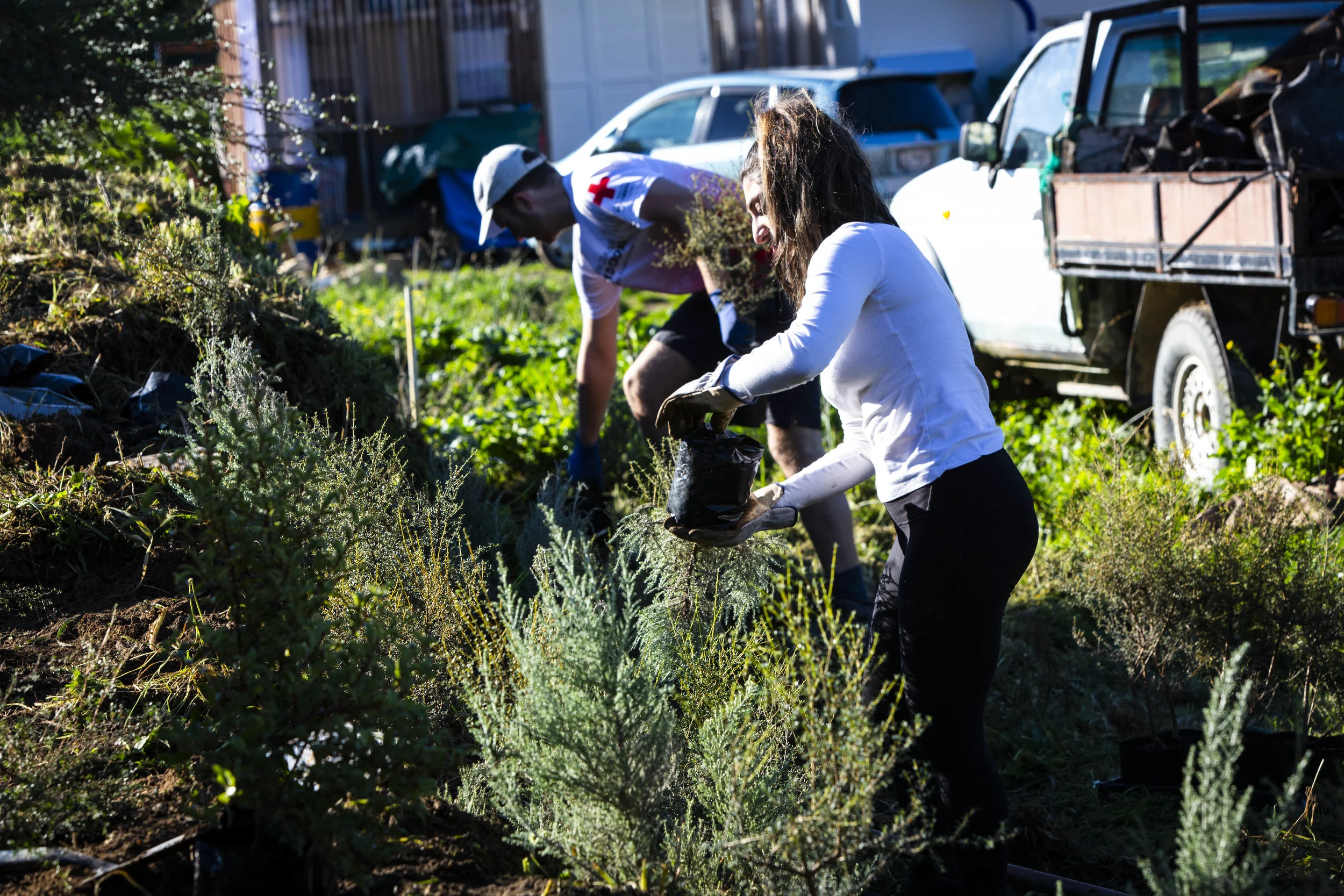
We had a successful month of planting in June, with large groups of people kindly volunteering their time.
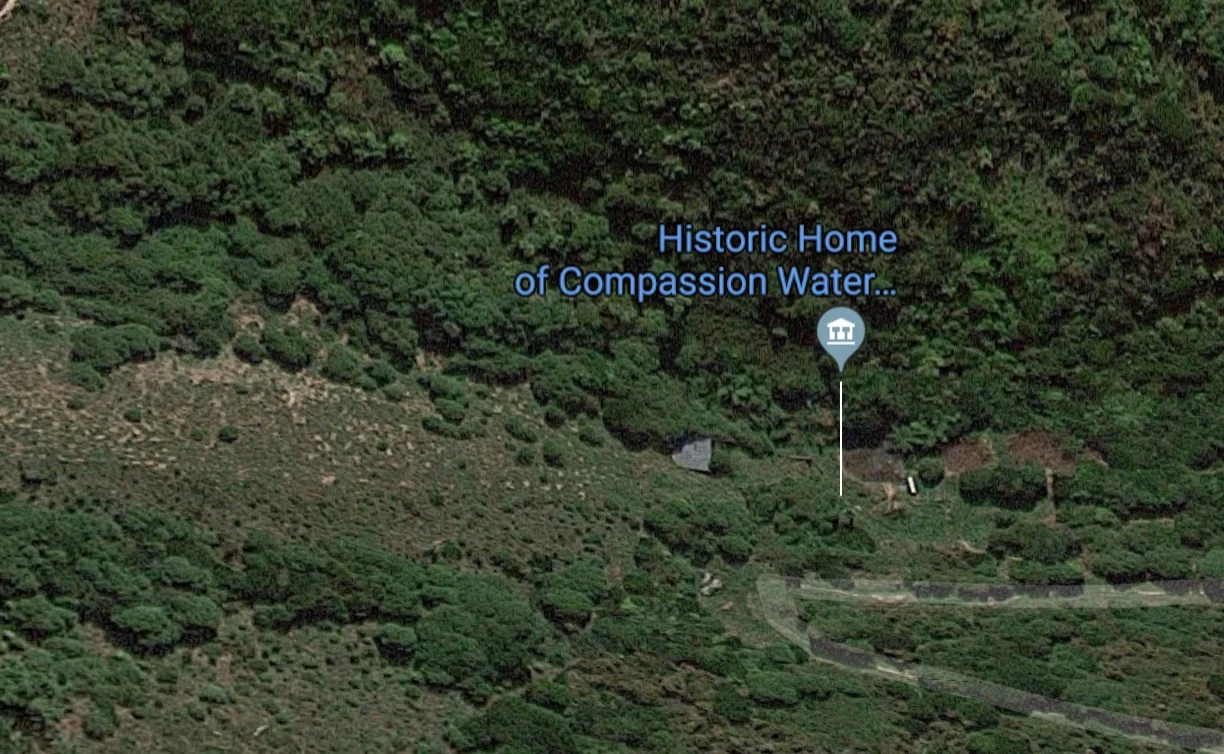
We will also be focussing on planting around the historic water reservoir in the gully from which we take our projects’ name – Manawa Karioi. This area has had a lot of natural regeneration of native bush along the stream bed and on the south-facing slope above it. However, this has been mostly of a limited number of species; predominantly mahoe and the tree fern mamaku, with an understorey of hangehange, kawakawa and rangiora.
Almost two decades ago, students from Victoria Environment Group planted a range of colonising species on the slope to the west of the reservoir. At several working bees over the last 3 years we have planted a wider range of trees further up the slope, and previously we had put in small numbers of kotukutuku, nikau, tawa and pukatea along the stream bed.
A former Manawa Karioi volunteer, Peter Hills, writes:
“In Spring of 2003 members of the Seed Carriers Hikoi completed their journey by staying at Tapu te Ranga Marae. After presenting their story to then Environment Minister, Marian Hobbs, they planted a number of Kahikatea around the Manawa Karioi spring. These had been sourced from local seed and grown in the Manawa Karioi nursery. The total number planted was twelve.
In 2004, I sourced twelve local Matai plants from the same nursery and planted them in the catchment area directly above the spring. These were planted to honour the twelve people who walked and reopened the Peace Trail ‘Te Huarahi o Rongo-marae-roa ' with Barry Brailsford in 1989.”
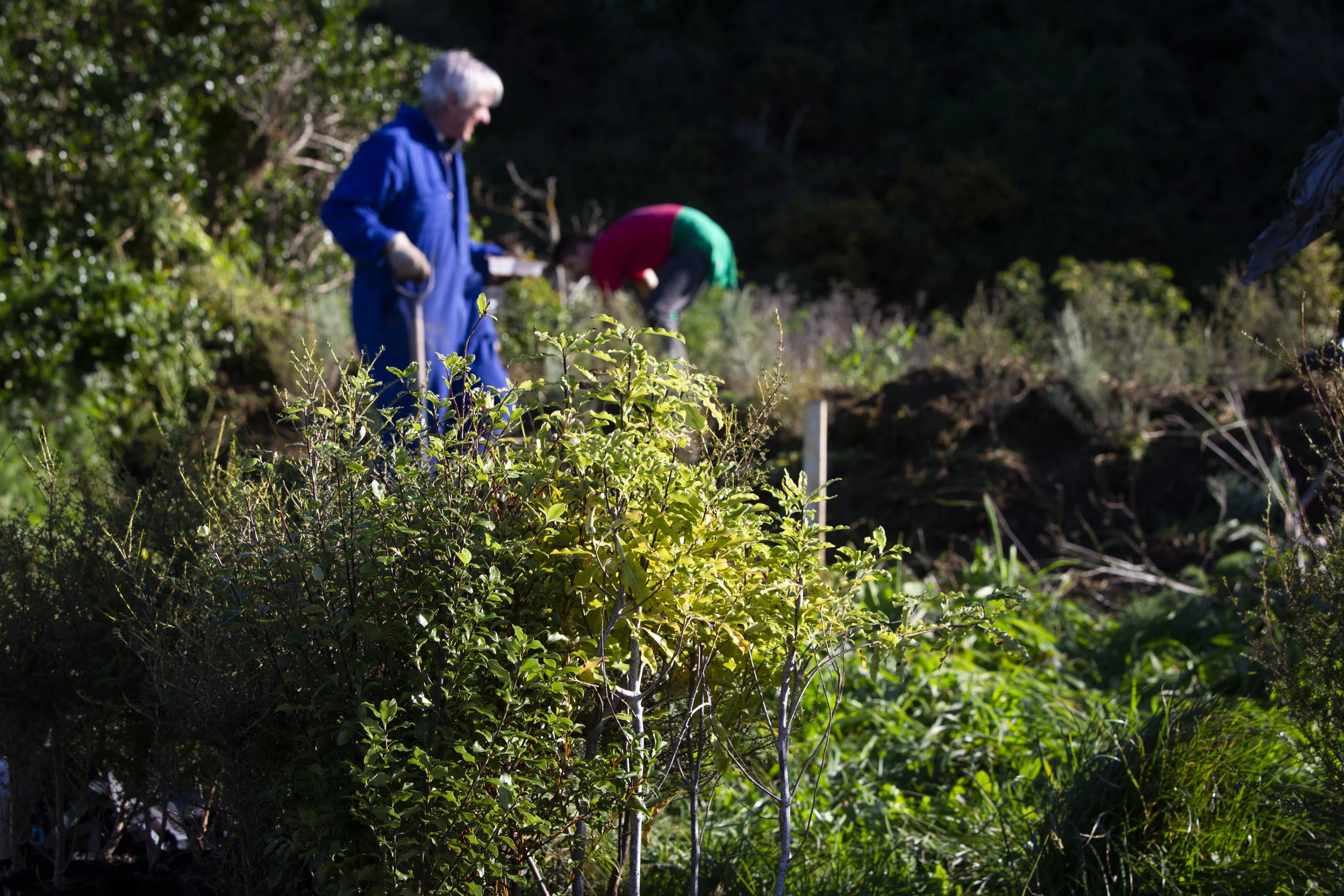
We will continue to increase the biodiversity of this gully by planting more kotukutuku, kohekohe and pate along the streambed, while on the sunnier slopes above it we will put in a small number each of totara, rata and rewarewa, and larger quantities of more common colonising species.
Pate: A small tree to 8m high, it flowers February/March with fruit ripening two months later, which is a food source for several bird species. Pate is the most common host of the parasitic plant Dactylanthus taylori. This is a root parasite which was known to the Maori as 'Pua-o-te-reinga', 'the flower of the underworld', which alludes to the way its’ flowers emerge from under the ground.
Kotukutuku: Growing to 15m high, it is the world’s tallest tree fuschia. Flowers appear between August and December. They change from greenish-yellow to purple-red.The flowers are rich in nectar and are visited by honey-eating birds, especially tūī, bellbirds and silvereyes. The dark purple berries, known as kōnini, are edible and taste like tamarillos.
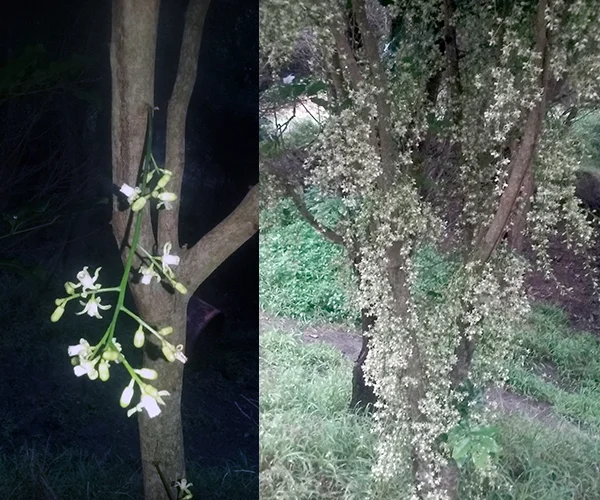
Kohekohe
Kohekohe: This was once the main forest canopy tree in the coastal strip around Wellington. While stands of it remain in patches along the Kaiwharawhara Stream catchment, in south Wellington we only know of one mature tree over the ridge in Tawatawa Reserve, and up to five on Te Motu Kairangi/Miramar Peninsula.
It is one of the few native trees to flower in winter, producing impressive quantities of small flowers directly from the trunk and branches in June. While we have planted dozens of kohekohe around Manawa Karioi, only one has been seen flowering yet, located by the track Te Ahi Kaa where it crosses Seed Source Gully.
Written by Ross Gardiner
Photos by Ness Patea
We have pledged to plant another 1000 trees in 2019 at Manawa Karioi Ecological Restoration Project in the hills of Island Bay.
We would appreciate help from any keen volunteers to the scheduled working bees. Please RSVP to this email to let us know which planting event you would like to attend or sign up via our Facebook event.
Upcoming Manawa Karioi Upcoming Planting Working Bees:
Sunday 4th August from 1pm - 3pm
Sunday 11th August from 1pm - 3pm
Sunday 18th August from 1pm - 3pm
Sunday 25th August from 1pm - 3pm
Meeting at the Interpretation Board Shelter in the Tapu te Ranga Carpark at the end of Danube Street in Island Bay.
Manawa Karioi Fundraiser at Third Eye - Tuatara Breweries
We are hosting a social fundraising event on Friday 5th July from 6 pm - 8 pm. We invite all past and present volunteers, supporters and beer lovers to join us at The Third Eye - Tuatara’s Temple of Taste. If you love trees and tasty craft beer - we would love to see you there!
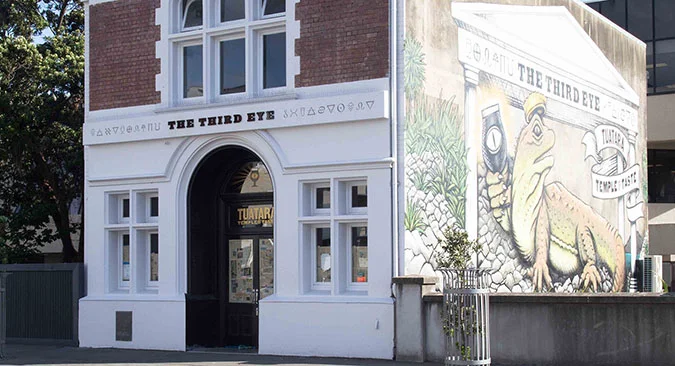
Come on out to The Third Eye - Tuatara’s Temple of Taste to sample “Union Road", a limited edition karma keg ale brewed specifically in support of the Manawa Karioi Ecological Restoration Project. All proceeds will go to support native tree planting, trail maintenance, and other operations at this beautiful nature reserve near Wellington’s south coast.
Founded in 1990, the Manawa Karioi Ecological Restoration Project is one of Wellington’s oldest revegetation projects and is situated on land in Island Bay owned previously by Sisters of Compassion. It is a community-driven initiative, operated by passionate community volunteers to bring back the bush and the birds.
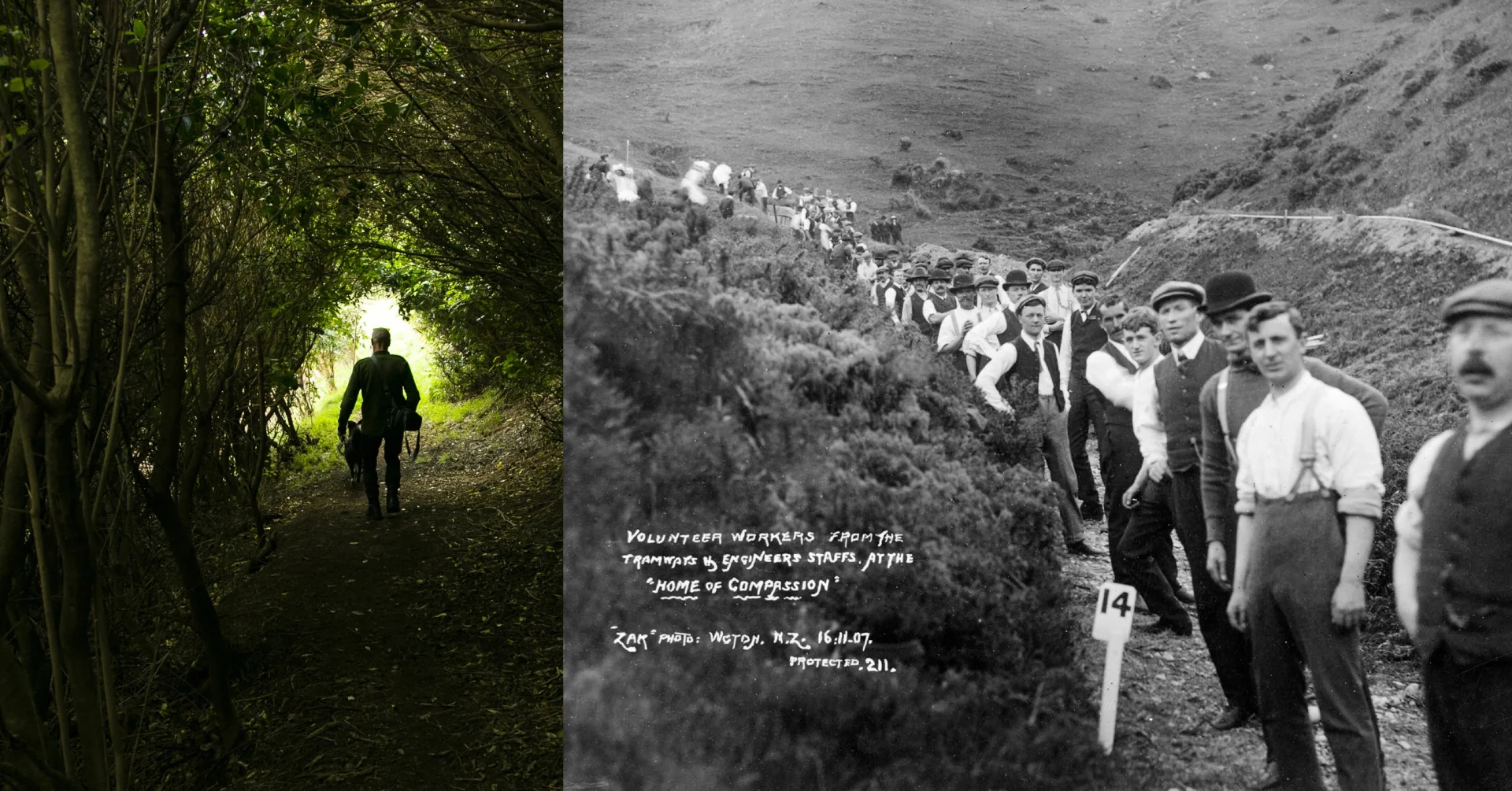
Union Road is a historic track at Manawa Karioi and was built approximately 100 years ago to provide access to the construction of the water reservoir which would supply the Home of Compassion. The name Union Road evokes the rich history of this area which now exists to regenerate native bush and further engage the Island Bay community with the whenua.

This social fundraising event was spearheaded by one of our committee members Kevin Thomas. It is fun to take some time out socially, have some chats and fundraise by drinking yummy craft beer at the same time, we think this fundraiser event is genius!
I asked Kevin some questions about brewing the beer and organising this fun event.
Tell me about your involvement in Manawa Karioi?
I discovered Manawa Karioi a few years ago when I attended a guided walk as part of the Island Bay Festival. I started volunteering for working bees, then I helped improve volunteer numbers via Meetup groups, and then more recently I joined the Board.
Can you tell me about what appealed to you about the Tuatara Breweries Karma Kegs as a possible fundraiser for Manawa Karioi?
I have seen karma kegs as charity fundraisers from various breweries around Wellington. I'm a big fan of Wellington's craft beer community and saw this as a fun opportunity to combine some of my personal passions.
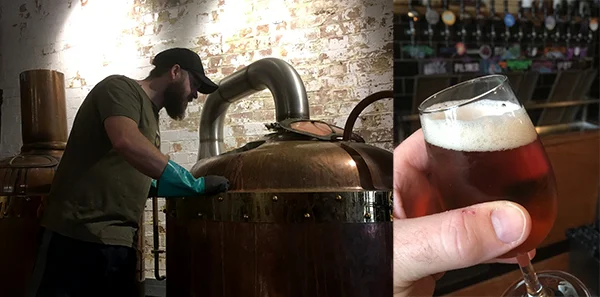
What was the process of brewing 'Union Road' Beer like?
I thoroughly enjoyed working alongside Brayden Owlinson, Tuatara's Head Brewer, to create our karma keg beer at the Third Eye. We started the process on a Thursday at 7:00 AM and wrapped around 1:30 PM. Brayden kindly allowed me to help with some of the tasks such as the hop addition and beer transfer into the fermentation tank.
What did you gain from the process?
Brayden is incredibly knowledgeable about all things beer so I learned a lot about how different aspects of brewing, such as type of hop, temperature, and yeast variety, can dramatically influence flavour. I have home brewed before, but the Third Eye equipment is significantly larger scale and more automated than I have experienced before.
What are your hopes for the Friday night fundraising event?
I hope to raise awareness about Manawa Karioi because it's amazing little nature reserve just outside of the Wellington CBD with a fascinating history and a group of dedicated volunteer stewards. Also, I hope everyone in attendance learns a bit more about conservation and enjoys a tasty craft beer.
A big thanks to Kevin, Mary and Jerry for organising the event! We look forward to seeing you there!